
Ceres
Dwarf Planet· orbits the Sun
Ceres is the largest object in the asteroid belt and the only dwarf planet in the inner Solar System. It is rich in water ice and bright salt deposits, studied in detail by NASA's Dawn mission.
Open in 3D viewSee Ceres in the live, interactive 3D map
Key facts
Mass
9.38 × 10²⁰ kg
0.0128 Moon masses
Radius
470 km
7% of Earth's radius
Surface gravity
0.284 m/s²
3% of Earth's gravity
Day length
9.07 hours
Year
4.6 Earth years
1,680 Earth days
Distance from Sun
2.77 AU
Moons
None
Science
Physical
- Mass
- 9.38 × 10²⁰ kg · 0.0128 Moon masses
- Radius
- 470 km · 7% of Earth's radius
- Density
- 2,162 kg/m³ · 2.2× water
- Computed from mass and radius
- Surface gravity
- 0.284 m/s² · 3% of Earth's gravity
- Computed from mass and radius
- Escape velocity
- 516 m/s · 5% of Earth's escape velocity
- Computed from mass and radius
- Axial tilt
- 4.00 °
Orbital
- Distance from the Sun
- 2.66 AU
- Computed from the position at the selected time
- Semi-major axis
- 2.77 AU
- Computed from the cached state vector
- Eccentricity
- 0.07979
- Computed from the cached state vector
- Inclination
- 27.19 °
- Computed from the cached state vector
- Orbital period
- 4.60 years
- Computed from the cached state vector
- Perihelion
- 2.55 AU
- Computed from the orbital elements
- Aphelion
- 2.99 AU
- Computed from the orbital elements
- Mean orbital velocity
- 17.9 km/s
- Computed from the orbital elements
Rotation
- Rotation period
- 9.07 hours
Temperature
- Mean
- 168 K (-105 °C)
Composition
- Bulk composition
- Rocky core with a water-ice-rich mantle and salt deposits
Radiation & temperature
- Insolation
- 0.131 S⊕ · 13% of the sunlight Earth receives
- Computed from the distance to the Sun (inverse-square; Earth's sunlight = 1), before any atmosphere.
- Bond albedo
- 0.09 · reflects 9% of incoming sunlight
- Equilibrium temperature
- 163 K (-110 °C)
- Computed from albedo + distance from the Sun (airless black body)
- Measured mean temperature
- 168 K (-105 °C)
Discovery & history
- Discovered
- January 1, 1801
- By
- Giuseppe Piazzi
- Method
- Visual discovery (telescopic)
- Name
- The Roman goddess of agriculture and patron of Sicily, where it was found.
Ceres was discovered on the first night of the 19th century, 1 January 1801, by Giuseppe Piazzi in Palermo. Hailed as a new planet filling the 'gap' between Mars and Jupiter, it was soon joined by Pallas, Juno and Vesta, and the four were reclassified as 'asteroids'. Ceres is by far the largest, and in 2006 it was promoted to dwarf planet. The Dawn spacecraft orbited it in 2015.
- 2015DawnOrbiter
First spacecraft to orbit a dwarf planet; studied the bright salt deposits in Occator crater.
Images


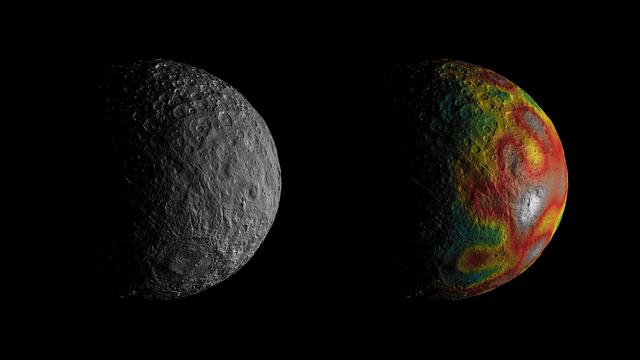

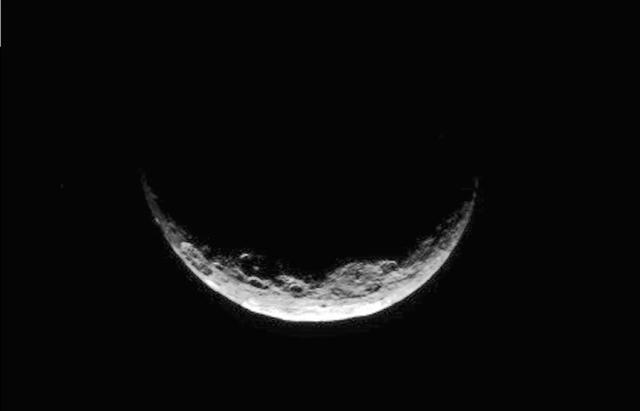
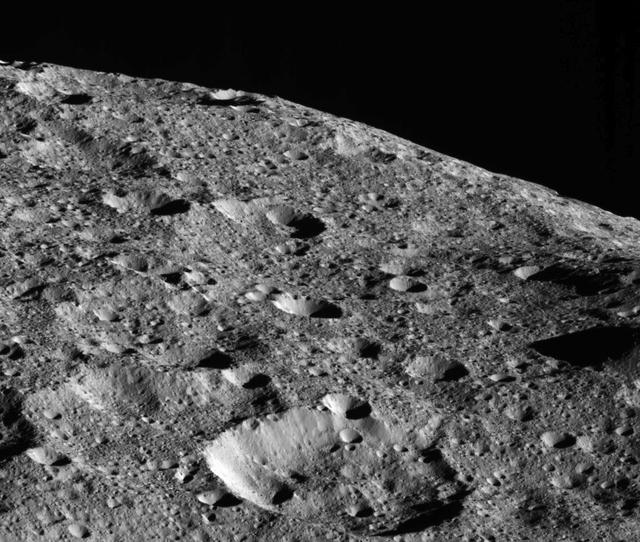
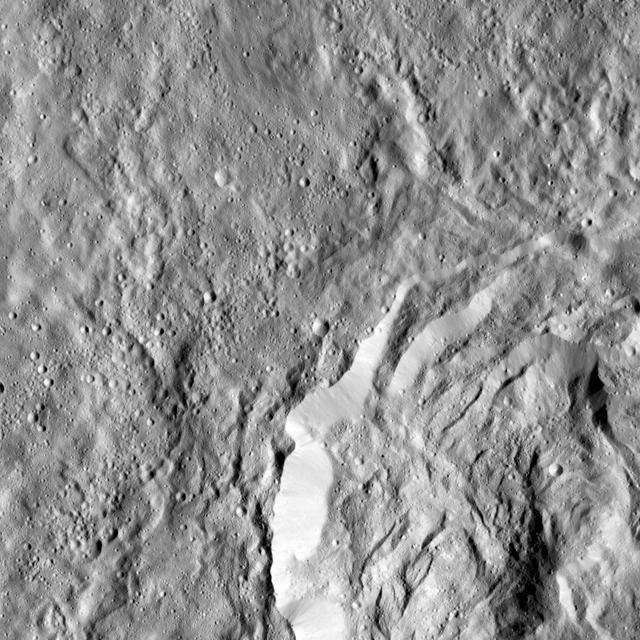
Images from open archives · credit shown per image