
Charon
Moon· orbits Pluto
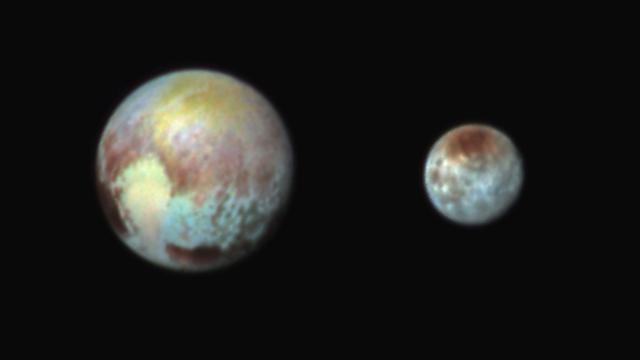
Charon is Pluto's largest moon — about half Pluto's size, so the two orbit a point in empty space as a 'double dwarf planet'. New Horizons revealed deep canyons and a dark reddish polar cap ('Mordor Macula').
Open in 3D viewSee Charon in the live, interactive 3D map
Key facts
Mass
1.59 × 10²¹ kg
0.0216 Moon masses
Radius
606 km
35% of our Moon's radius
Surface gravity
0.288 m/s²
3% of Earth's gravity
Day length
6.4 days
Orbit around Pluto
6.39 Earth days
Science
Physical
- Mass
- 1.59 × 10²¹ kg · 0.0216 Moon masses
- JPL / IAU mean radii; spacecraft-tracked GM where measured
- Radius
- 606 km · 35% of our Moon's radius
- JPL / IAU mean radii; spacecraft-tracked GM where measured
- Density
- 1,701 kg/m³ · 1.7× water
- Computed from mass and radius
- Surface gravity
- 0.288 m/s² · 3% of Earth's gravity
- Computed from mass and radius
- Escape velocity
- 591 m/s · 5% of Earth's escape velocity
- Computed from mass and radius
Orbit around Pluto
- Distance from Pluto
- 19,600 km
- From JPL orbital elements
- Orbital period
- 6.4 days
- From JPL orbital elements
- Eccentricity
- 0
- From JPL orbital elements
- Inclination to the J2000 equator
- 0.00 °
- From JPL orbital elements
Rotation
- Rotation period
- 6.4 days
- Tidal locking
- Tidally locked to its parent
Temperature
- Mean
- 53 K (-220 °C)
Composition
- Bulk composition
- A water-ice crust (with ammonia-bearing ices) over a rocky interior, and a dark, reddish, tholin-stained north pole.
Radiation & temperature
- Insolation
- 0.000788 S⊕ · 1/1,269 of the sunlight Earth receives
- Computed from the distance to the Sun (inverse-square; Earth's sunlight = 1), before any atmosphere.
- Geometric albedo
- 0.38
- Geometric (V-band) albedo (New Horizons); Bond albedo lower.
- Equilibrium temperature
- 41 K (-232 °C)
- Computed from albedo + distance from the Sun (airless black body); uses the geometric albedo as an estimate
- Measured mean temperature
- 53 K (-220 °C)
- Greenhouse warming
- +12 K
- Measured temperature minus the airless equilibrium — the greenhouse effect
Discovery & history
- Discovered
- June 22, 1978
- By
- James W. Christy
- Method
- Photographic plates
- Name
- Charon, the ferryman of the dead in Greek myth — and a nod to discoverer James Christy's wife, Charlene.
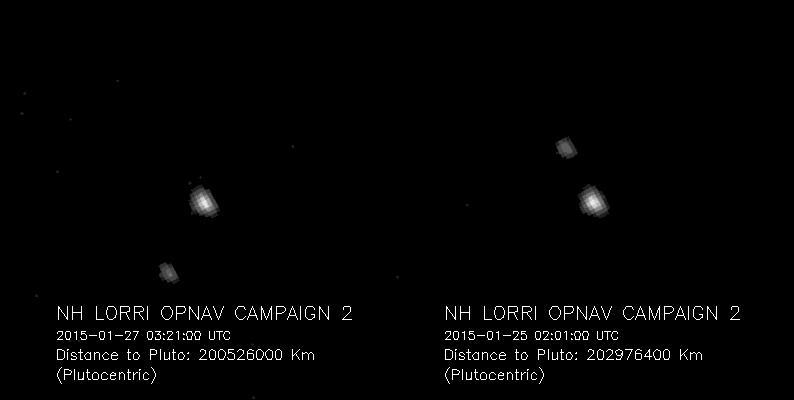
James Christy spotted Charon in 1978 as a bump that kept reappearing on photographs of Pluto. Fully half Pluto's size, it is so large relative to its world that the two orbit a point in empty space between them — a genuine double system. New Horizons revealed its great reddish polar cap, nicknamed Mordor, in 2015.
Images

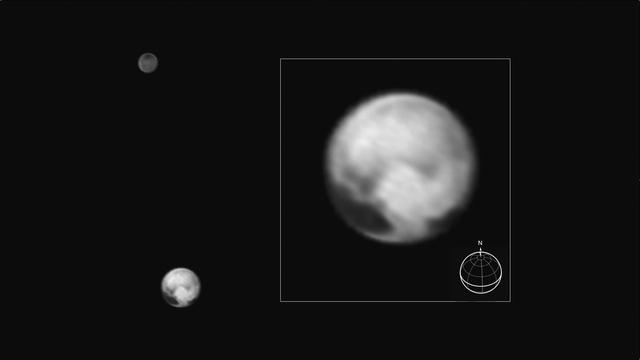

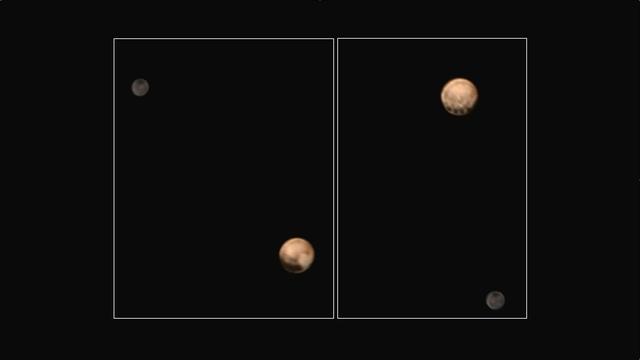
Images from open archives · credit shown per image