Galactic Centre
Star Cluster
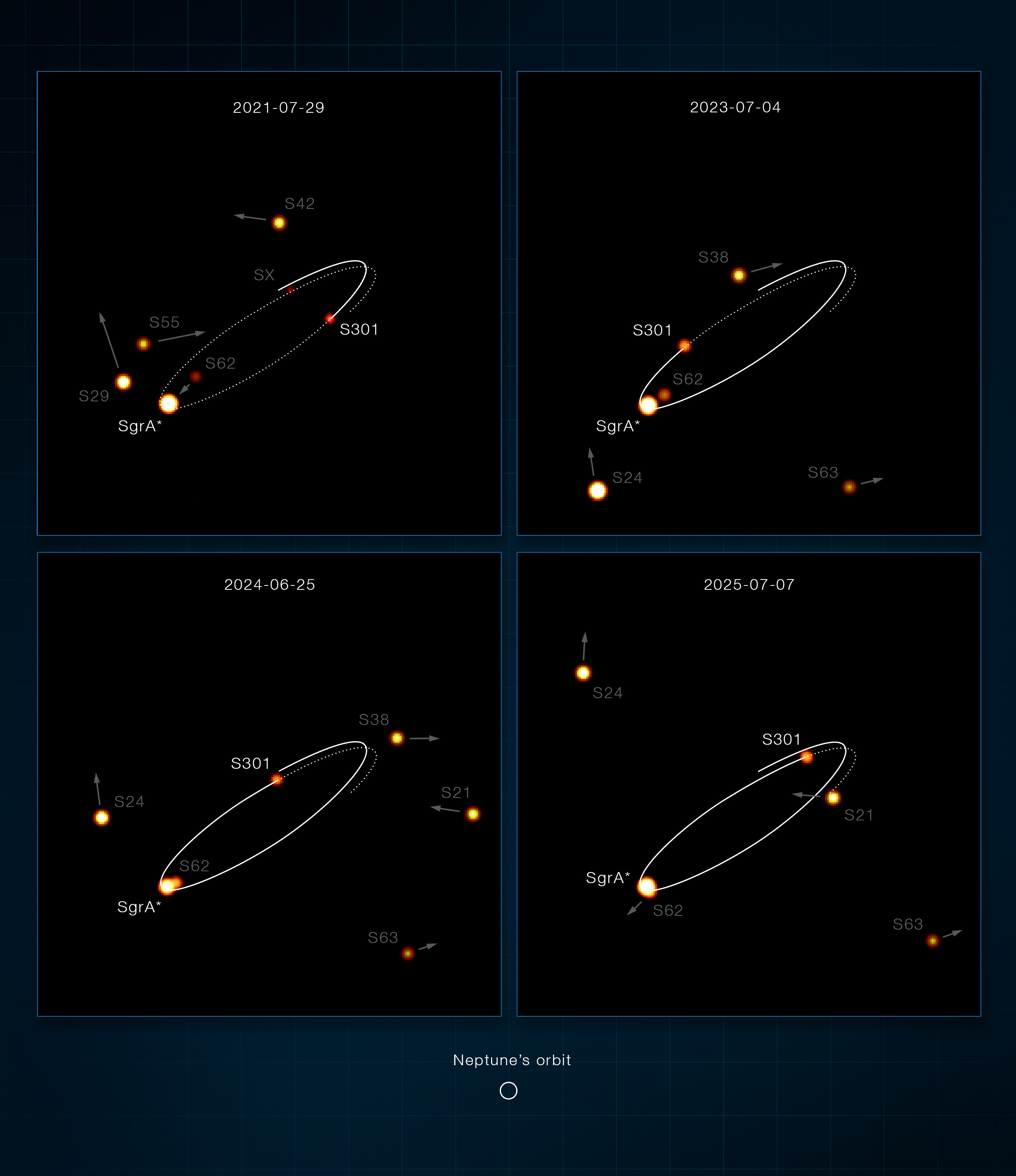
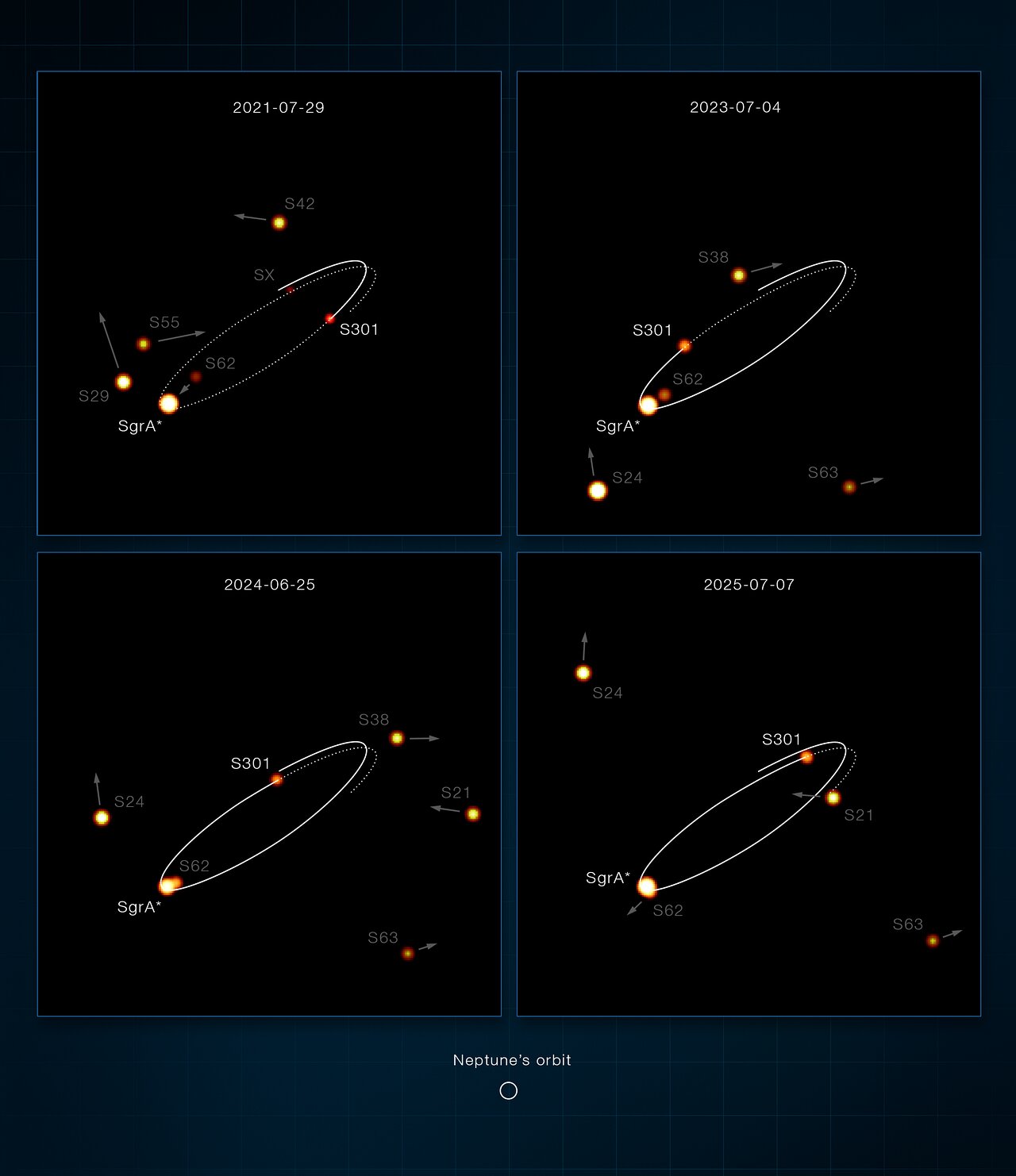
The Galactic Centre — the innermost few light-years of the Milky Way, where a dense cluster of stars orbits the supermassive black hole Sagittarius A*. Descend to see the black hole and two of those stars mapped from their real measured paths: S2, which tested Einstein's relativity near the hole, and S301, on the shortest and fastest orbit yet measured.
Open in 3D viewSee Galactic Centre in the live, interactive 3D map
Key facts
Central object
Sagittarius A* (black hole)
Distance
~26,700 light-years
Stars mapped
2 (S2, S301)
Science
What this is
- Region
- The Galactic Centre — the innermost few light-years of the Milky Way
- Anchored by
- Sagittarius A* — a ~4.3-million-solar-mass black hole
- The 'S' cluster
- Dozens of stars on tight, fast orbits around the hole
- Distance
- ~26,700 light-years
- GRAVITY Collaboration 2019
Mapped here
- S2 (S0-2)
- 16-year orbit — tested general relativity; part of the 2020 Nobel Prize work
- S301
- 8.7-year orbit — the shortest and fastest yet measured (~8% of light speed)
- Why two, not forty
- Two stars told properly, from real measured orbits — not a field of unlabelled dots
How we know
- Note
- The stars here are unresolved points of light: their orbits are MODELS built from decades of astrometric tracking (ESO's GRAVITY interferometer and its predecessors), never images. The orbit sizes, shapes and periods are firmly measured; S301's 3-D tilt has a mirror-image alternative not yet distinguished. The black hole's own 2022 Event Horizon Telescope image is itself an interferometric reconstruction from radio (VLBI) data — computed, not a photograph — of the ring of hot gas around it, not the hole itself.
Discovery & history
- Method
- Telescope
- Name
- The Galactic Centre lies in the constellation Sagittarius; its black hole is Sagittarius A*, and the stars tightly bound to it form the 'S' (Sagittarius-A* star) cluster.
A bright, compact radio source at the galactic centre was found by Balick & Brown in 1974. Decades of tracking stars whipping around an invisible ~4-million-solar-mass point (Genzel and Ghez, 2020 Nobel Prize) proved it a black hole; the EHT imaged its shadow in 2022. That same star-tracking maps the orbits shown when you descend.
Images
Images from open archives · credit shown per image