
Perseverance
Perseverance is NASA's Mars 2020 rover, working since February 2021 in Jezero crater, a dry river delta where a lake once stood. Its task is astrobiology: searching the rocks for signs of ancient microbial life and sealing cores of the most promising ones for a later mission to carry home. In 2026 its SHERLOC spectrometer reported hundreds of detections of macromolecular carbon — large, disordered networks of carbon atoms — in two mudstones of the Bright Angel outcrop, the most extensive organic material yet found in the crater. Organic carbon is not evidence of life: the same material arrives on meteorites and forms where hot water reacts with rock, and the study does not attribute this carbon to biology. Its origin may only be settled once the cached samples reach a laboratory on Earth.
Key facts
Mission & specifications
Mission
- Operator
- NASA
- Launched
- July 30, 2020
- Status
- Active
Trajectory
- Distance from the Sun
- 1.57 AU
- Computed from the cached position
- Distance from Earth
- 1.57 AU
- Computed from cached positions
- Distance from Mars
- 1,309,340 km
- Computed from cached positions
Cost & funding
- Program cost
- $2.70 × 10⁹ USD
Mission
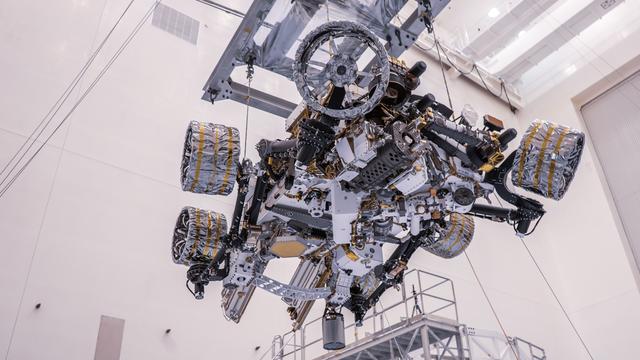
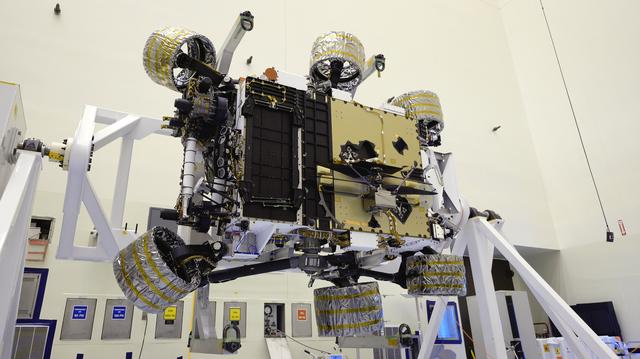
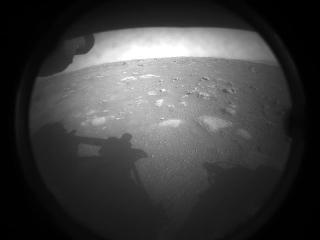
Perseverance is NASA's most advanced Mars rover, sent not only to study the planet but to begin bringing a piece of it home. Built on the proven body of Curiosity, the Mars 2020 rover launched on 30 July 2020 and used a guided sky-crane descent to touch down on 18 February 2021 inside Jezero crater — an ancient river delta where a lake once stood, one of the most promising places on Mars to look for signs of past life. Its central task is astrobiology: searching the delta's rocks for chemical and textural biosignatures, and drilling pencil-thin cores of the most promising material into sealed titanium tubes. These are being cached for the planned Mars Sample Return campaign, a joint NASA and ESA effort to fly them back to Earth in the 2030s for study in laboratories far more capable than anything that could be carried to Mars; as insurance, Perseverance has already laid down a backup depot of tubes on the surface. The mission also carried two pioneering experiments. MOXIE made oxygen from the carbon-dioxide atmosphere, a first rehearsal of living off the land for future crews. And tucked beneath the rover's belly rode Ingenuity, a small helicopter that on 19 April 2021 made the first powered, controlled flight by any aircraft on another world — a feat its makers likened to the Wright brothers. Built for five flights, Ingenuity flew seventy-two over nearly three years before damaging a rotor blade. Perseverance, meanwhile, has climbed out of Jezero and onto its rim, still exploring and still gathering the samples a later mission will one day retrieve.
- 2020Launch toward Jezero craterLaunch
An Atlas V sends Perseverance and the Ingenuity helicopter toward an ancient delta on Mars.
Guided by terrain-relative navigation, the rover touches down beside a dried-up river delta.
- 2021Ingenuity's first flightMilestone
Ingenuity makes the first powered, controlled flight by an aircraft on another world.
- 2021First rock core sealedMilestone
Perseverance drills and seals its first sample of Martian rock for eventual return to Earth.
The rover lays down a backup cache of sealed sample tubes as insurance for Mars Sample Return.
- 2024Ingenuity's final flightMilestone
After seventy-two flights over nearly three years, the helicopter damages a rotor blade and is retired.
Perseverance reaches the crater rim to explore older rocks while still collecting samples.
Images

Images from open archives · credit shown per image