
Atlas
Moon· orbits Saturn
Atlas is a moon orbiting Saturn.
Open in 3D viewSee Atlas in the live, interactive 3D map
Key facts
Mass
5.54 × 10¹⁵ kg
0.0000000755 Moon masses
Radius
15.1 km
1% of our Moon's radius
Surface gravity
0.00162 m/s²
0% of Earth's gravity
Orbit around Saturn
14.5 hours
0.60 Earth days
Science
Physical
- Mass
- 5.54 × 10¹⁵ kg · 0.0000000755 Moon masses
- JPL SSD Planetary Satellite Physical Parameters (GM SAT415) — dynamical (spacecraft ephemeris fit)
- Radius
- 15.1 km · 1% of our Moon's radius
- JPL SSD Planetary Satellite Physical Parameters (mean radius)
- Density
- 384 kg/m³ · 0.38× water
- Computed from mass and radius
- Surface gravity
- 0.00162 m/s² · 0% of Earth's gravity
- Computed from mass and radius
- Escape velocity
- 7 m/s · 0% of Earth's escape velocity
- Computed from mass and radius
Orbit around Saturn
- Distance from Saturn
- 137,700 km
- From JPL orbital elements
- Orbital period
- 14.51 hours
- From JPL orbital elements
- Eccentricity
- 0.001
- From JPL orbital elements
- Inclination to Saturn's Laplace plane
- 0.00 °
- From JPL orbital elements · The Laplace plane is the one a moon's orbit precesses about: close in it is the planet's equatorial plane, the plane of the rings, and further out it tilts toward the planet's own orbit.
Radiation & temperature
- Insolation
- 0.0112 S⊕ · 1% of the sunlight Earth receives
- Computed from the distance to the Sun (inverse-square; Earth's sunlight = 1), before any atmosphere.
Discovery & history
- By
- Voyager Science Team
Atlas was discovered in 1980 by Voyager Science Team. Saturn's moons are named after the Titans, giants and monsters of Greek and Roman myth. Beyond its discovery and naming, little more about it has been individually recorded.
Images


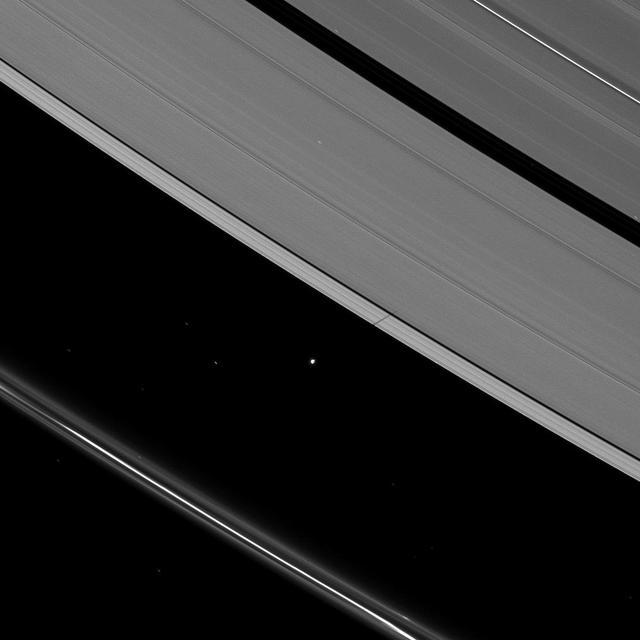

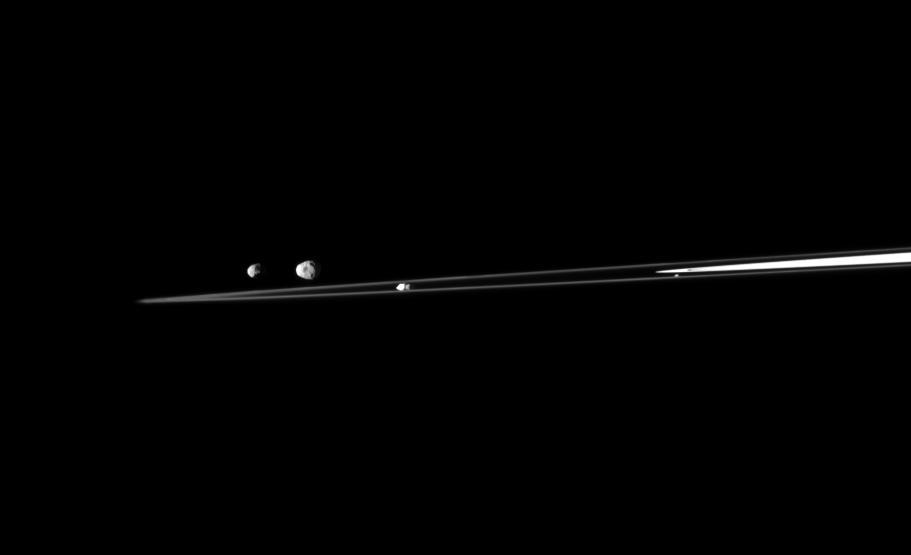


Images from open archives · credit shown per image