
Saturn
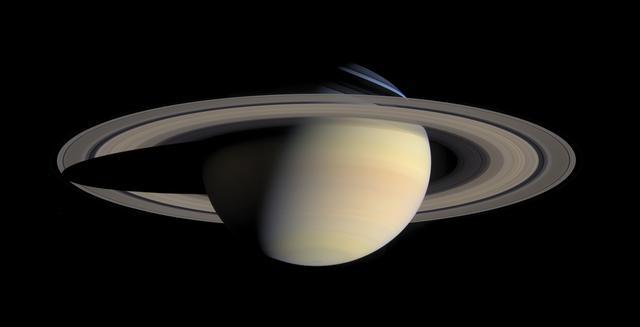
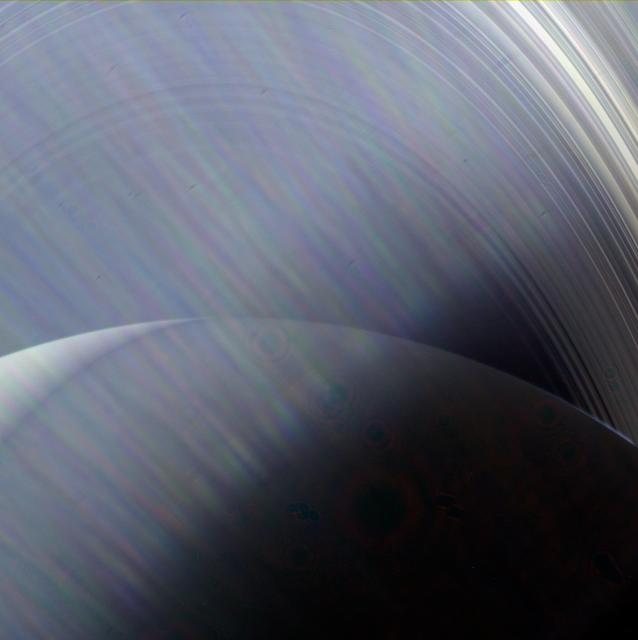
Saturn is the sixth planet and the second-largest, famous for its spectacular ring system of ice and rock. It is the least dense planet — it would float in water. Around its north pole sits a hexagon — a six-sided standing wave in a jet stream, first seen by Voyager in 1981 and stable for over forty years. In 2025 Hubble and ground-based telescopes found its southern counterpart: a ten-sided wave, a decagon, encircling the south pole at about 58–63°S. It drifts east at just 2.5 m/s inside a 116 m/s jet, its corners sway with a 32-day rhythm, and images from 2023–24 show it still taking shape (Sánchez-Lavega et al., Science Advances, September 2026) — so unlike the hexagon, it is new, evolving, and nobody yet knows whether it will last.
Key facts
Science
Physical
- Mass
- 5.68 × 10²⁶ kg · 95.2 M⊕
- Radius
- 58,232 km · 9.14× wider than Earth
- Density
- 687 kg/m³ · 0.69× water
- Computed from mass and radius
- Surface gravity
- 11.2 m/s² · 1.14× Earth's gravity
- Computed from mass and radius
- Escape velocity
- 36.1 km/s · 3.23× Earth's escape velocity
- Computed from mass and radius
- Axial tilt
- 26.73 °
Orbital
- Distance from the Sun
- 9.43 AU
- Computed from the position at the selected time
- Semi-major axis
- 9.54 AU
- Computed from the cached state vector
- Eccentricity
- 0.05507
- Computed from the cached state vector
- Inclination
- 22.55 °
- Computed from the cached state vector
- Orbital period
- 29.46 years
- Computed from the cached state vector
- Perihelion
- 9.01 AU
- Computed from the orbital elements
- Aphelion
- 10.1 AU
- Computed from the orbital elements
- Mean orbital velocity
- 9.64 km/s
- Computed from the orbital elements
Rotation
- Rotation period
- 10.66 hours
Atmosphere
- Composition
- 96% H₂, 3% He, traces of CH₄
- Scale height
- 59.5 km
Rings
- Composition & structure
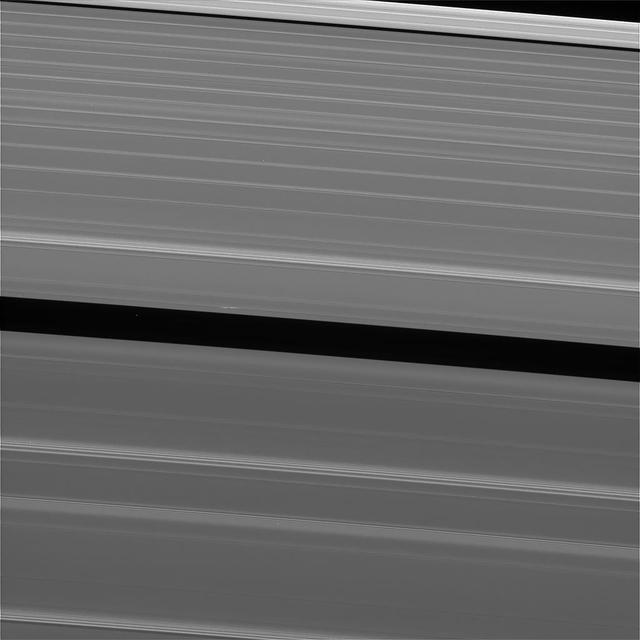
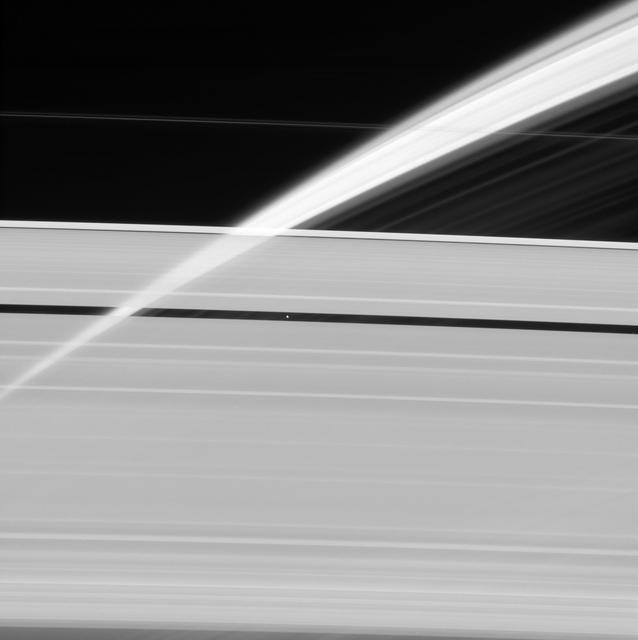
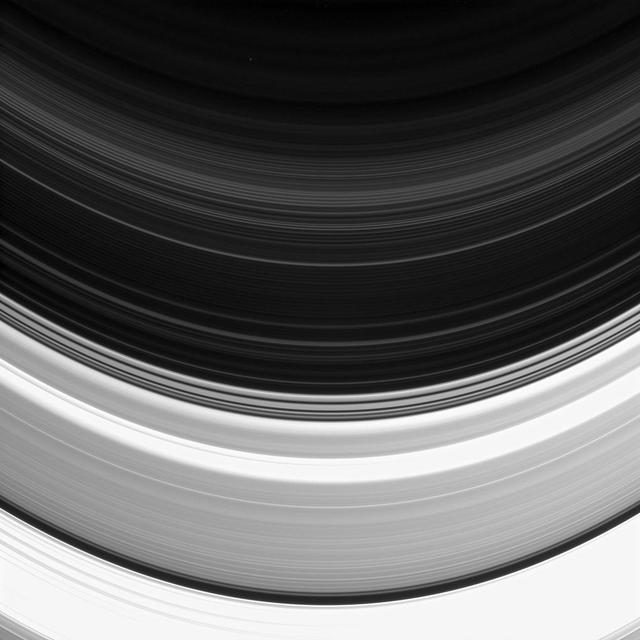
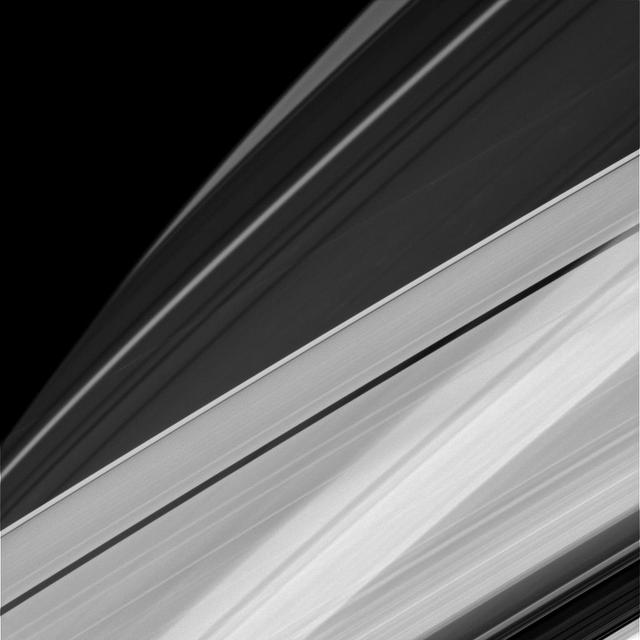
- Almost pure water ice (>90–95%) with a small rocky/carbonaceous contaminant that reddens them slightly. Particles span micron-scale dust to house-sized boulders, in a disk only tens of metres thick — the brightest, most massive ring system in the Solar System. Extensively mapped by Voyager (1980–81) and Cassini (2004–17).
Temperature
- Mean
- 134 K (-139 °C)
Composition
- Bulk composition
- Hydrogen/helium with a rocky/icy core; iconic ring system
Radiation & temperature
- Insolation
- 0.011 S⊕ · 1% of the sunlight Earth receives
- Computed from the distance to the Sun (inverse-square; Earth's sunlight = 1), before any atmosphere.
- Bond albedo
- 0.34 · reflects 34% of incoming sunlight
- Equilibrium temperature
- 81 K (-192 °C)
- Computed from albedo + distance from the Sun (airless black body)
- Measured mean temperature
- 134 K (-139 °C)
- Greenhouse warming
- +53 K
- Measured temperature minus the airless equilibrium — the greenhouse effect
- Surface magnetic field
- 21 µT · 42% of Earth's magnetic field
Discovery & history
- First known
- Known since antiquity
- Name
- The Roman god of agriculture; to antiquity it was the most distant planet known.
Saturn, the slowest-moving of the naked-eye planets, marked the edge of the known Solar System for millennia. When Galileo saw it in 1610 his telescope was too crude to resolve the rings — he reported mysterious 'ears'. In 1655 Christiaan Huygens correctly identified a flat ring and discovered Titan. Centuries later the Cassini–Huygens mission orbited Saturn for 13 years, landing a probe on Titan and diving through the rings.
First spacecraft to fly past Saturn.
Close study of the rings and a targeted flyby of Titan.
Imaged the rings in fine detail before heading on to Uranus and Neptune.
- 2004Cassini–HuygensOrbiter
Orbited Saturn for 13 years; the Huygens probe landed on Titan in 2005.
Images


Images from open archives · credit shown per image