
Hyperion
Moon· orbits Saturn
Hyperion is a small, sponge-like moon of Saturn with a chaotic, tumbling rotation and an unusually porous surface.
Open in 3D viewSee Hyperion in the live, interactive 3D map
Key facts
Mass
5.62 × 10¹⁸ kg
0.0000765 Moon masses
Radius
135 km
8% of our Moon's radius
Surface gravity
0.0206 m/s²
0% of Earth's gravity
Orbit around Saturn
21.28 Earth days
Science
Physical
- Mass
- 5.62 × 10¹⁸ kg · 0.0000765 Moon masses
- JPL / IAU mean radii; spacecraft-tracked GM where measured
- Radius
- 135 km · 8% of our Moon's radius
- JPL / IAU mean radii; spacecraft-tracked GM where measured
- Density
- 545 kg/m³ · 0.55× water
- Computed from mass and radius
- Surface gravity
- 0.0206 m/s² · 0% of Earth's gravity
- Computed from mass and radius
- Escape velocity
- 74.5 m/s · 1% of Earth's escape velocity
- Computed from mass and radius
Orbit around Saturn
- Distance from Saturn
- 1,481,500 km
- From JPL orbital elements
- Orbital period
- 21.3 days
- From JPL orbital elements
- Eccentricity
- 0.105
- From JPL orbital elements
- Inclination to Saturn's Laplace plane
- 0.60 °
- From JPL orbital elements · The Laplace plane is the one a moon's orbit precesses about: close in it is the planet's equatorial plane, the plane of the rings, and further out it tilts toward the planet's own orbit.
Rotation
- Rotation
- Chaotic — Hyperion tumbles unpredictably with no fixed period or spin axis, the textbook case of chaotic rotation (Wisdom, Peale & Mignard 1984; confirmed by Cassini). Not tidally locked.
Composition
- Bulk composition
- A highly porous body of mostly water ice with some rock — so under-dense it may be nearly half empty space.
Radiation & temperature
- Insolation
- 0.0112 S⊕ · 1% of the sunlight Earth receives
- Computed from the distance to the Sun (inverse-square; Earth's sunlight = 1), before any atmosphere.
- Geometric albedo
- 0.30
- Geometric (V-band) albedo; Bond albedo not directly measured.
- Equilibrium temperature
- 83 K (-190 °C)
- Computed from albedo + distance from the Sun (airless black body); uses the geometric albedo as an estimate
Discovery & history
- By
- William Lassell and, independently, William and George Bond
- Method
- Visual discovery (telescopic)
- Name
- Hyperion, a Titan of Greek myth and father of the Sun.
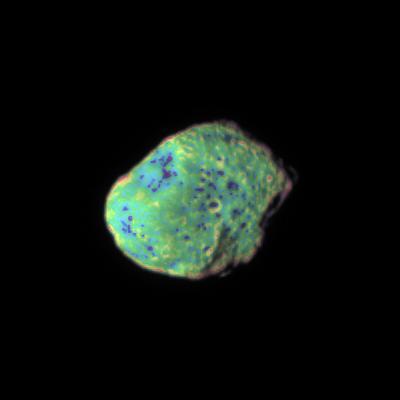
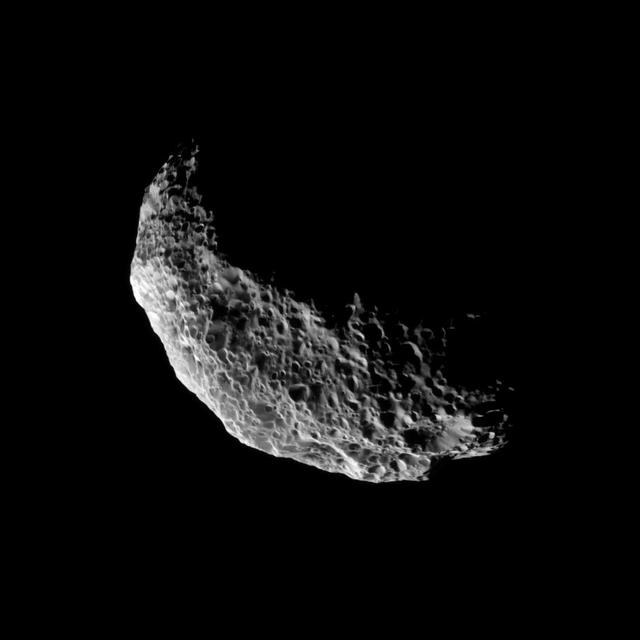
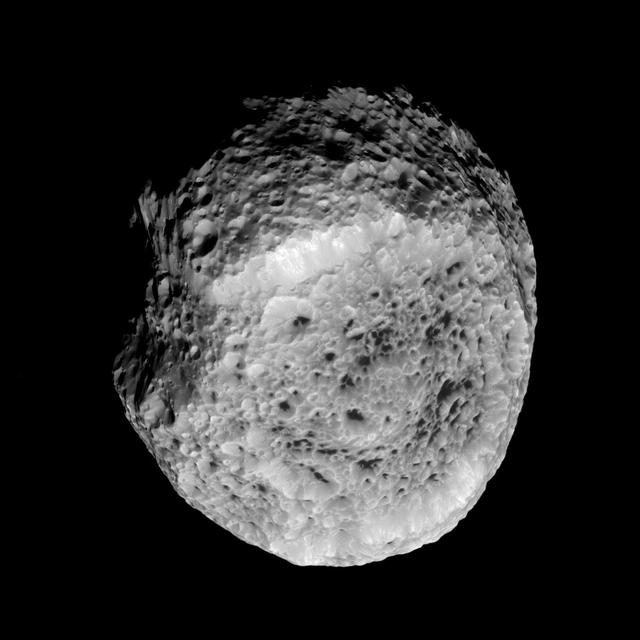
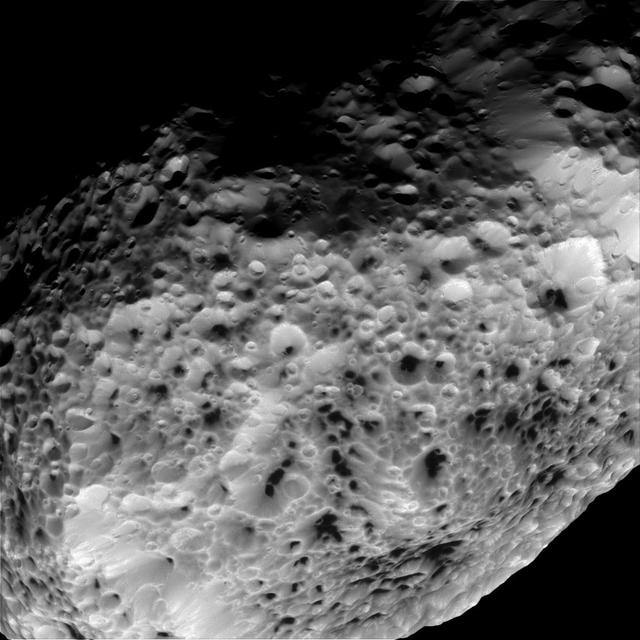
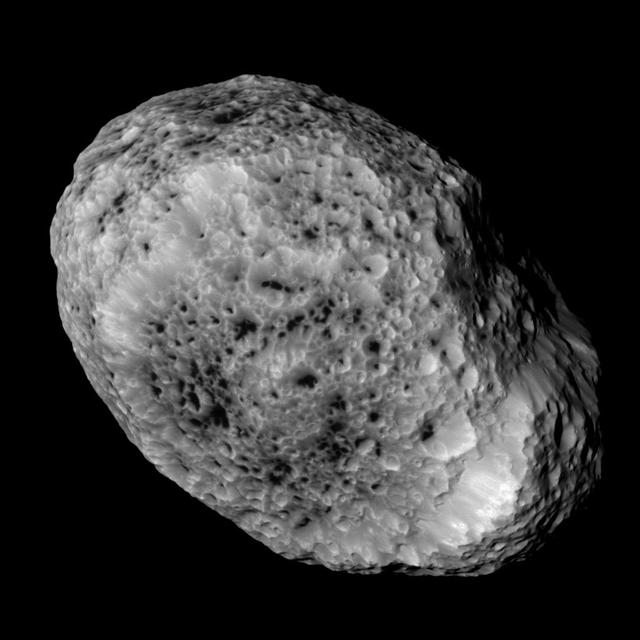
Discovered in 1848 independently by William Lassell and the father-and-son Bonds, Hyperion is one of the largest irregularly shaped moons. Riddled with deep pits, it looks like a sponge and tumbles so chaotically that its orientation can't be predicted from one orbit to the next.
Images


Images from open archives · credit shown per image