
Dione
Moon· orbits Saturn
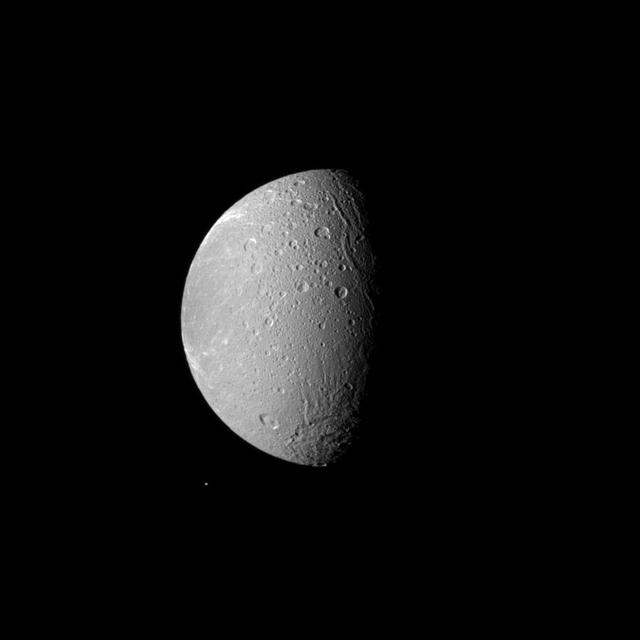
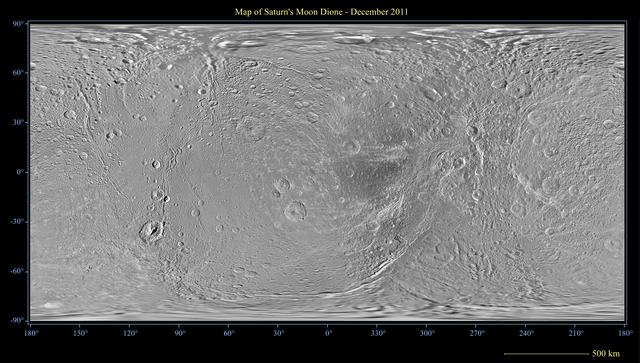
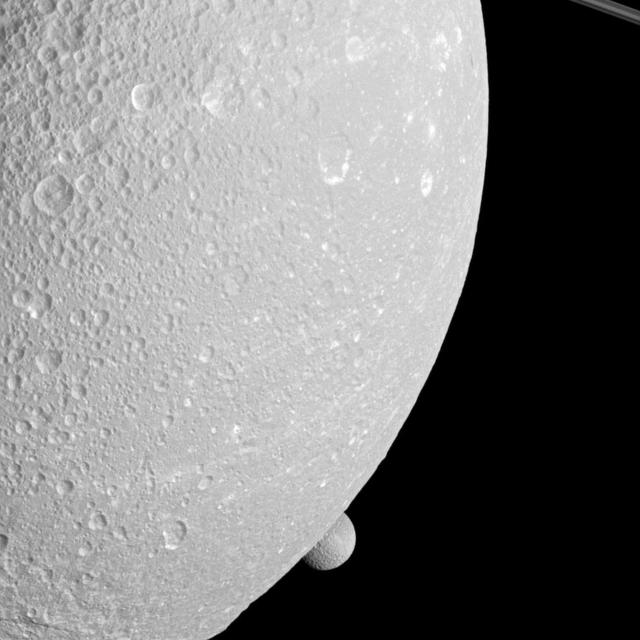
Dione is a dense moon of Saturn whose trailing hemisphere is streaked with bright ice cliffs (chasmata) cutting across older cratered terrain.
Open in 3D viewSee Dione in the live, interactive 3D map
Key facts
Mass
1.10 × 10²¹ kg
0.0149 Moon masses
Radius
561 km
32% of our Moon's radius
Surface gravity
0.232 m/s²
2% of Earth's gravity
Day length
2.7 days
Orbit around Saturn
2.74 Earth days
Science
Physical
- Mass
- 1.10 × 10²¹ kg · 0.0149 Moon masses
- JPL / IAU mean radii; spacecraft-tracked GM where measured
- Radius
- 561 km · 32% of our Moon's radius
- JPL / IAU mean radii; spacecraft-tracked GM where measured
- Density
- 1,478 kg/m³ · 1.5× water
- Computed from mass and radius
- Surface gravity
- 0.232 m/s² · 2% of Earth's gravity
- Computed from mass and radius
- Escape velocity
- 510 m/s · 5% of Earth's escape velocity
- Computed from mass and radius
Orbit around Saturn
- Distance from Saturn
- 377,700 km
- From JPL orbital elements
- Orbital period
- 2.7 days
- From JPL orbital elements
- Eccentricity
- 0.002
- From JPL orbital elements
- Inclination to Saturn's Laplace plane
- 0.00 °
- From JPL orbital elements · The Laplace plane is the one a moon's orbit precesses about: close in it is the planet's equatorial plane, the plane of the rings, and further out it tilts toward the planet's own orbit.
Rotation
- Rotation period
- 2.7 days
- Tidal locking
- Tidally locked to its parent
Temperature
- Mean
- 87 K (-186 °C)
Composition
- Bulk composition
- A water-ice crust over a silicate-rock interior; possibly a small subsurface ocean.
Radiation & temperature
- Insolation
- 0.0112 S⊕ · 1% of the sunlight Earth receives
- Computed from the distance to the Sun (inverse-square; Earth's sunlight = 1), before any atmosphere.
- Bond albedo
- 0.65 · reflects 65% of incoming sunlight
- Equilibrium temperature
- 70 K (-203 °C)
- Computed from albedo + distance from the Sun (airless black body)
- Measured mean temperature
- 87 K (-186 °C)
- Greenhouse warming
- +17 K
- Measured temperature minus the airless equilibrium — the greenhouse effect
Discovery & history
- Discovered
- March 21, 1684
- By
- Giovanni Domenico Cassini
- Method
- Visual discovery (telescopic)
- Name
- Dione, a Titaness of Greek myth.
Cassini found Dione on the same night as Tethys in 1684. Its trailing hemisphere is laced with bright icy cliffs — fractures hundreds of metres high that Voyager could see only as wispy streaks until Cassini resolved them.
Images

Images from open archives · credit shown per image