
Neptune
Neptune is the eighth and most distant planet — a deep-blue ice giant with the fastest winds in the Solar System (up to 2,100 km/h). It was the first planet found by mathematical prediction.
Key facts
Science
Physical
- Mass
- 1.02 × 10²⁶ kg · 17.1 M⊕
- Radius
- 24,622 km · 3.86× wider than Earth
- Density
- 1,638 kg/m³ · 1.6× water
- Computed from mass and radius
- Surface gravity
- 11.3 m/s² · 1.15× Earth's gravity
- Computed from mass and radius
- Escape velocity
- 23.6 km/s · 2.11× Earth's escape velocity
- Computed from mass and radius
- Axial tilt
- 28.32 °
Orbital
- Distance from the Sun
- 29.9 AU
- Computed from the position at the selected time
- Semi-major axis
- 30.1 AU
- Computed from the cached state vector
- Eccentricity
- 0.01003
- Computed from the cached state vector
- Inclination
- 22.30 °
- Computed from the cached state vector
- Orbital period
- 164.93 years
- Computed from the cached state vector
- Perihelion
- 29.8 AU
- Computed from the orbital elements
- Aphelion
- 30.4 AU
- Computed from the orbital elements
- Mean orbital velocity
- 5.43 km/s
- Computed from the orbital elements
Rotation
- Rotation period
- 16.11 hours
Atmosphere
- Composition
- 80% H₂, 19% He, 1.5% CH₄
- Scale height
- 19.7 km
Rings
- Composition & structure
- Dark, reddish particles — likely water ice coated with a radiation-darkened, carbon-rich (organic) material, mixed with a high fraction of microscopic dust, so the rings are faint. The outermost Adams ring holds the bright, clumpy 'arcs' (Fraternité, Égalité, Liberté, Courage), confined by the shepherd moon Galatea. Established from stellar-occultation studies and Voyager 2 (1989). The precise composition of the dark component is not established.
Temperature
- Mean
- 72 K (-201 °C)
Composition
- Bulk composition
- Still debated — usually modelled as water, ammonia and methane ices over a rocky core, but models with far more rock fit the same measurements
Radiation & temperature
- Insolation
- 0.00111 S⊕ · 1/904 of the sunlight Earth receives
- Computed from the distance to the Sun (inverse-square; Earth's sunlight = 1), before any atmosphere.
- Bond albedo
- 0.29 · reflects 29% of incoming sunlight
- Equilibrium temperature
- 47 K (-227 °C)
- Computed from albedo + distance from the Sun (airless black body)
- Measured mean temperature
- 72 K (-201 °C)
- Greenhouse warming
- +25 K
- Measured temperature minus the airless equilibrium — the greenhouse effect
- Surface magnetic field
- 14 µT · 28% of Earth's magnetic field
Discovery & history
- Discovered
- September 23, 1846
- By
- Johann Galle, from predictions by Urbain Le Verrier and John Couch Adams
- Method
- Mathematical prediction (gravity)
- Name
- The Roman god of the sea, for its deep blue colour.
Neptune is the only planet found by mathematics before it was seen. Uranus was drifting slightly off its predicted path, and Urbain Le Verrier (in France) and John Couch Adams (in England) independently calculated that the gravity of an unseen planet could explain it. On 23 September 1846 Johann Galle at the Berlin Observatory pointed his telescope where Le Verrier predicted and found Neptune within a degree of the spot — a stunning vindication of Newtonian gravity. Voyager 2 flew past in 1989, revealing supersonic winds and the moon Triton.
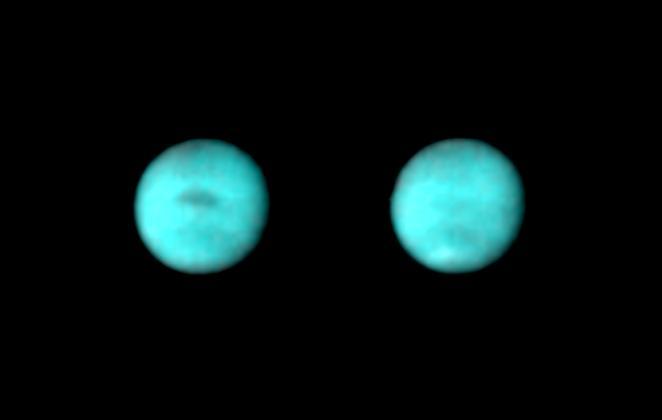
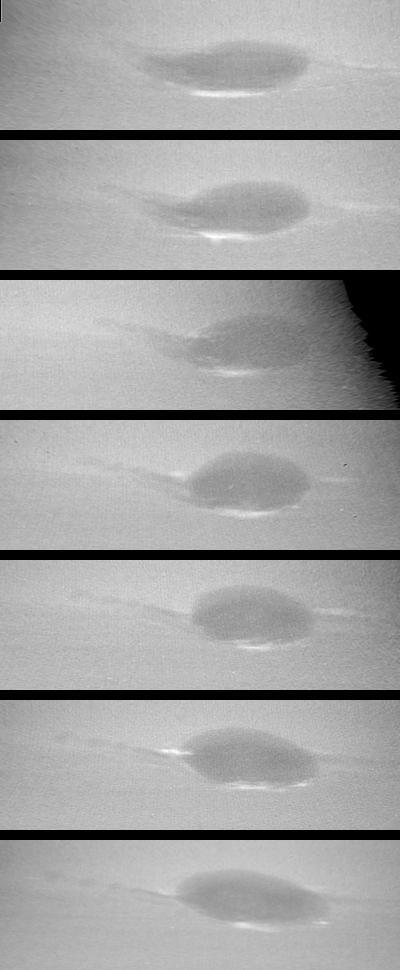
Humanity's only visit to Neptune, and Voyager 2's closest approach to any planet — passing ~4,950 km above the north pole. Revealed the Great Dark Spot, the fastest winds in the Solar System (~2,100 km/h), six new moons and faint rings, then imaged nitrogen geysers on the moon Triton.
Images




Images from open archives · credit shown per image