
Uranus
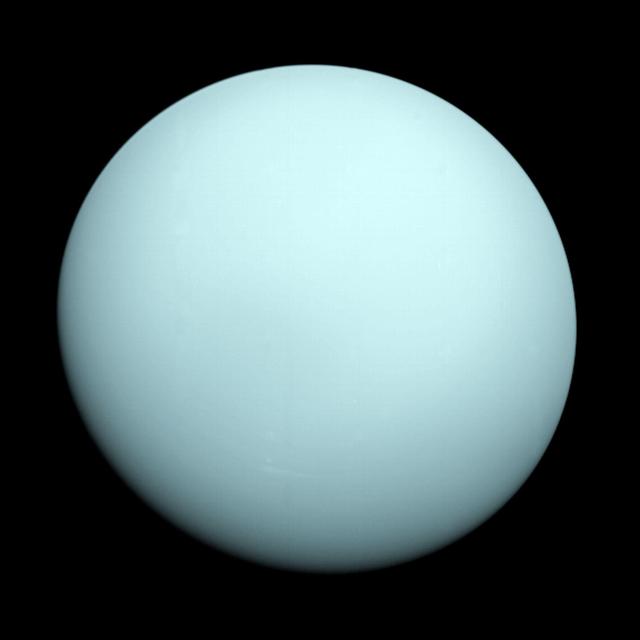
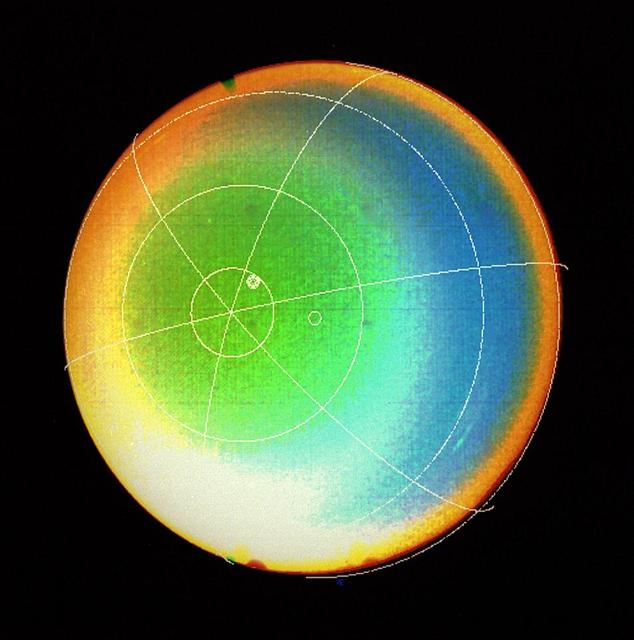
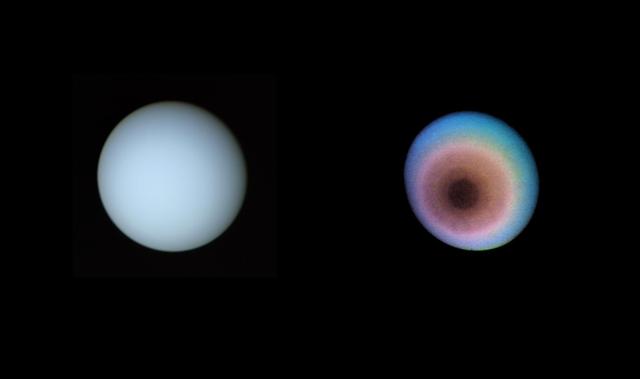
Uranus is the seventh planet — an ice giant that rotates on its side, tipped 98° so its poles take turns facing the Sun. Methane gives it a pale cyan colour.
Key facts
Science
Physical
- Mass
- 8.68 × 10²⁵ kg · 14.5 M⊕
- Radius
- 25,362 km · 3.98× wider than Earth
- Density
- 1,270 kg/m³ · 1.3× water
- Computed from mass and radius
- Surface gravity
- 9.01 m/s² · 92% of Earth's gravity
- Computed from mass and radius
- Escape velocity
- 21.4 km/s · 1.91× Earth's escape velocity
- Computed from mass and radius
- Axial tilt
- 97.77 °
Orbital
- Distance from the Sun
- 19.4 AU
- Computed from the position at the selected time
- Semi-major axis
- 19.3 AU
- Computed from the cached state vector
- Eccentricity
- 0.04756
- Computed from the cached state vector
- Inclination
- 23.66 °
- Computed from the cached state vector
- Orbital period
- 84.54 years
- Computed from the cached state vector
- Perihelion
- 18.3 AU
- Computed from the orbital elements
- Aphelion
- 20.2 AU
- Computed from the orbital elements
- Mean orbital velocity
- 6.79 km/s
- Computed from the orbital elements
Rotation
- Rotation period
- 17.24 hours
- Direction
- Retrograde
Atmosphere
- Composition
- 83% H₂, 15% He, 2.3% CH₄
- Scale height
- 27.7 km
Rings
- Composition & structure
- Dark, low-albedo particles — as dark as charcoal (geometric albedo ~0.03): water ice mixed with a radiation-processed, carbon-rich (organic) component. The main narrow rings (notably ε) are made mostly of centimetre-to-metre boulders with very little dust; the outer ν and μ rings are the dusty exception. Established from Voyager 2 (1986) and Hubble/ground-based observation. The precise chemistry of the dark carbon-bearing component is not established — that is the genuine open question.
Temperature
- Mean
- 76 K (-197 °C)
Composition
- Bulk composition
- Still debated — usually modelled as water, ammonia and methane ices over a rocky core, but models with far more rock fit the same measurements
Radiation & temperature
- Insolation
- 0.0027 S⊕ · 1/371 of the sunlight Earth receives
- Computed from the distance to the Sun (inverse-square; Earth's sunlight = 1), before any atmosphere.
- Bond albedo
- 0.30 · reflects 30% of incoming sunlight
- Equilibrium temperature
- 58 K (-215 °C)
- Computed from albedo + distance from the Sun (airless black body)
- Measured mean temperature
- 76 K (-197 °C)
- Greenhouse warming
- +18 K
- Measured temperature minus the airless equilibrium — the greenhouse effect
- Surface magnetic field
- 23 µT · 46% of Earth's magnetic field
Discovery & history
- Discovered
- March 13, 1781
- By
- William Herschel
- Method
- Visual discovery (telescopic)
- Name
- The Greek god of the sky, Ouranos — father of Saturn (Cronus).
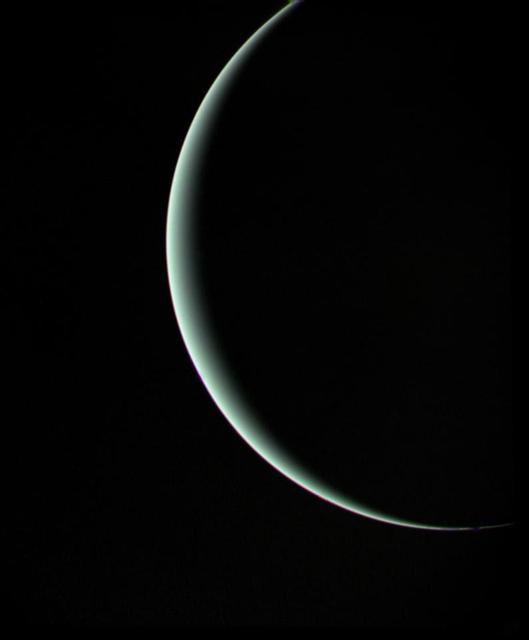
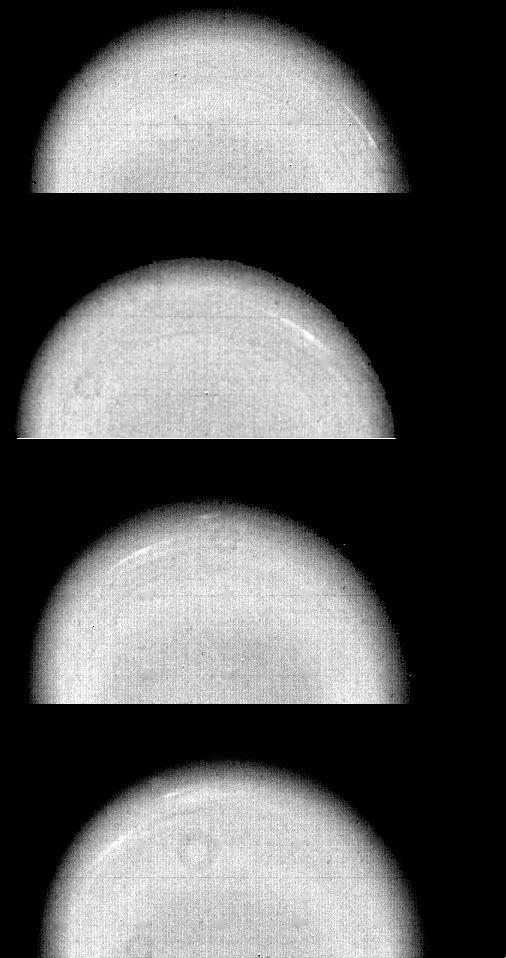
Uranus was the first planet discovered with a telescope. On 13 March 1781 William Herschel, surveying the sky from his garden in Bath, England, noticed a 'curious' object that he first took for a comet. Tracking its slow, near-circular orbit revealed a new planet, doubling the size of the known Solar System overnight. Herschel wanted to name it 'Georgium Sidus' after King George III; the name Uranus, proposed by Johann Bode, eventually won out. Voyager 2 remains the only spacecraft to have visited it, in 1986.
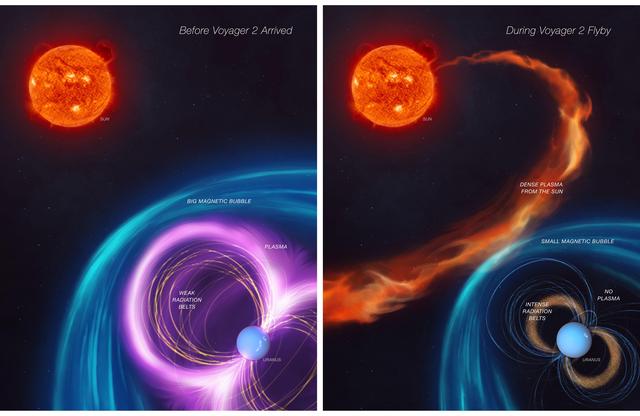
The first and only close visit to Uranus — found ten new moons and two new rings, and a magnetic field bizarrely tilted 59° and offset from the planet's centre.
Images


Images from open archives · credit shown per image