
Oberon
Moon· orbits Uranus
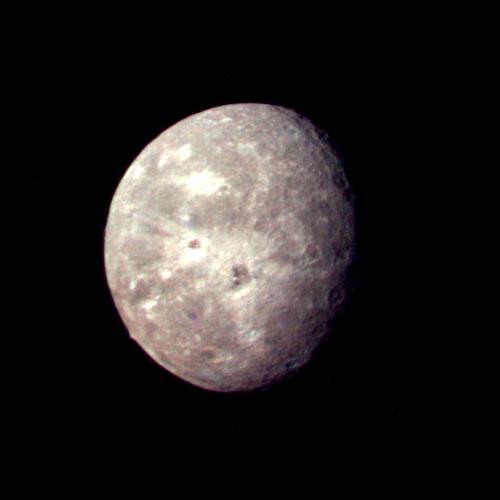
Oberon is the outermost large moon of Uranus — an ancient, heavily cratered surface of ice and rock, with dark deposits on some crater floors.
Open in 3D viewSee Oberon in the live, interactive 3D map
Key facts
Mass
3.08 × 10²¹ kg
0.0419 Moon masses
Radius
761 km
44% of our Moon's radius
Surface gravity
0.354 m/s²
4% of Earth's gravity
Day length
13.5 days
Orbit around Uranus
13.46 Earth days
Science
Physical
- Mass
- 3.08 × 10²¹ kg · 0.0419 Moon masses
- JPL / IAU mean radii; spacecraft-tracked GM where measured
- Radius
- 761 km · 44% of our Moon's radius
- JPL / IAU mean radii; spacecraft-tracked GM where measured
- Density
- 1,664 kg/m³ · 1.7× water
- Computed from mass and radius
- Surface gravity
- 0.354 m/s² · 4% of Earth's gravity
- Computed from mass and radius
- Escape velocity
- 734 m/s · 7% of Earth's escape velocity
- Computed from mass and radius
Orbit around Uranus
- Distance from Uranus
- 583,511 km
- From JPL orbital elements
- Orbital period
- 13.5 days
- From JPL orbital elements
- Eccentricity
- 0.002
- From JPL orbital elements
- Inclination to the J2000 equator
- 0.10 °
- From JPL orbital elements
Rotation
- Rotation period
- 13.5 days
- Tidal locking
- Tidally locked to its parent
Temperature
- Mean
- 75 K (-198 °C)
Composition
- Bulk composition
- Water ice and rock in roughly equal measure, with dark reddish material in some craters.
Radiation & temperature
- Insolation
- 0.00265 S⊕ · 1/378 of the sunlight Earth receives
- Computed from the distance to the Sun (inverse-square; Earth's sunlight = 1), before any atmosphere.
- Bond albedo
- 0.14 · reflects 14% of incoming sunlight
- Equilibrium temperature
- 61 K (-212 °C)
- Computed from albedo + distance from the Sun (airless black body)
- Measured mean temperature
- 75 K (-198 °C)
- Greenhouse warming
- +14 K
- Measured temperature minus the airless equilibrium — the greenhouse effect
Discovery & history
- Discovered
- January 11, 1787
- By
- William Herschel
- Method
- Visual discovery (telescopic)
- Name
- Oberon, king of the fairies in Shakespeare's 'A Midsummer Night's Dream'.
Herschel found Oberon, the outermost large moon of Uranus, on the same night as Titania in 1787. Its old, cratered surface is dotted with dark patches and a lone mountain that juts some 11 km above the limb.
Images

Images from open archives · credit shown per image