
Miranda
Moon· orbits Uranus
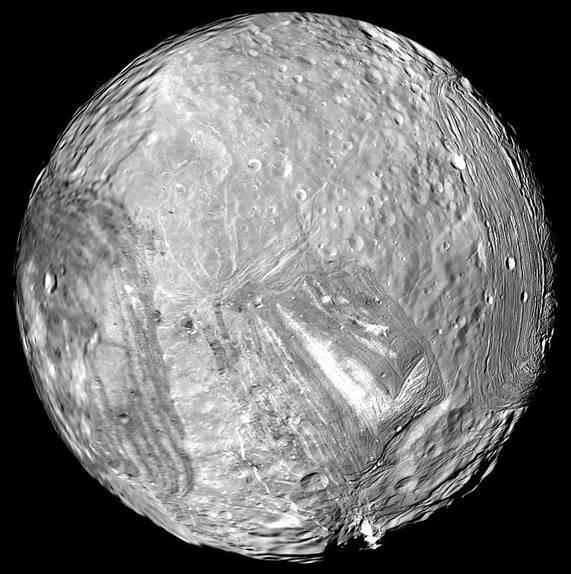
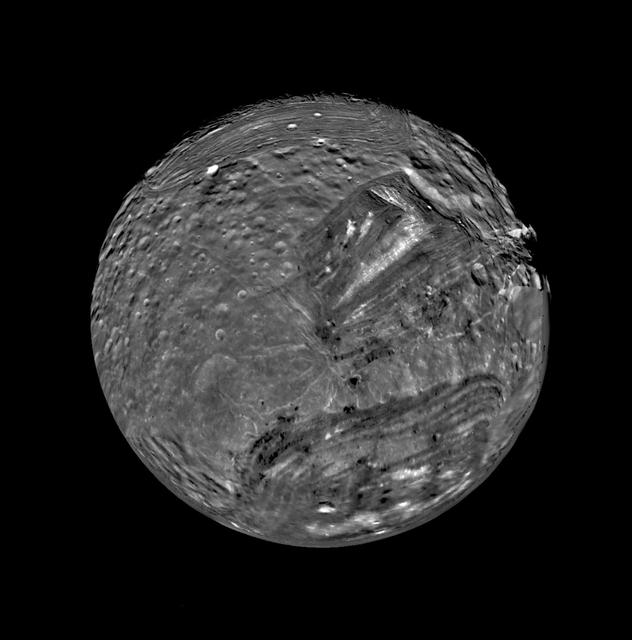
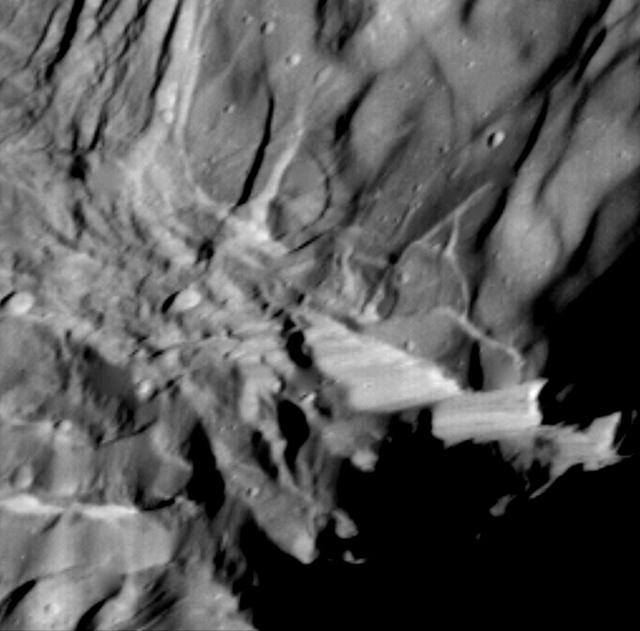
Miranda is the smallest of Uranus's five major moons and one of the strangest, its surface a patchwork of grooved terraces, cliffs and fault scarps (Verona Rupes) up to 20 km high.
Open in 3D viewSee Miranda in the live, interactive 3D map
Key facts
Mass
6.40 × 10¹⁹ kg
0.000872 Moon masses
Radius
236 km
14% of our Moon's radius
Surface gravity
0.0768 m/s²
1% of Earth's gravity
Day length
33.92 hours
Orbit around Uranus
1.41 Earth days
Science
Physical
- Mass
- 6.40 × 10¹⁹ kg · 0.000872 Moon masses
- JPL / IAU mean radii; spacecraft-tracked GM where measured
- Radius
- 236 km · 14% of our Moon's radius
- JPL / IAU mean radii; spacecraft-tracked GM where measured
- Density
- 1,165 kg/m³ · 1.2× water
- Computed from mass and radius
- Surface gravity
- 0.0768 m/s² · 1% of Earth's gravity
- Computed from mass and radius
- Escape velocity
- 190 m/s · 2% of Earth's escape velocity
- Computed from mass and radius
Orbit around Uranus
- Distance from Uranus
- 129,846 km
- From JPL orbital elements
- Orbital period
- 33.92 hours
- From JPL orbital elements
- Eccentricity
- 0.001
- From JPL orbital elements
- Inclination to the J2000 equator
- 4.40 °
- From JPL orbital elements
Rotation
- Rotation period
- 33.92 hours
- Tidal locking
- Tidally locked to its parent
Temperature
- Mean
- 60 K (-213 °C)
Composition
- Bulk composition
- Water ice with silicate rock; a jumbled surface that may record past tidal heating or a violent disruption.
Radiation & temperature
- Insolation
- 0.00265 S⊕ · 1/378 of the sunlight Earth receives
- Computed from the distance to the Sun (inverse-square; Earth's sunlight = 1), before any atmosphere.
- Bond albedo
- 0.32 · reflects 32% of incoming sunlight
- Equilibrium temperature
- 57 K (-216 °C)
- Computed from albedo + distance from the Sun (airless black body)
- Measured mean temperature
- 60 K (-213 °C)
Discovery & history
- Discovered
- February 16, 1948
- By
- Gerard P. Kuiper
- Method
- Visual discovery (telescopic)
- Name
- Miranda, the heroine of Shakespeare's 'The Tempest'.
Kuiper found Miranda in 1948, the last of Uranus's five large moons discovered. The smallest of them has one of the strangest surfaces known — a patchwork of grooved terrain split by Verona Rupes, a cliff up to 20 km high and the tallest known precipice in the Solar System.
Images

Images from open archives · credit shown per image