
Jupiter
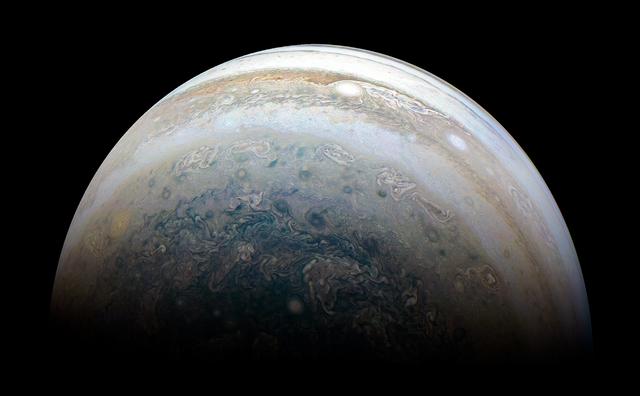
Jupiter is the fifth and largest planet — a gas giant more massive than all the other planets combined, banded with ammonia clouds and home to the centuries-old Great Red Spot storm.
Key facts
Science
Physical
- Mass
- 1.90 × 10²⁷ kg · 1 M♃ (318 M⊕)
- Radius
- 69,911 km · 11× wider than Earth
- Density
- 1,326 kg/m³ · 1.3× water
- Computed from mass and radius
- Surface gravity
- 25.9 m/s² · 2.64× Earth's gravity
- Computed from mass and radius
- Escape velocity
- 60.2 km/s · 5.38× Earth's escape velocity
- Computed from mass and radius
- Axial tilt
- 3.13 °
Orbital
- Distance from the Sun
- 5.31 AU
- Computed from the position at the selected time
- Semi-major axis
- 5.21 AU
- Computed from the cached state vector
- Eccentricity
- 0.04793
- Computed from the cached state vector
- Inclination
- 23.23 °
- Computed from the cached state vector
- Orbital period
- 11.88 years
- Computed from the cached state vector
- Perihelion
- 4.96 AU
- Computed from the orbital elements
- Aphelion
- 5.46 AU
- Computed from the orbital elements
- Mean orbital velocity
- 13.1 km/s
- Computed from the orbital elements
Rotation
- Rotation period
- 9.93 hours
Atmosphere
- Composition
- 90% H₂, 10% He, traces of CH₄ and NH₃
- Scale height
- 27 km
Rings
- Composition & structure
- Faint and made almost entirely of fine dust — microscopic silicate and carbon-rich grains, with very little ice or large particles (unlike Saturn's icy rings). The dust is continuously resupplied by micrometeoroid impacts on the small inner moons (Metis, Adrastea, Amalthea, Thebe), which feed the main ring, the inner halo and the two tenuous gossamer rings. Discovered by Voyager 1 (1979).
Temperature
- Mean
- 165 K (-108 °C)
Composition
- Bulk composition
- Hydrogen/helium enveloping a dense core; possible metallic-hydrogen layer
Radiation & temperature
- Insolation
- 0.0369 S⊕ · 4% of the sunlight Earth receives
- Computed from the distance to the Sun (inverse-square; Earth's sunlight = 1), before any atmosphere.
- Bond albedo
- 0.50 · reflects 50% of incoming sunlight
- Equilibrium temperature
- 102 K (-171 °C)
- Computed from albedo + distance from the Sun (airless black body)
- Measured mean temperature
- 165 K (-108 °C)
- Greenhouse warming
- +63 K
- Measured temperature minus the airless equilibrium — the greenhouse effect
- Surface magnetic field
- 417 µT · 8.34× Earth's magnetic field
Discovery & history
- First known
- Known since antiquity
- Name
- King of the Roman gods, for its commanding brightness and slow, stately motion.
Jupiter has been watched since antiquity as one of the five 'wandering stars'. In January 1610 Galileo Galilei turned his telescope on it and saw four points of light that changed position night to night — the first moons ever found orbiting another planet. That observation was decisive evidence that not everything circles the Earth, helping overturn the geocentric model. The Great Red Spot was recorded by the 17th century, and from the 1970s a parade of spacecraft — Pioneer, Voyager, Galileo and Juno — transformed Jupiter from a bright dot into a roiling, banded world with rings, storms and dozens of moons.
First spacecraft to fly past Jupiter; survived and measured its intense radiation belts.
Swept three times closer than Pioneer 10, imaging the polar regions, then used Jupiter's gravity to sling across the Solar System toward Saturn.
Discovered Jupiter's faint rings and active volcanism on the moon Io.
Detailed studies of the Galilean moons and the Great Red Spot.
Used Jupiter's gravity to swing out of the ecliptic plane and into a solar polar orbit.
- 1995GalileoOrbiter
First Jupiter orbiter; dropped a probe into the atmosphere and studied the moons for eight years.
- 2000CassiniFlyby
Distant gravity-assist flyby en route to Saturn, imaging the atmosphere.
Gravity-assist flyby that shortened the trip to Pluto by three years; caught erupting plumes on Io and studied the Jovian system in over 700 observations.
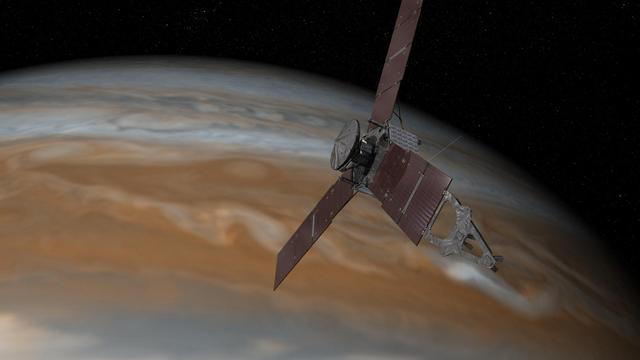
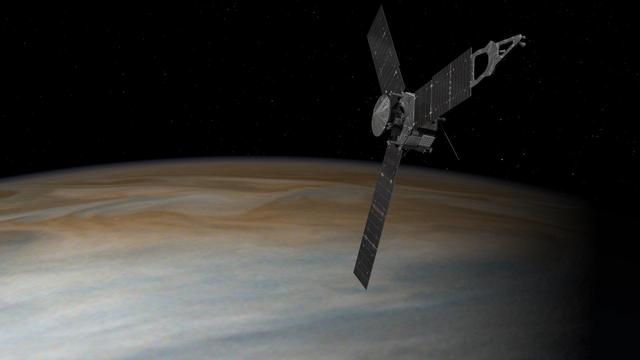
Mapping Jupiter's gravity, magnetic field and deep atmosphere from a polar orbit.
Images

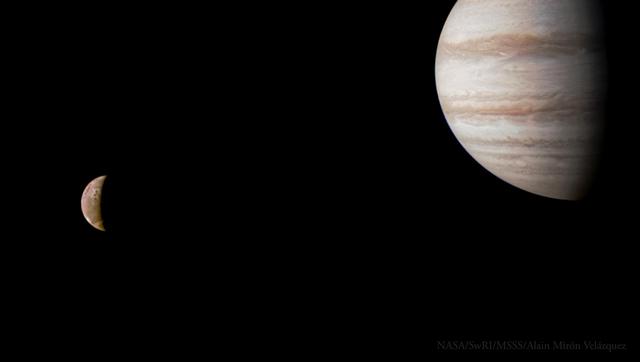

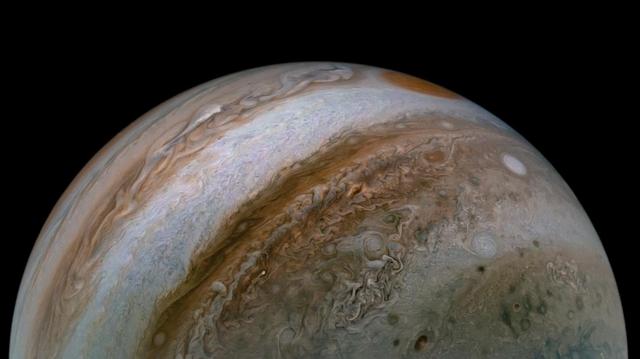
Images from open archives · credit shown per image