
Europa
Moon· orbits Jupiter
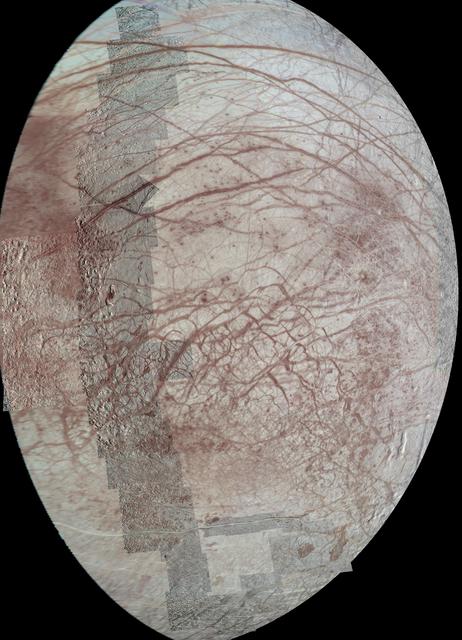
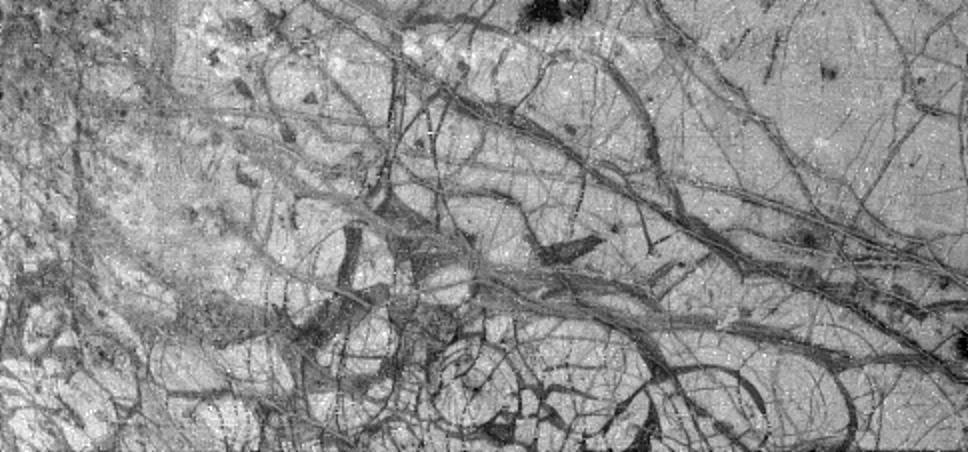
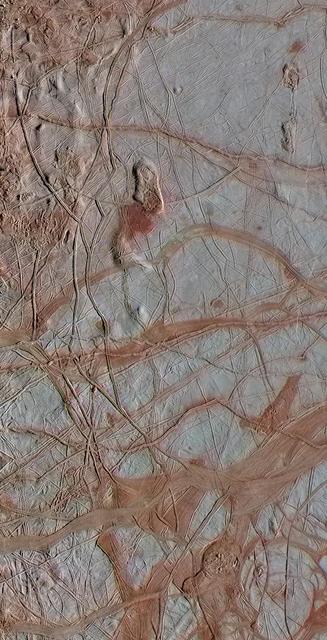
Europa is the smoothest Galilean moon — a cracked ice shell over a global saltwater ocean thought to hold more water than all of Earth's, making it a leading target in the search for life.
Open in 3D viewSee Europa in the live, interactive 3D map
Key facts
Mass
4.80 × 10²² kg
0.00804 M⊕
Radius
1,561 km
90% of our Moon's radius
Surface gravity
1.32 m/s²
13% of Earth's gravity
Day length
3.5 days
Orbit around Jupiter
3.53 Earth days
Science
Physical
- Mass
- 4.80 × 10²² kg · 0.00804 M⊕
- JPL / IAU mean radii; spacecraft-tracked GM where measured
- Radius
- 1,561 km · 90% of our Moon's radius
- JPL / IAU mean radii; spacecraft-tracked GM where measured
- Density
- 3,014 kg/m³ · 3× water
- Computed from mass and radius
- Surface gravity
- 1.32 m/s² · 13% of Earth's gravity
- Computed from mass and radius
- Escape velocity
- 2.03 km/s · 18% of Earth's escape velocity
- Computed from mass and radius
Orbit around Jupiter
- Distance from Jupiter
- 671,100 km
- From JPL orbital elements
- Orbital period
- 3.5 days
- From JPL orbital elements
- Eccentricity
- 0.009
- From JPL orbital elements
- Inclination to Jupiter's Laplace plane
- 0.50 °
- From JPL orbital elements · The Laplace plane is the one a moon's orbit precesses about: close in it is the planet's equatorial plane, the plane of the rings, and further out it tilts toward the planet's own orbit.
Rotation
- Rotation period
- 3.5 days
- Tidal locking
- Tidally locked to its parent
Temperature
- Minimum
- 50 K (-223 °C)
- Mean
- 102 K (-171 °C)
- Maximum
- 125 K (-148 °C)
Composition
- Bulk composition
- A water-ice crust over a probable global saltwater ocean, surrounding a silicate mantle and an iron core.
Radiation & temperature
- Insolation
- 0.0355 S⊕ · 4% of the sunlight Earth receives
- Computed from the distance to the Sun (inverse-square; Earth's sunlight = 1), before any atmosphere.
- Bond albedo
- 0.62 · reflects 62% of incoming sunlight
- Equilibrium temperature
- 95 K (-178 °C)
- Computed from albedo + distance from the Sun (airless black body)
- Measured mean temperature
- 102 K (-171 °C)
- Greenhouse warming
- +7 K
- Measured temperature minus the airless equilibrium — the greenhouse effect
Discovery & history
- Discovered
- January 8, 1610
- By
- Galileo Galilei
- Method
- Visual discovery (telescopic)
- Name
- Europa, a Phoenician princess courted by Zeus.
A Galilean moon discovered in January 1610. Beneath its cracked ice shell lies a global ocean — one of the most promising places to search for life.
Images



Images from open archives · credit shown per image