
New Horizons
New Horizons — flew past Pluto in 2015 and Arrokoth in 2019; now exploring the Kuiper belt.
Key facts
Mission & specifications
Mission
- Operator
- NASA
- Launched
- January 19, 2006
- Status
- Active
Trajectory
- Current speed
- 13.6 km/s
- Computed from the cached state vector
- Distance from the Sun
- 65.8 AU
- Computed from the cached position
- Distance from Earth
- 65.8 AU
- Computed from cached positions
Cost & funding
- Program cost
- $7.80 × 10⁸ USD
Mission
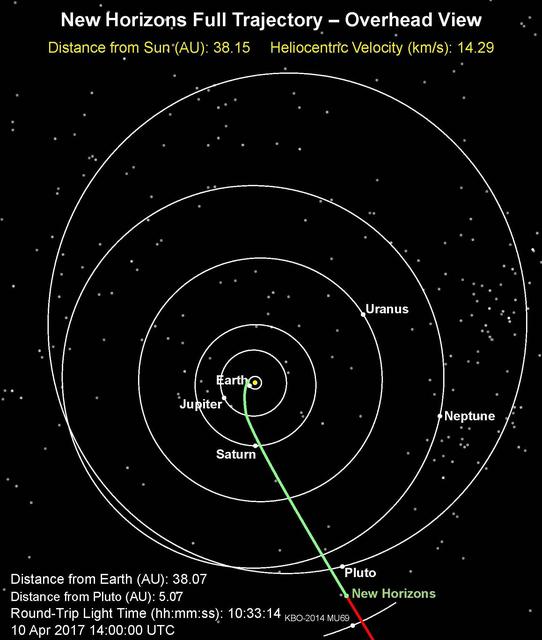
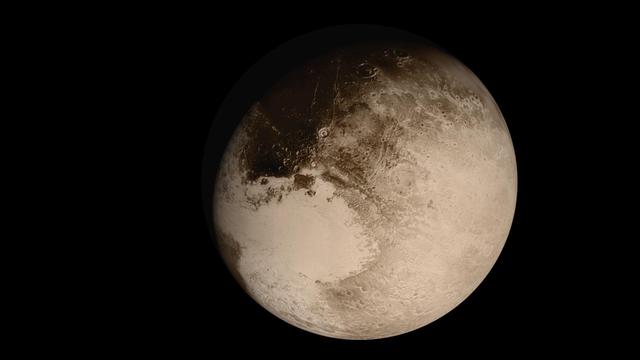
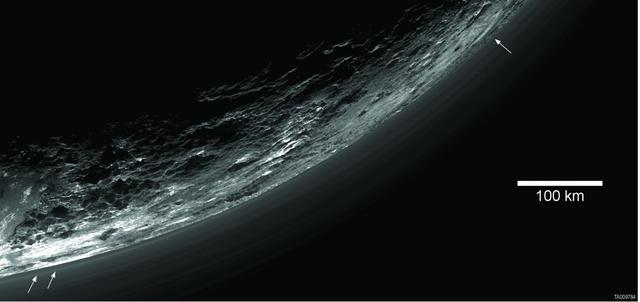
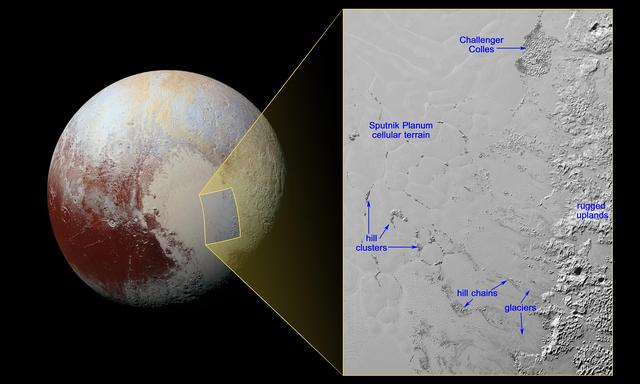
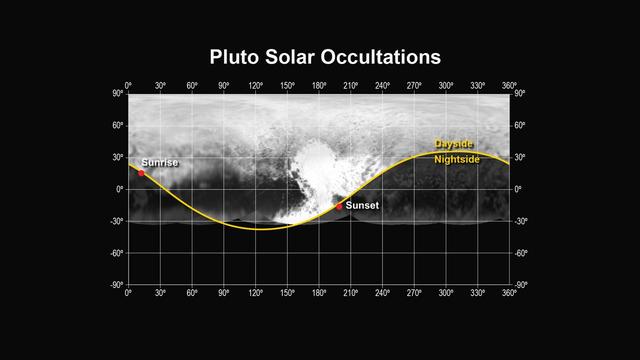
New Horizons gave humanity its first close look at Pluto, the last of the classical planets to be explored. Launched on 19 January 2006 as the fastest spacecraft ever sent from Earth, the piano-sized, nuclear-powered probe swung past Jupiter for a gravity boost in 2007 and then coasted for eight years across the Solar System. On 14 July 2015 it swept just 12,500 kilometres above Pluto, and the dim, distant speck resolved into a startlingly complex world: a vast plain of nitrogen ice shaped like a heart, mountains of water ice, a layered blue haze, and hints of an ocean buried beneath the frozen crust — overturning the assumption that so small and cold a body would be geologically dead. Its companion Charon proved just as dramatic, scarred by deep canyons and capped with a red polar stain. With its primary goal achieved, New Horizons pressed deeper into the Kuiper belt, and on 1 January 2019 flew past a tiny, pristine object now named Arrokoth — at the time the most distant world ever explored at close range. Arrokoth turned out to be a gently joined pair of lobes, a 'snowman' frozen since the Solar System's birth, offering a rare glimpse of how the first planetary building blocks came together. Now well beyond fifty times the Earth–Sun distance and still healthy, New Horizons is one of only five craft on a path out of the Solar System. It continues to study the outer heliosphere, measure the faint glow of the distant universe, and search the dark for one more Kuiper-belt target.
- 2006The fastest launch yetLaunch
An Atlas V sends New Horizons toward Pluto at the highest Earth-departure speed ever recorded.
A swing past Jupiter boosts the probe's speed and trims years from the journey.
The first spacecraft to reach Pluto reveals nitrogen-ice plains, water-ice mountains and a hazy atmosphere.
New Horizons explores the most distant object ever visited, a pristine Kuiper-belt 'snowman'.
- 202150 astronomical units from the SunMilestone
The probe passes fifty times the Earth–Sun distance, deep in the Kuiper belt and still healthy.
- 2023Extended for outer-heliosphere scienceMilestone
With the planets behind it, the mission is extended to study the solar wind's edge and the faint glow of the distant universe.
Images



Images from open archives · credit shown per image