
Pluto
Pluto is a dwarf planet in the Kuiper belt — a world of nitrogen ice plains, water-ice mountains and a thin atmosphere, explored up close by New Horizons in 2015.
Key facts
Science
Physical
- Mass
- 1.30 × 10²² kg · 0.177 Moon masses
- Radius
- 1,188 km · 19% of Earth's radius
- Density
- 1,854 kg/m³ · 1.9× water
- Computed from mass and radius
- Surface gravity
- 0.616 m/s² · 6% of Earth's gravity
- Computed from mass and radius
- Escape velocity
- 1.21 km/s · 11% of Earth's escape velocity
- Computed from mass and radius
- Axial tilt
- 122.53 °
Orbital
- Distance from the Sun
- 35.6 AU
- Computed from the position at the selected time
- Semi-major axis
- 39.2 AU
- Computed from the cached state vector
- Eccentricity
- 0.249
- Computed from the cached state vector
- Inclination
- 23.47 °
- Computed from the cached state vector
- Orbital period
- 245.26 years
- Computed from the cached state vector
- Perihelion
- 29.4 AU
- Computed from the orbital elements
- Aphelion
- 48.9 AU
- Computed from the orbital elements
- Mean orbital velocity
- 4.76 km/s
- Computed from the orbital elements
Rotation
- Rotation period
- 6.4 days
Atmosphere
- Composition
- N₂ with CH₄ and CO
- Surface pressure
- 1 Pa
Temperature
- Minimum
- 33 K (-240 °C)
- Mean
- 44 K (-229 °C)
- Maximum
- 55 K (-218 °C)
Composition
- Bulk composition
- Rock and water-ice interior; nitrogen-ice surface
Radiation & temperature
- Insolation
- 0.000651 S⊕ · 1/1,535 of the sunlight Earth receives
- Computed from the distance to the Sun (inverse-square; Earth's sunlight = 1), before any atmosphere.
- Bond albedo
- 0.72 · reflects 72% of incoming sunlight
- Equilibrium temperature
- 32 K (-241 °C)
- Computed from albedo + distance from the Sun (airless black body)
- Measured mean temperature
- 44 K (-229 °C)
- Greenhouse warming
- +12 K
- Measured temperature minus the airless equilibrium — the greenhouse effect
Discovery & history
- Discovered
- February 18, 1930
- By
- Clyde Tombaugh
- Method
- Photographic plates
- Name
- The Roman god of the underworld — suggested by 11-year-old Venetia Burney. Its initials, PL, also honour Percival Lowell.
Pluto was found by 24-year-old Clyde Tombaugh at the Lowell Observatory, who painstakingly compared photographic plates with a blink comparator until, on 18 February 1930, a faint dot shifted between exposures. Hailed as the ninth planet, Pluto turned out to be tiny — and the first of many icy worlds in the Kuiper belt. The 2005 discovery of the more massive Eris led the IAU to reclassify Pluto as a 'dwarf planet' in 2006. New Horizons revealed its true face in 2015.
First and only spacecraft to visit Pluto, revealing nitrogen-ice plains and water-ice mountains.
Images


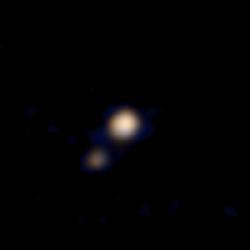

Images from open archives · credit shown per image