
Nix
Moon· orbits Pluto
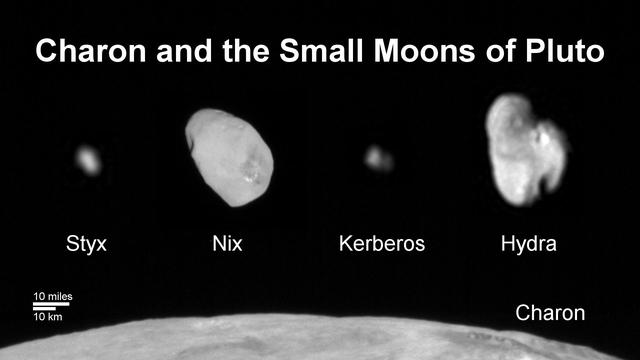
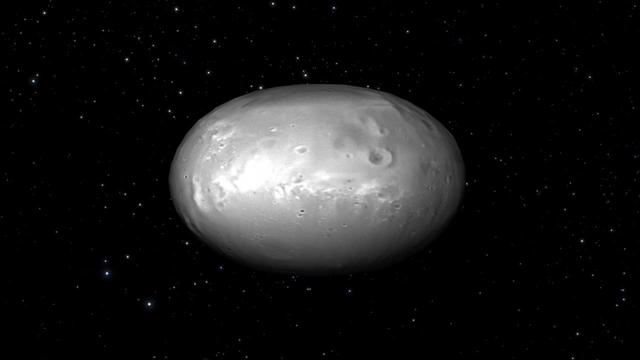
Nix is a small, elongated moon of Pluto with a bright water-ice surface and a chaotic, tumbling rotation, discovered in 2005.
Open in 3D viewSee Nix in the live, interactive 3D map
Key facts
Mass (est.)
2.25 × 10¹⁶ kg
0.000000306 Moon masses
Radius
18 km
1% of our Moon's radius
Surface gravity
0.00463 m/s²
0% of Earth's gravity
Orbit around Pluto
24.85 Earth days
Science
Physical
- Mass (estimated)
- 2.25 × 10¹⁶ kg · 0.000000306 Moon masses
- Estimated: the implied density (~0.9 g/cm3) is a standard assumed value, so the mass is effectively size-and-density based, not weighed. Source: JPL SSD Planetary Satellite Physical Parameters (GM PLU060).
- Radius
- 18 km · 1% of our Moon's radius
- JPL SSD Planetary Satellite Physical Parameters (mean radius)
- Surface gravity
- 0.00463 m/s² · 0% of Earth's gravity
- Estimated from the estimated mass and radius
- Escape velocity
- 12.9 m/s · 0% of Earth's escape velocity
- Estimated from the estimated mass and radius
Orbit around Pluto
- Distance from Pluto
- 49,300 km
- From JPL orbital elements
- Orbital period
- 24.9 days
- From JPL orbital elements
- Eccentricity
- 0.015
- From JPL orbital elements
- Inclination to the J2000 equator
- 0.00 °
- From JPL orbital elements
Rotation
- Rotation
- Chaotic — Nix tumbles unpredictably, its spin constantly reshuffled by the shifting pull of the Pluto–Charon binary, with no fixed period (Showalter & Hamilton 2015). Not tidally locked.
Composition
- Bulk composition
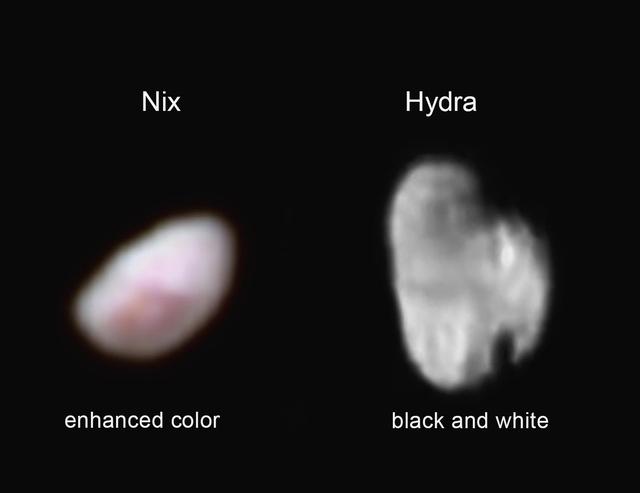
- A predominantly water-ice surface; small and irregular, with a reddish patch.
Radiation & temperature
- Insolation
- 0.000788 S⊕ · 1/1,269 of the sunlight Earth receives
- Computed from the distance to the Sun (inverse-square; Earth's sunlight = 1), before any atmosphere.
- Geometric albedo
- 0.56
- Geometric (V-band) albedo (New Horizons); data limited.
- Equilibrium temperature
- 38 K (-235 °C)
- Computed from albedo + distance from the Sun (airless black body); uses the geometric albedo as an estimate
Discovery & history
- By
- the Hubble Space Telescope Pluto Companion Search Team (Hal Weaver, Alan Stern and colleagues)
- Method
- Photographic plates
- Name
- Nyx, the Greek goddess of night and mother of Charon; the initials N and H also honour the New Horizons mission.
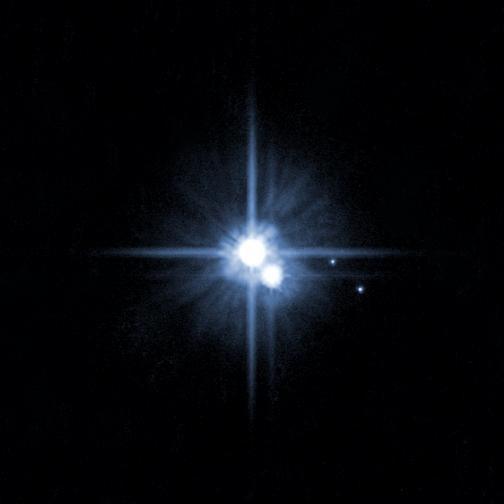
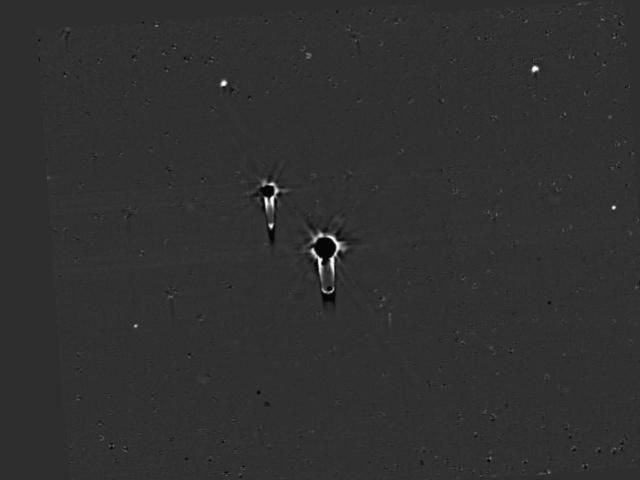
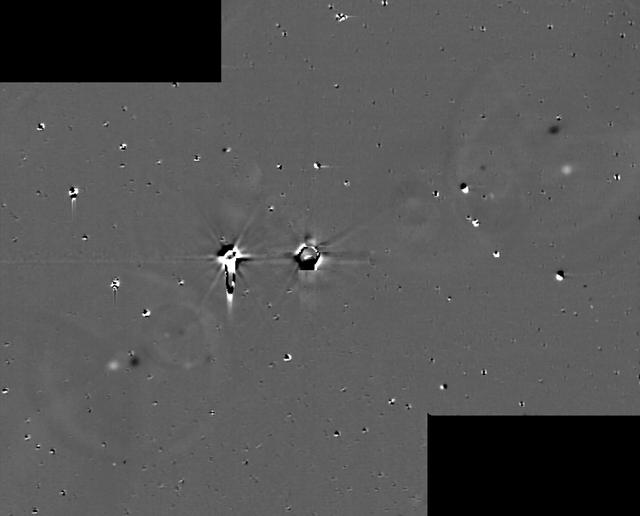
Nix was discovered, with Hydra, in Hubble Space Telescope images taken in May 2005 during a search for moons around Pluto ahead of the New Horizons flyby. A small, elongated moon, it tumbles unpredictably through the shifting gravity of the Pluto–Charon binary, and a reddish patch hints at a history unlike its icy surface. Beyond its discovery and the 2015 flyby, little detail is known.
Images

Images from open archives · credit shown per image