
Juno
Juno — polar Jupiter orbiter probing the planet's interior and magnetosphere.
Key facts
Mission & specifications
Mission
- Operator
- NASA
- Launched
- August 5, 2011
- Status
- Active
Trajectory
- Speed rel. Jupiter
- 4.31 km/s
- Computed from the cached state vector, relative to Jupiter
- Distance from the Sun
- 5.31 AU
- Computed from the cached position
- Distance from Earth
- 5.68 AU
- Computed from cached positions
- Distance from Jupiter
- 4,779,131 km
- Computed from cached positions
Cost & funding
- Program cost
- $1.13 × 10⁹ USD
Mission
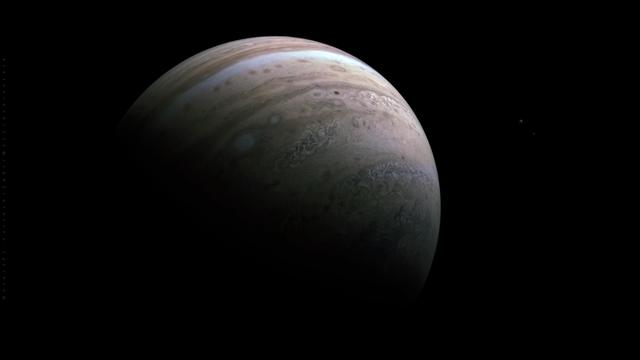
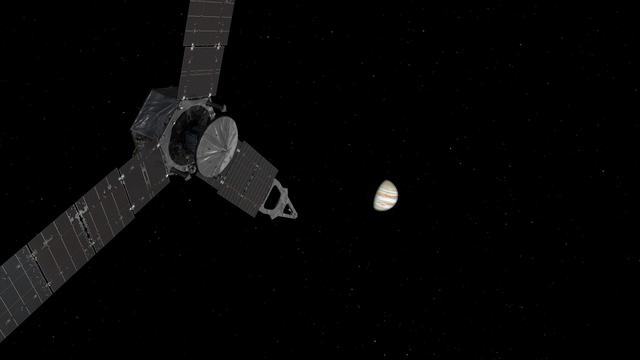
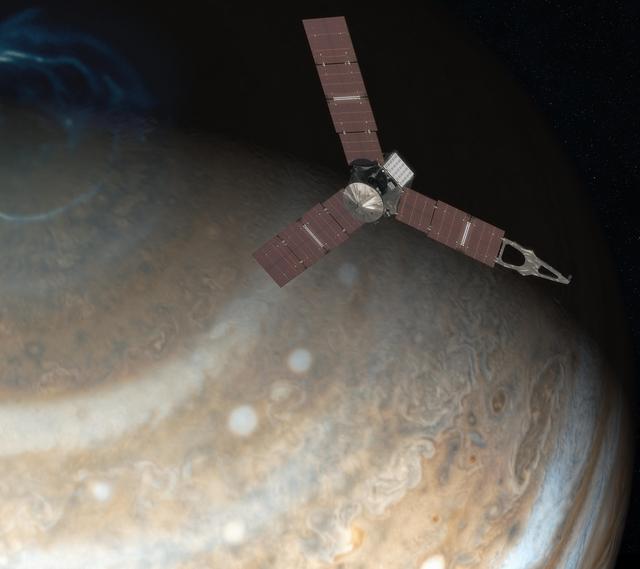
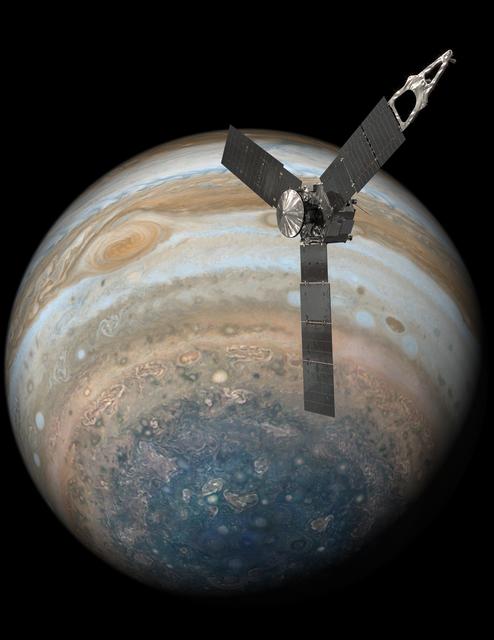
Juno is NASA's mission to look beneath the clouds of Jupiter and read the story of how the Solar System's largest planet — and the Sun's whole family of worlds — came to be. Launched on 5 August 2011, it arrived on 4 July 2016 and slipped into a long, looping polar orbit, swinging close over the cloud tops every few weeks and then retreating far out to escape the planet's punishing radiation belts. Remarkably, it does all this on solar power, its three great panels making it the most distant solar-powered spacecraft ever flown. From its unique vantage over the poles, Juno has transformed our picture of the giant: it found that Jupiter's banded weather reaches thousands of kilometres deep, that its core is not a compact ball but a vast, 'fuzzy' region diluted through the interior, and that its magnetic field is stronger and more lopsided than anyone expected. Its most arresting discovery is at the poles themselves, where clusters of cyclones the size of continents are locked into geometric patterns — eight ringing the north, five the south — unlike anything seen on Earth. Having mapped the planet, Juno's extended mission turned it into a tour of the Jovian system: a close pass of Ganymede in 2021, the first in a generation; a flyby of ocean-bearing Europa in 2022 that scouted ahead of the dedicated missions now en route; and a series of daring approaches to Io through 2023 and 2024, imaging the most volcanic body in the Solar System from as close as 1,500 kilometres. Juno still circles Jupiter, deepening a portrait of the planet that grows richer with every orbit.
- 2011Launch toward JupiterLaunch
An Atlas V sends the solar-powered Juno on a five-year cruise to the giant planet.
A flyby of home gives Juno the final speed boost toward Jupiter.
Juno fires its engine into a looping polar orbit, beginning its survey beneath the clouds.
The polar orbit reveals clusters of continent-sized cyclones locked into geometric patterns, unlike anything on Earth.
Juno makes the first close pass of the Solar System's largest moon in over twenty years.
A close pass of ocean-bearing Europa returns detailed images of its fractured ice, scouting for missions to come.
The first of two daring approaches, with a second in February 2024, maps the most volcanic world in the Solar System.
Images


Images from open archives · credit shown per image