
Galileo
Galileo — first spacecraft to orbit Jupiter (1995–2003), studying the giant planet and its Galilean moons; ended with a planned plunge into Jupiter.
Key facts
Mission & specifications
Mission
- Operator
- NASA
- Launched
- October 18, 1989
- Status
- Completed
Trajectory
- Speed rel. Jupiter
- 5.72 km/s
- Computed from the cached state vector, relative to Jupiter
- Distance from the Sun
- 5.27 AU
- Computed from the cached position
- Distance from Earth
- 5.64 AU
- Computed from cached positions
- Distance from Jupiter
- 6,688,497 km
- Computed from cached positions
Cost & funding
- Program cost
- $1.60 × 10⁹ USD
Mission
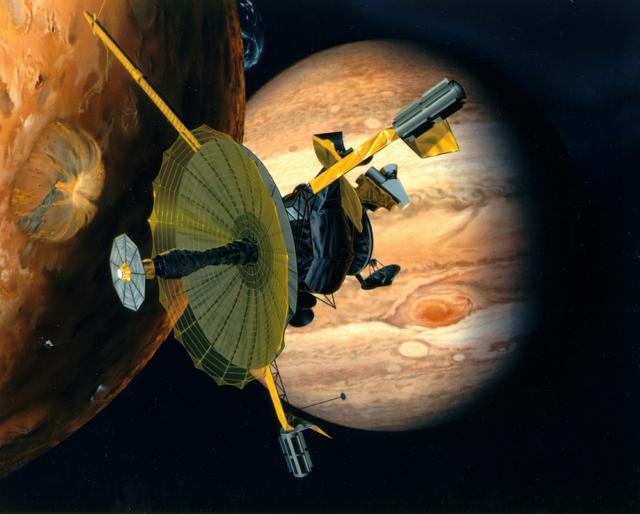
Galileo was the first spacecraft to orbit Jupiter, and it transformed the giant planet and its moons from points of light into worlds. Released from the Space Shuttle Atlantis on 18 October 1989, it took a roundabout, six-year path to Jupiter, using gravity assists from Venus and Earth to build up speed. Along the way it made the first close flybys of asteroids, and at the asteroid Ida in 1993 it discovered Dactyl, the first moon ever found orbiting an asteroid. In 1994 it had a unique vantage point to watch the fragments of comet Shoemaker-Levy 9 slam into Jupiter. Galileo suffered a serious setback when its main antenna failed to unfurl, forcing engineers to squeeze the entire mission's data through a much smaller backup antenna using clever compression. It still delivered. On arrival in December 1995, it dropped a probe that plunged into Jupiter's atmosphere — the first ever to sample the air of a giant planet directly — while the main craft settled into orbit. Over nearly eight years and dozens of loops through the Jovian system, Galileo returned evidence that a salty ocean lies beneath the icy crust of Europa, watched the volcanoes of Io erupt, and discovered a magnetic field around Ganymede. To ensure it could never crash into and contaminate the potentially habitable Europa, controllers deliberately steered Galileo into Jupiter on 21 September 2003, ending the mission in the planet it had come to know.
- 1989Deployed from Shuttle AtlantisLaunch
Released in Earth orbit, then boosted on a six-year, gravity-assisted path to Jupiter.
The first asteroid a spacecraft ever visited, and the first close-up pictures of one.
At asteroid Ida it discovers Dactyl, the first known moon orbiting an asteroid.
Uniquely placed to watch the fragments of comet Shoemaker-Levy 9 strike Jupiter.
Enters orbit and drops a probe — the first to sample the atmosphere of a giant planet.
Magnetic measurements point to a salty ocean hidden under Europa's icy crust.
Steered into the planet to ensure it can never contaminate Europa.
Images




Images from open archives · credit shown per image