
Phoebe
Moon· orbits Saturn
Phoebe is a dark, irregular outer moon of Saturn on a retrograde orbit — most likely a captured Kuiper-belt object or centaur rather than a body that formed at Saturn.
Open in 3D viewSee Phoebe in the live, interactive 3D map
Key facts
Mass
8.29 × 10¹⁸ kg
0.000113 Moon masses
Radius
106 km
6% of our Moon's radius
Surface gravity
0.0488 m/s²
0% of Earth's gravity
Day length
9.27 hours
Orbit around Saturn
550 Earth days
1.51 Earth years
Science
Physical
- Mass
- 8.29 × 10¹⁸ kg · 0.000113 Moon masses
- JPL / IAU mean radii; spacecraft-tracked GM where measured
- Radius
- 106 km · 6% of our Moon's radius
- JPL / IAU mean radii; spacecraft-tracked GM where measured
- Density
- 1,639 kg/m³ · 1.6× water
- Computed from mass and radius
- Surface gravity
- 0.0488 m/s² · 0% of Earth's gravity
- Computed from mass and radius
- Escape velocity
- 102 m/s · 1% of Earth's escape velocity
- Computed from mass and radius
Orbit around Saturn
- Distance from Saturn
- 12,929,400 km
- From JPL orbital elements
- Orbital period
- 550.3 days
- From JPL orbital elements
- Eccentricity
- 0.164
- From JPL orbital elements
- Inclination to Saturn's Laplace plane
- 175.20 °
- From JPL orbital elements · The Laplace plane is the one a moon's orbit precesses about: close in it is the planet's equatorial plane, the plane of the rings, and further out it tilts toward the planet's own orbit.
Rotation
- Rotation period
- 9.27 hours
- Rotation
- Spins once every ~9.3 hours — NOT tidally locked, unlike Saturn's regular moons (Cassini). Its short spin is unrelated to its ~1.5-year retrograde orbit.
Temperature
- Mean
- 110 K (-163 °C)
Composition
- Bulk composition
- A dark mix of water ice, rock and carbon-rich material, resembling an outer Solar System body.
Radiation & temperature
- Insolation
- 0.0112 S⊕ · 1% of the sunlight Earth receives
- Computed from the distance to the Sun (inverse-square; Earth's sunlight = 1), before any atmosphere.
- Geometric albedo
- 0.06
- Geometric (V-band) albedo — a dark surface; Bond albedo not directly measured.
- Equilibrium temperature
- 89 K (-184 °C)
- Computed from albedo + distance from the Sun (airless black body); uses the geometric albedo as an estimate
- Measured mean temperature
- 110 K (-163 °C)
- Greenhouse warming
- +21 K
- Measured temperature minus the airless equilibrium — the greenhouse effect
Discovery & history
- By
- William Henry Pickering
- Method
- Photographic plates
- Name
- Phoebe, a Titaness of Greek myth.
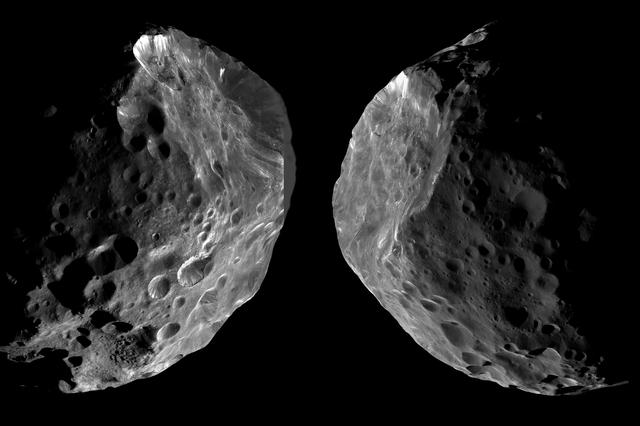
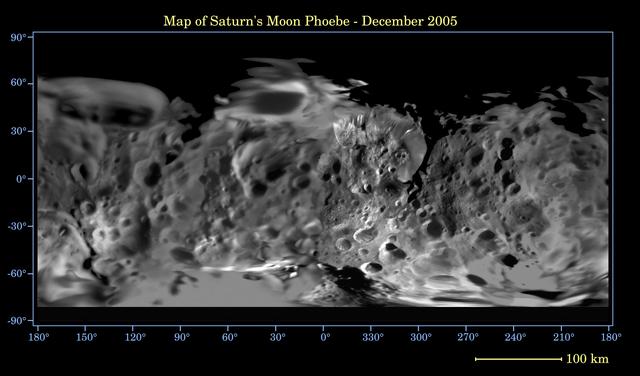
Phoebe was the first moon discovered photographically, found by William Pickering in 1899 on plates from Harvard's southern station. It circles Saturn backwards, far out and steeply tilted — a captured visitor from the outer Solar System that Cassini revealed as a battered, primitive body.
Images

Images from open archives · credit shown per image