
Deimos
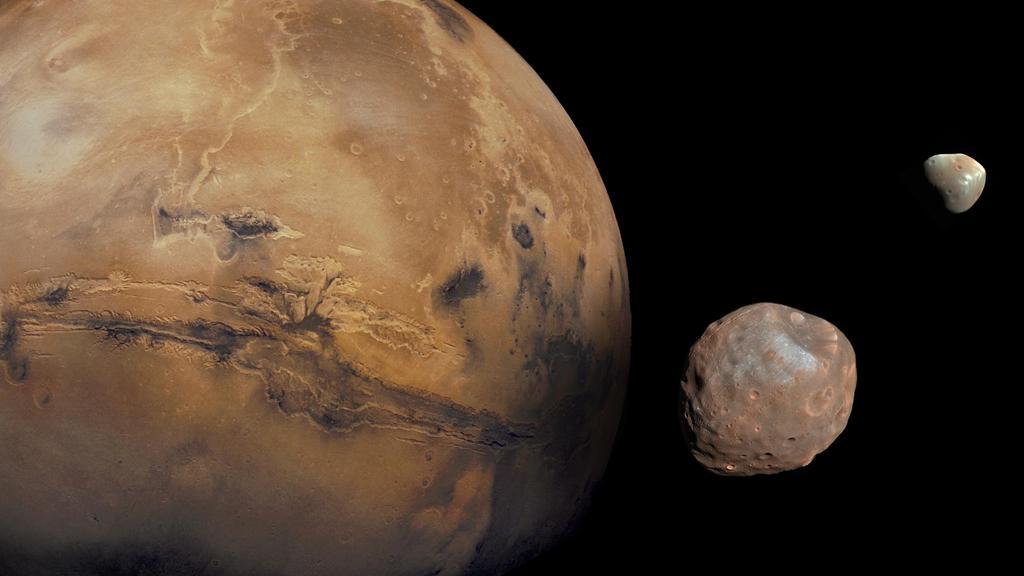
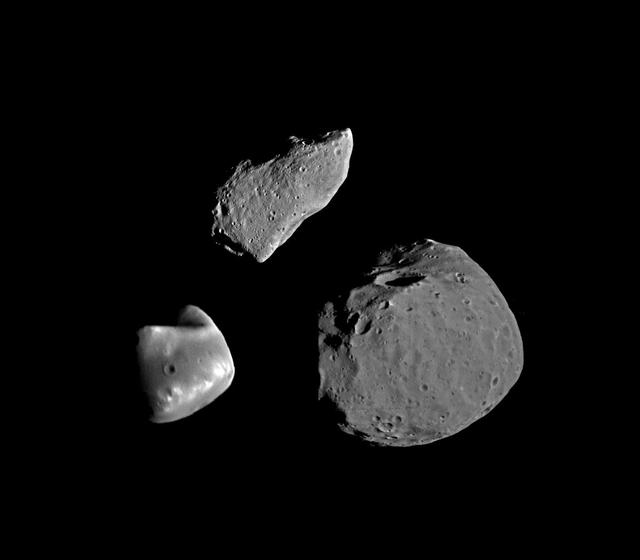
Deimos is the smaller, outer moon of Mars — a tiny body whose craters are partly buried under a blanket of fine regolith, giving it a smooth look. One 2026 modelling study (Raducan et al., Nature Astronomy) proposes that a single oblique impact — a ~320 m asteroid striking at about 45°, whose debris resurfaced the moon without breaking it up — gave Deimos both that smoothness and its lopsided shape with the big southern depression; the authors say other explanations remain possible, and JAXA's MMX mission can test the prediction.
Key facts
Science
Physical
- Mass
- 1.48 × 10¹⁵ kg · 0.0000000201 Moon masses
- JPL / IAU mean radii; spacecraft-tracked GM where measured
- Radius
- 6.2 km
- JPL / IAU mean radii; spacecraft-tracked GM where measured
- Density
- 1,479 kg/m³ · 1.5× water
- Computed from mass and radius
- Surface gravity
- 0.00256 m/s² · 0% of Earth's gravity
- Computed from mass and radius
- Escape velocity
- 5.64 m/s · 0% of Earth's escape velocity
- Computed from mass and radius
Orbit around Mars
- Distance from Mars
- 23,457 km
- From JPL orbital elements
- Orbital period
- 30.30 hours
- From JPL orbital elements
- Eccentricity
- 0
- From JPL orbital elements
- Inclination to Mars's Laplace plane
- 1.80 °
- From JPL orbital elements · The Laplace plane is the one a moon's orbit precesses about: close in it is the planet's equatorial plane, the plane of the rings, and further out it tilts toward the planet's own orbit.
Rotation
- Rotation period
- 30.30 hours
- Tidal locking
- Tidally locked to its parent
Temperature
- Mean
- 233 K (-40 °C)
Composition
- Bulk composition
- Dark, carbonaceous-chondrite-like rock, like Phobos; a small, porous body.
Radiation & temperature
- Insolation
- 0.404 S⊕ · 40% of the sunlight Earth receives
- Computed from the distance to the Sun (inverse-square; Earth's sunlight = 1), before any atmosphere.
- Geometric albedo
- 0.07
- Geometric (V-band) albedo — a very dark surface.
- Equilibrium temperature
- 218 K (-55 °C)
- Computed from albedo + distance from the Sun (airless black body); uses the geometric albedo as an estimate
- Measured mean temperature
- 233 K (-40 °C)
- Greenhouse warming
- +15 K
- Measured temperature minus the airless equilibrium — the greenhouse effect
Discovery & history
- Discovered
- August 12, 1877
- By
- Asaph Hall
- Method
- Visual discovery (telescopic)
- Name
- Deimos ('dread'), a son of the war-god Ares (Mars) in Greek myth.
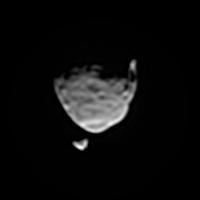
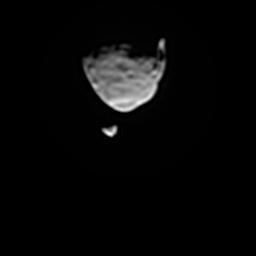
Deimos is the smaller, outer moon of Mars, spotted by Asaph Hall on 12 August 1877, days before he found Phobos. Barely 12 km across, it is a dark, cratered lump — likely a captured asteroid — with gravity so weak you could almost throw a stone off it into space.
Images

Images from open archives · credit shown per image