
Phobos
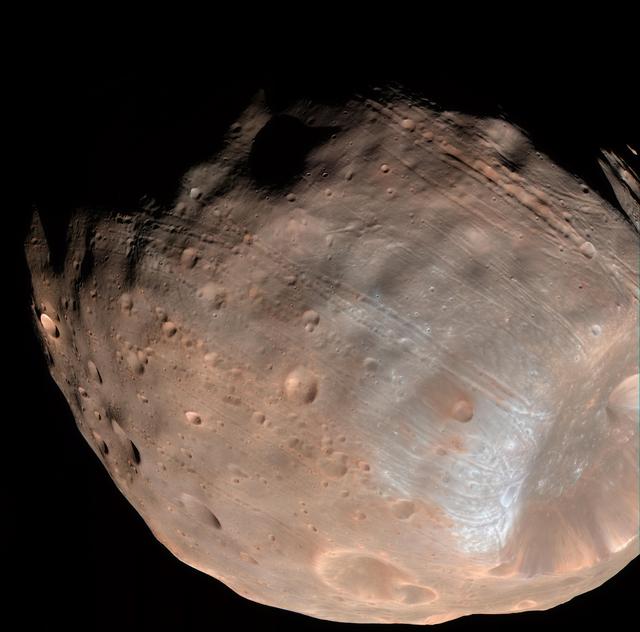
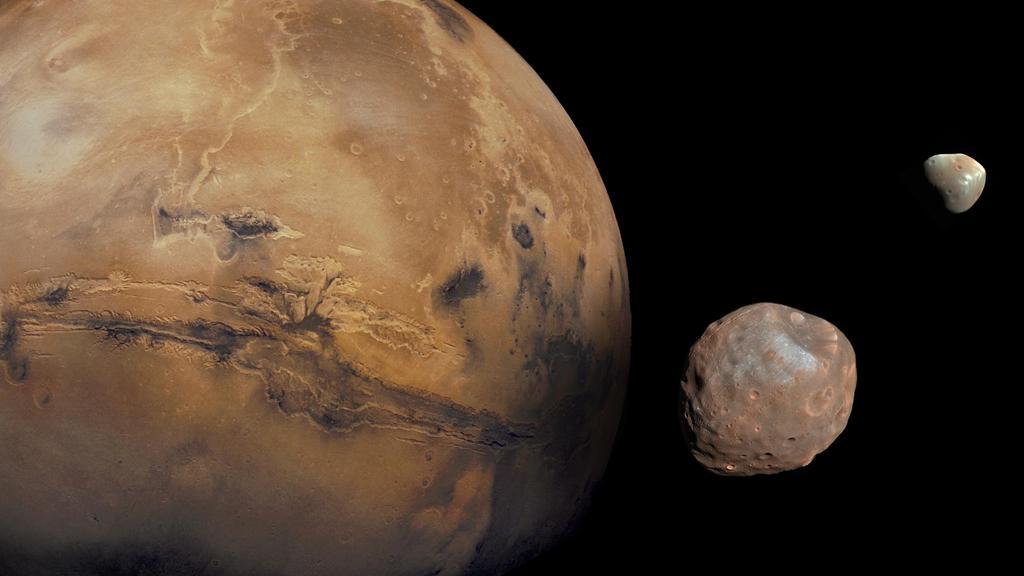
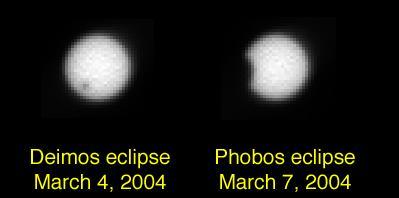
Phobos is the larger, inner moon of Mars, orbiting so low and fast that it crosses the Martian sky twice a day and is slowly spiralling inward toward eventual breakup. Because it rides so low and quick, from the Martian surface Phobos is regularly seen passing directly in front of the Sun — a transit, or partial solar eclipse, that rovers such as Perseverance have photographed (the moon is too small to hide the Sun completely).
Key facts
Science
Physical
- Mass
- 1.07 × 10¹⁶ kg · 0.000000145 Moon masses
- JPL / IAU mean radii; spacecraft-tracked GM where measured
- Radius
- 11.1 km · 1% of our Moon's radius
- JPL SSD Planetary Satellite Physical Parameters (mean radius)
- Density
- 1,871 kg/m³ · 1.9× water
- Computed from mass and radius
- Surface gravity
- 0.00579 m/s² · 0% of Earth's gravity
- Computed from mass and radius
- Escape velocity
- 11.3 m/s · 0% of Earth's escape velocity
- Computed from mass and radius
Orbit around Mars
- Distance from Mars
- 9,375 km
- From JPL orbital elements
- Orbital period
- 7.65 hours
- From JPL orbital elements
- Eccentricity
- 0.015
- From JPL orbital elements
- Inclination to Mars's Laplace plane
- 1.10 °
- From JPL orbital elements · The Laplace plane is the one a moon's orbit precesses about: close in it is the planet's equatorial plane, the plane of the rings, and further out it tilts toward the planet's own orbit.
Rotation
- Rotation period
- 7.65 hours
- Tidal locking
- Tidally locked to its parent
Temperature
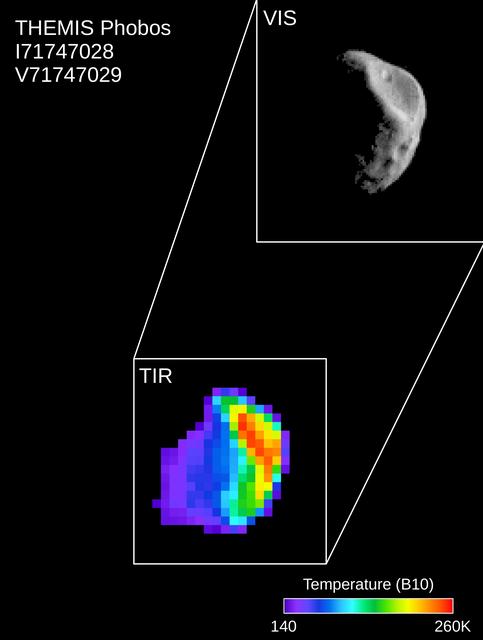
- Mean
- 233 K (-40 °C)
Composition
- Bulk composition
- Dark, carbonaceous-chondrite-like rock with a porous, possibly rubble-pile interior. Its bluer terrain shows a faint absorption band, confirmed in 2026 from Mars Express and ExoMars TGO data, that suggests iron-bearing (mafic) silicates. Its origin (captured asteroid vs. re-accreted debris) is still debated.
Radiation & temperature
- Insolation
- 0.404 S⊕ · 40% of the sunlight Earth receives
- Computed from the distance to the Sun (inverse-square; Earth's sunlight = 1), before any atmosphere.
- Geometric albedo
- 0.07
- Geometric (V-band) albedo — a very dark surface.
- Equilibrium temperature
- 218 K (-55 °C)
- Computed from albedo + distance from the Sun (airless black body); uses the geometric albedo as an estimate
- Measured mean temperature
- 233 K (-40 °C)
- Greenhouse warming
- +15 K
- Measured temperature minus the airless equilibrium — the greenhouse effect
Discovery & history
- Discovered
- August 18, 1877
- By
- Asaph Hall
- Method
- Visual discovery (telescopic)
- Name
- Phobos ('fear'), a son of the war-god Ares (Mars) in Greek myth.
Asaph Hall found both of Mars's tiny moons over a few nights in August 1877. Phobos, the larger, inner moon, orbits so close that it crosses the Martian sky three times a day and is slowly spiralling inward — in tens of millions of years it will break apart into a ring or strike the planet.
Photographed Phobos from as close as 191 km, covering about 80% of its surface.
Images




Images from open archives · credit shown per image