
Kepler Space Telescope
Kepler — discovered thousands of exoplanets (2009–2018) by watching for transits, from an Earth-trailing orbit.
Key facts
Mission & specifications
Mission
- Operator
- NASA
- Launched
- March 7, 2009
- Status
- Completed
Trajectory
- Current speed
- 28.5 km/s
- Computed from the cached state vector
- Distance from the Sun
- 1.05 AU
- Computed from the cached position
- Distance from Earth
- 1.78 AU
- Computed from cached positions
- Distance from Mercury
- 0.917 AU
- Computed from cached positions
Mission
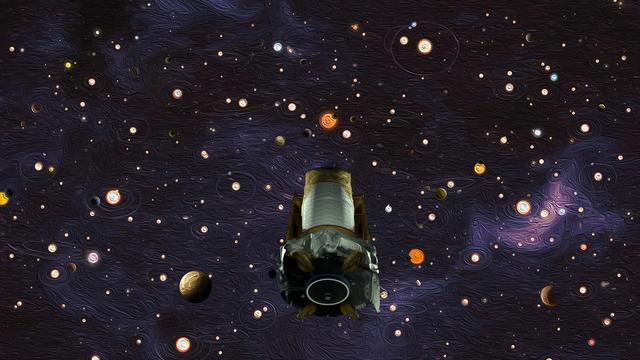
Kepler transformed our understanding of the galaxy by answering a simple question: how common are planets? Launched on 7 March 2009, the space telescope stared continuously at a single patch of sky containing about 150,000 stars, measuring their brightness with exquisite precision and watching for the tiny, repeating dip that occurs when a planet crosses in front of its star. Over its mission it confirmed more than 2,600 exoplanets — over half of all those known at the time — and revealed that planets outnumber stars in our galaxy, that small rocky worlds are abundant, and that many stars host planets in the 'habitable zone' where liquid water could exist. Among its finds were Kepler-22b, the first confirmed planet in a star's habitable zone, and a planet orbiting two suns at once. In 2013 the second of its four stabilising reaction wheels failed, robbing it of precise pointing and ending the original mission, but engineers cleverly revived it as 'K2', using the gentle pressure of sunlight to help steady the craft for four more years. Kepler finally ran out of fuel and was retired on 30 October 2018, having shown that the galaxy is full of worlds.
- 2009Launch toward a single patch of skyLaunch
Sets out to stare at ~150,000 stars and measure how common planets are.
- 2010First exoplanets announcedMilestone
Reports its first new worlds, beginning a flood of discoveries.
- 2011A planet in the habitable zoneMilestone
Confirms Kepler-22b, the first planet found orbiting in a star's habitable zone.
- 2013A reaction wheel failsMilestone
The loss of a second stabilising wheel ends the original fixed-stare mission.
- 2014Reborn as the K2 missionMilestone
Engineers use the pressure of sunlight to steady the craft for four more years of work.
- 2018Out of fuelMission end
Retired after revealing that planets outnumber stars in the galaxy.
Images

Images from open archives · credit shown per image