
Mariner 2
Mariner 2 — the first spacecraft to successfully fly by another planet, reaching Venus on 1962-12-14.
Key facts
Mission & specifications
Mission
- Operator
- NASA
- Launched
- August 27, 1962
- Status
- Completed
Trajectory
- Current speed
- 5.15 km/s
- Computed from the cached state vector
- Distance from the Sun
- 0.695 AU
- Computed from the cached position
- Distance from Earth
- 0.414 AU
- Computed from cached positions
- Distance from Venus
- 0.191 AU
- Computed from cached positions
Mission
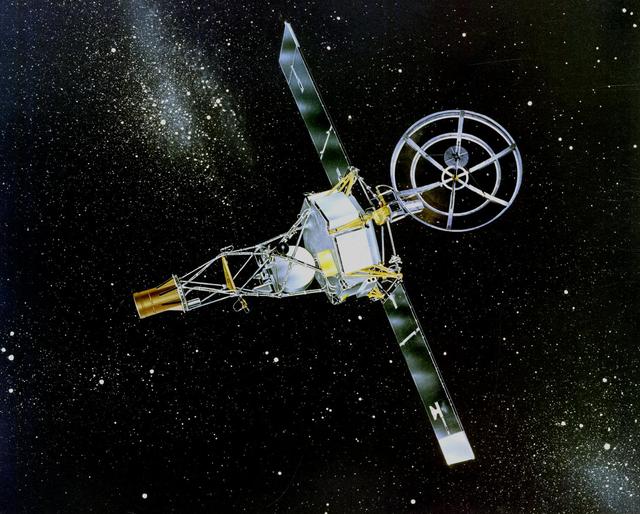
Mariner 2 was the first spacecraft to successfully reach another planet, and the mission that opened interplanetary exploration. It was a hurried backup: its twin, Mariner 1, had been destroyed by a range-safety officer moments after launch in July 1962 when a guidance fault sent it off course. Just weeks later, on 27 August 1962, Mariner 2 rose on an Atlas-Agena rocket and set off on a three-and-a-half-month cruise to Venus. The journey was harrowing — the spacecraft suffered power losses, overheating and a temporary loss of attitude control — but it survived. On 14 December 1962 it swept past Venus at about 34,800 kilometres, scanning the planet with infrared and microwave radiometers. The results ended centuries of speculation about a possibly temperate, cloud-covered world: Venus was extraordinarily hot, with surface temperatures around 460 °C, the same searing heat on its day and night sides, and unbroken clouds. Mariner 2 detected no magnetic field, and refined the mass of Venus and the length of the astronomical unit. During its cruise it also made the first sustained measurements of the solar wind, confirming that charged particles stream continuously from the Sun. Contact was lost on 3 January 1963, but Mariner 2 had proven that humans could navigate the gulf between the planets.
- 1962Launch as Mariner 1's backupLaunch
An Atlas-Agena lifts off weeks after Mariner 1 was destroyed by a launch fault.
First spacecraft to fly past another planet, scanning Venus with infrared and microwave radiometers.
- 1962A scorching Venus revealedMilestone
Finds surface temperatures around 460 °C and no magnetic field — ending hopes of a temperate Venus.
- 1963Contact lostMission end
Falls silent after returning the first sustained measurements of the solar wind in deep space.
Images
Images from open archives · credit shown per image