S2
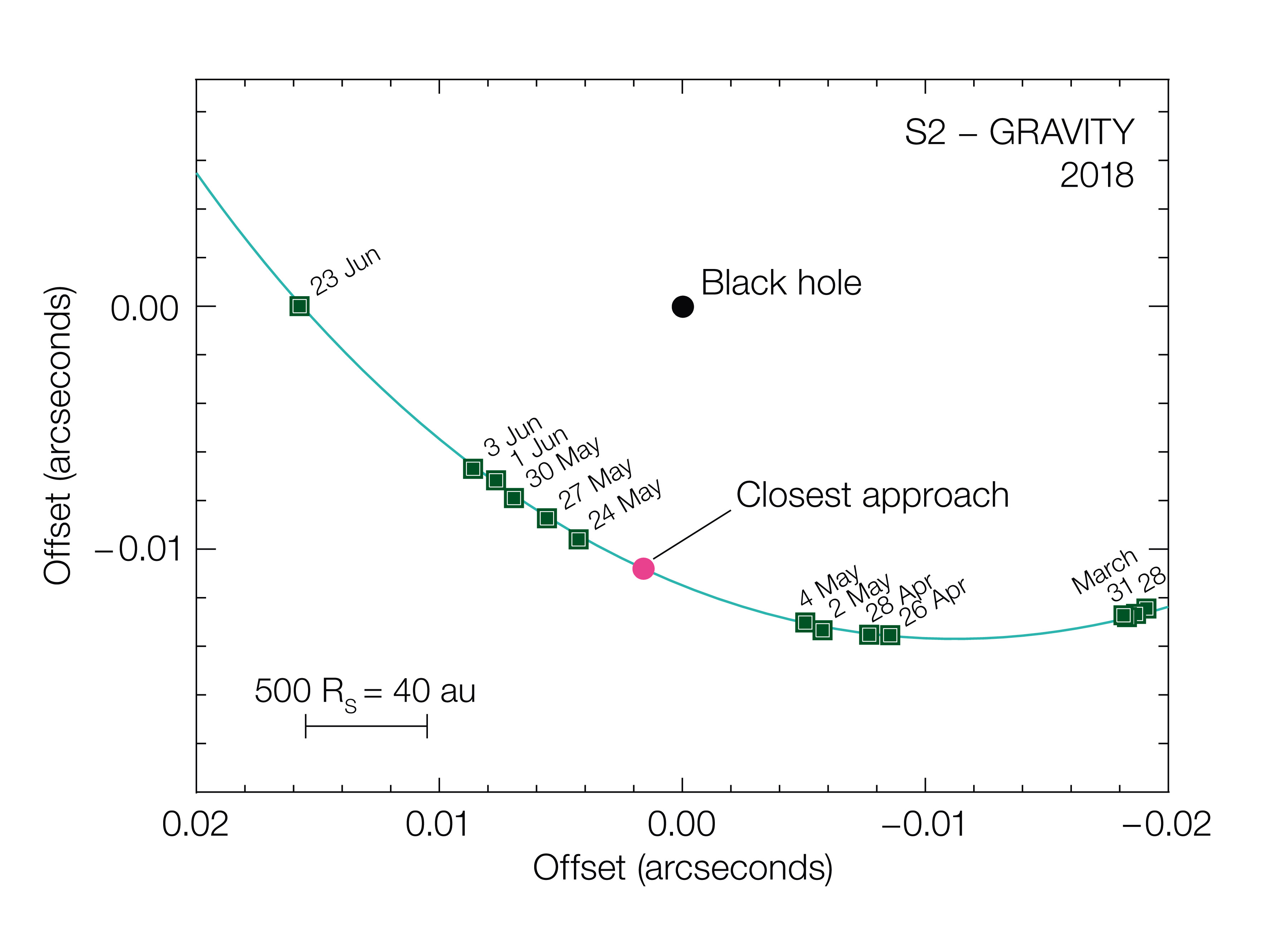
S2 (also S0-2) — a hot, young, blue B-type star that loops around Sagittarius A* every ~16 years on a highly eccentric orbit, sweeping to within ~120 AU of the black hole. Tracking it for three decades let astronomers weigh the black hole and test Einstein's general relativity in its strong gravity: in 2018 its light was seen redshifted as predicted, and in 2020 its orbit was shown to slowly rotate (Schwarzschild precession) exactly as relativity requires. This work shared the 2020 Nobel Prize in Physics.
Key facts
Science
Physical
- Spectral type
- B0–2.5 V (hot, blue-white main-sequence star)
Orbit around Sagittarius A*
- Semi-major axis
- 1.03e+03 AU
- Real published orbital elements from decades of astrometric tracking of Sgr A* (see the Science tab for the measured values and their sources); the star is an unresolved point of light — this orbit is a model, not an image.
- Eccentricity
- 0.8846
- Real published orbital elements from decades of astrometric tracking of Sgr A* (see the Science tab for the measured values and their sources); the star is an unresolved point of light — this orbit is a model, not an image.
- Orbital period
- 16.05 years
- Real published orbital elements from decades of astrometric tracking of Sgr A* (see the Science tab for the measured values and their sources); the star is an unresolved point of light — this orbit is a model, not an image.
At the black hole
- Closest approach
- ≈120 AU (~1,400 Schwarzschild radii)
- GRAVITY Collaboration, A&A 615, L15 (2018)
- Peak speed
- ≈7,650 km/s (~2.55% of light speed) at pericentre
- GRAVITY Collaboration 2018
- Relativity tested
- Gravitational redshift seen in 2018; the orbit's slow rotation (Schwarzschild precession) in 2020 — both as general relativity predicts
- GRAVITY Collaboration, A&A 636, L5 (2020) — 2020 Nobel Prize work
- Note
- The semi-major axis is measured as an angle (125 mas); the AU value is converted at the adopted distance R0 ≈ 8,250 pc, not measured as a length.
Composition
- By mass
- A young main-sequence B star — hot (~24,000–30,000 K) and blue-white. Spectroscopy gives a mass of roughly 14 solar masses and an age of only a few million years (Habibi et al. 2017); its radius is not directly measured, so no density is shown. Its importance is dynamical, not chemical: bright enough to track through the dust toward the galactic centre and on a short enough orbit to follow through full revolutions — the ideal test particle for the black hole's gravity.
Temperature
- Surface
- 27,000 K (26,727 °C)
Radiation & temperature
- Surface temperature
- 27,000 K (26,727 °C)
- Peak wavelength
- 107 nm · ultraviolet (invisible to the eye)
- Computed (Wien's law) from the surface temperature
Discovery & history
- Discovered
- 2002
- By
- R. Schödel, R. Genzel, A. Eckart et al. (MPE); A. Ghez et al. (UCLA)
- Method
- Telescope
- Name
- 'S2' is the second source catalogued in the central 'S' cluster of stars around Sgr A* by the MPE group; the UCLA group calls the same star S0-2. The 'S' stands for the Sagittarius-A* star cluster, and the number is a catalogue index, not a brightness or distance rank.
S2 emerged from the first infrared surveys of the galactic centre in the 1990s (Eckart & Genzel), when astronomers began measuring the motions of stars around the unseen radio source Sgr A*. Its first full orbit was published by Schödel et al. in 2002 — direct evidence for a supermassive black hole. The teams of Reinhard Genzel (MPE) and Andrea Ghez (UCLA), later with ESO's GRAVITY interferometer, refined the orbit to detect the gravitational redshift (2018) and the Schwarzschild precession (2020) of its path, work recognised by the 2020 Nobel Prize in Physics.
Images

Images from open archives · credit shown per image