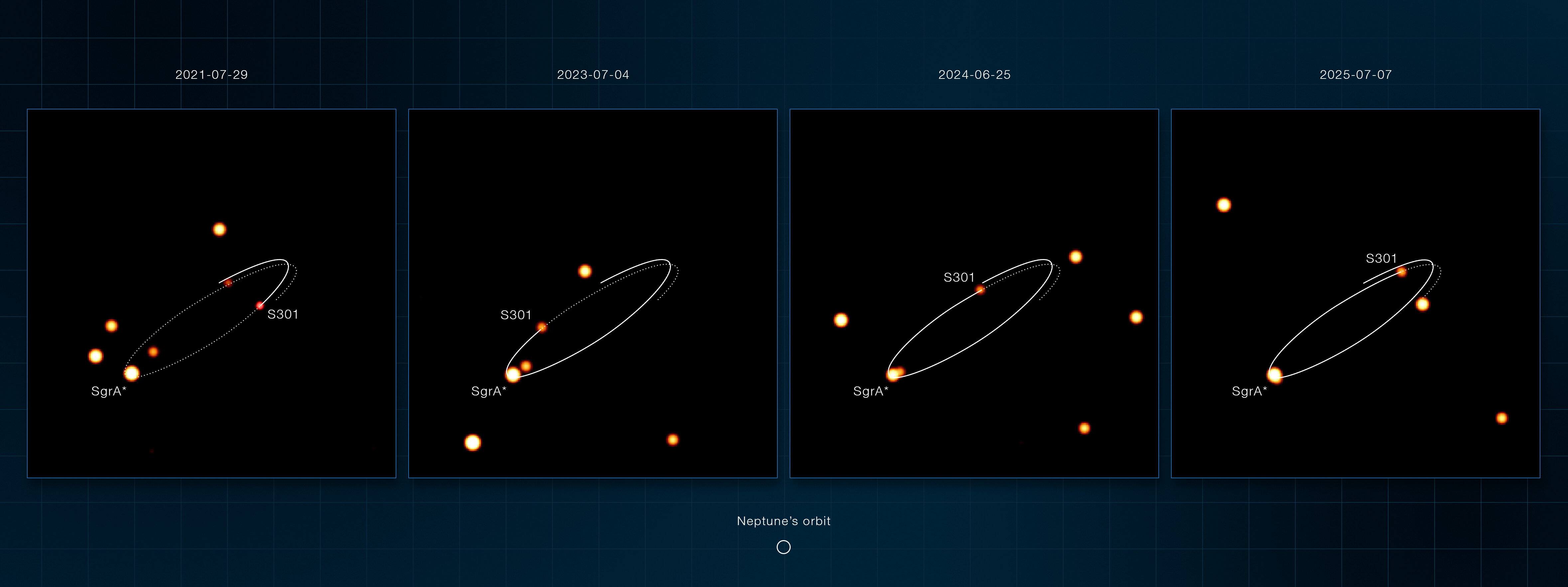
S301
S301 — a faint star on the shortest, fastest orbit yet measured around Sagittarius A*. Every 8.7 years it swings to within about 12 AU of the black hole — roughly Saturn's distance from the Sun, and ~10 times closer than S2 — and at that moment races at some 25,000 km/s, about 8% of the speed of light: the fastest orbital motion of any robustly measured star in the Galaxy. Its tight, extreme orbit will, within about a decade, let astronomers measure whether the black hole spins — the star does not measure the spin itself, but makes the measurement possible.
Key facts
Science
Physical
- Spectral type
- Faint main-sequence star (apparent K magnitude 19.3); spectral type not yet determined
Orbit around Sagittarius A*
- Semi-major axis
- 687 AU
- Real published orbital elements from decades of astrometric tracking of Sgr A* (see the Science tab for the measured values and their sources); the star is an unresolved point of light — this orbit is a model, not an image.
- Eccentricity
- 0.9832
- Real published orbital elements from decades of astrometric tracking of Sgr A* (see the Science tab for the measured values and their sources); the star is an unresolved point of light — this orbit is a model, not an image.
- Orbital period
- 8.68 years
- Real published orbital elements from decades of astrometric tracking of Sgr A* (see the Science tab for the measured values and their sources); the star is an unresolved point of light — this orbit is a model, not an image.
At the black hole
- Closest approach
- ≈12 AU (~140 Schwarzschild radii) — about Saturn's distance from the Sun, and ~10× closer than S2
- GRAVITY Collaboration, Nature 2026 (arXiv:2607.12664)
- Peak speed
- ≈25,000 km/s (~8% of light speed) at pericentre — the fastest orbital motion of any robustly (interferometrically) measured star
- GRAVITY Collaboration 2026
- Record
- Shortest known orbital period (8.7 yr) and most relativistic tracked orbit around Sgr A* — the previous record-holder was S55/S0-102 (~12.8 yr). Earlier faster claims (S62, S4711–S4715) were never confirmed by interferometry and are excluded by this discovery.
- GRAVITY Collaboration 2026
- Black-hole spin
- S301's tight orbit is sensitive to the black hole's spin: within about a decade, GRAVITY+ and the Extremely Large Telescope should measure how fast Sagittarius A* rotates from how this orbit precesses. The spin is NOT yet measured — S301 makes the measurement possible.
- GRAVITY Collaboration 2026
- Note
- The semi-major axis is measured as an angle (83 mas); the AU value is converted at the adopted distance R0 = 8,277 pc. The orbit's 3-D orientation has a mirror-image alternative (two near-equal solutions) not yet distinguished; its size, shape and period are firmly measured.
Composition
- By mass
- A faint main-sequence star (apparent K magnitude 19.3 — about two billion times fainter than Betelgeuse). Its mass, radius and spectral type are not yet constrained: it is known chiefly as a rapidly moving point of light whose orbit has been measured, so no density or surface properties are shown. What makes it remarkable is the orbit, not the star — a pericentre of ~140 Schwarzschild radii, ~10× deeper into the black hole's gravity than S2's, the most relativistic of any tracked star.
Discovery & history
- Discovered
- August 19, 2026
- By
- GRAVITY Collaboration (K. Abd El Dayem, R. Abuter et al.)
- Method
- Telescope
- Name
- 'S301' continues the MPE group's numbering of stars in the central 'S' cluster around Sgr A*; the high index reflects how deep the GRAVITY census of faint stars now reaches. The number is a catalogue index, not a rank.
S301 was first picked out in spring 2023 with ESO's GRAVITY interferometer at the VLTI, from four decades of monitoring the galactic centre, and announced by the GRAVITY Collaboration in Nature in August 2026. Its orbit is so tight and fast that it feels the black hole's spin: within about a decade, GRAVITY+ and the Extremely Large Telescope should measure how fast Sagittarius A* rotates from how S301's orbit precesses. The discovery paper shows S301 is genuinely new — none of the earlier, disputed 'fast star' claims (S62, S4711-S4715) match its orbit, and GRAVITY's interferometric images should have caught them if they existed.
Images
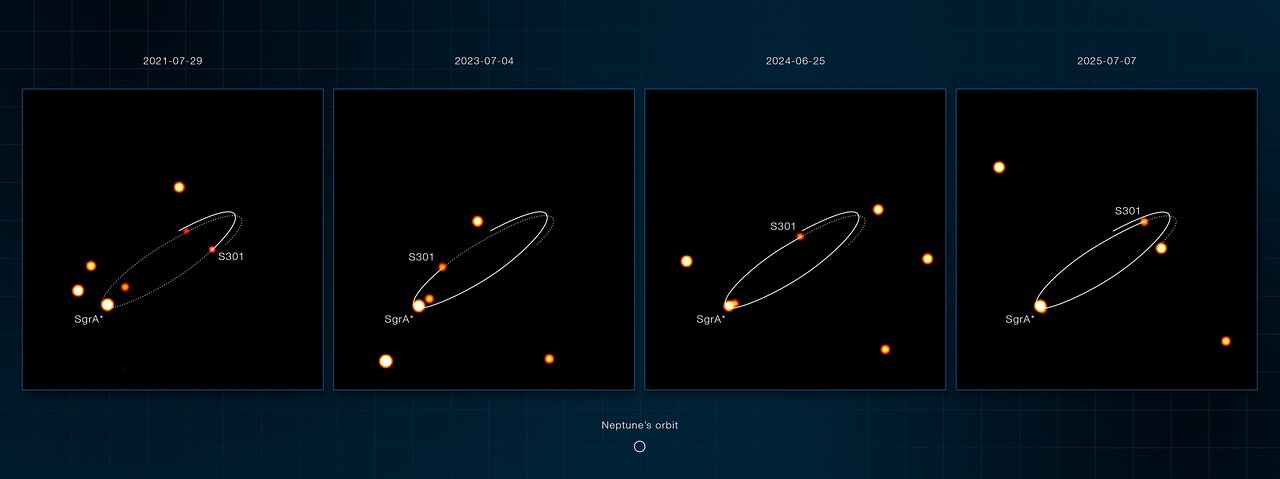
Images from open archives · credit shown per image