Selam
Moon· orbits (152830) Dinkinesh
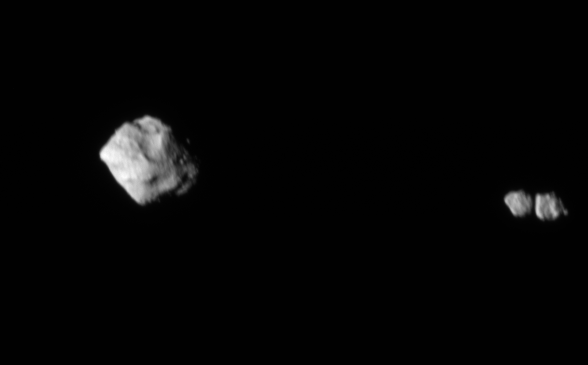
Selam is the moon of the asteroid Dinkinesh, seen by NASA's Lucy as it flew past on 1 November 2023 — the first moon of an asteroid known to be a contact binary, two lobes touching.
Open in 3D viewSee Selam in the live, interactive 3D map
Key facts
Radius
0.139 km
Day length
2.2 days
Orbit around (152830) Dinkinesh
2.19 Earth days
Science
Physical
- Radius (estimated)
- 0.139 km
- Two lobes, not a sphere: the radius is that of their combined volume.
Orbit around (152830) Dinkinesh
- Distance from (152830) Dinkinesh
- 3.11 km
- From JPL orbital elements
- Orbital period
- 2.2 days
- From the separation and period Lucy measured (Levison et al. 2024); the tilt of the orbit is estimated
- Eccentricity
- 0
- From the separation and period Lucy measured (Levison et al. 2024); the tilt of the orbit is estimated
- Inclination to the ecliptic
- 177.91 °
- From the separation and period Lucy measured (Levison et al. 2024); the tilt of the orbit is estimated
Rotation
- Rotation period
- 2.2 days
- Tidal locking
- Tidally locked to its parent
Composition
- Bulk composition
- Two lobes about 210 and 230 m across (Levison et al. 2024) — the inner Piękna Lobus and the outer Lewa Lobus (Bierhaus et al. 2025). It orbits Dinkinesh 3.1 km out, once every 52.67 hours, backwards relative to Dinkinesh's path round the Sun, and always keeps the same face towards it. It probably formed from material Dinkinesh shed as its spin sped up. No shape model has been published, so it is drawn as a single sphere of the lobes' combined volume; its own mass has not been measured.
Radiation & temperature
- Insolation
- 0.225 S⊕ · 22% of the sunlight Earth receives
- Computed from the distance to the Sun (inverse-square; Earth's sunlight = 1), before any atmosphere.
Discovery & history
- By
- NASA's Lucy mission
- Name
- Selam is the name given to the fossil remains of a three-year-old Australopithecus afarensis female, the same species as the Lucy fossil, found in Dikika, Ethiopia, in 2000 by the paleoanthropologist Zeresenay Alemseged. The name is an Ethiopian word meaning "peace"; the Swiss planetary scientist Raphael Marschall suggested it for Dinkinesh's satellite.
Lucy's pictures from its flyby of Dinkinesh on 1 November 2023 showed that the asteroid has a moon, and that the moon is two lobes, about 210 and 230 m across, resting against each other. It orbits Dinkinesh 3.1 km out, once every 52.67 hours, and keeps the same face towards it.
Seen as Lucy passed Dinkinesh: the first moon of an asteroid found to be a contact binary.
Images

Images from open archives · credit shown per image