(152830) Dinkinesh
Asteroid· orbits the Sun
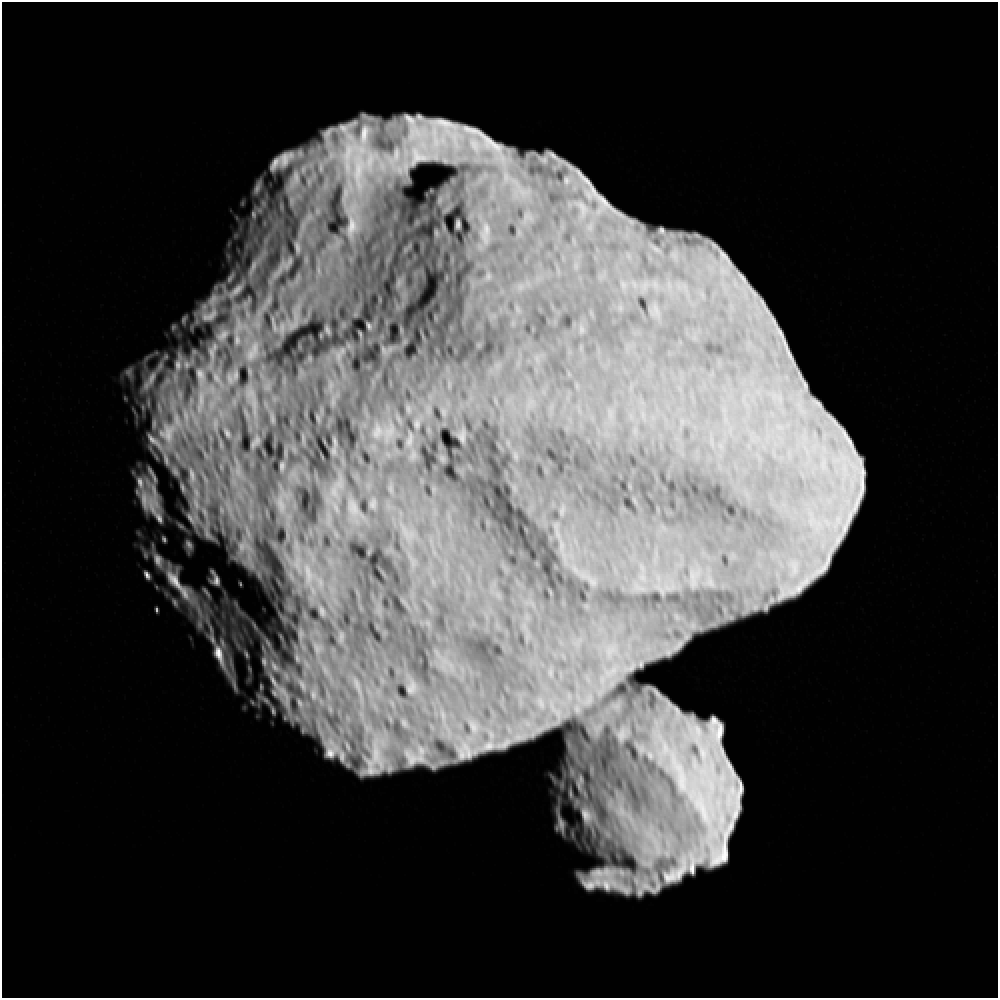
(152830) Dinkinesh is a small stony (S-type) asteroid, about 720 m across, near the inner edge of the main belt. NASA's Lucy flew 431 km from it on 1 November 2023 and found that it has a moon, Selam — itself two lobes touching.
Open in 3D viewSee (152830) Dinkinesh in the live, interactive 3D map
Key facts
Radius
0.359 km
Distance from Sun
2.19 AU
Orbital period
3.24 years
Eccentricity
0.1127
Rotation
3.74 hours
Science
Physical
- Mean radius
- 0.359 km
- Rotation period
- 3.74 hours
Orbital
- Semi-major axis
- 2.19 AU
- From catalogued orbital elements (MPC)
- Eccentricity
- 0.1127
- From catalogued orbital elements (MPC)
- Inclination
- 2.09 °
- From catalogued orbital elements (MPC)
- Orbital period
- 3.24 years
- From catalogued orbital elements (MPC)
- Perihelion
- 1.94 AU
- Computed from the orbital elements
- Aphelion
- 2.44 AU
- Computed from the orbital elements
- Mean orbital velocity
- 20.1 km/s
- Computed from the orbital elements
Discovery
- Discovered
- November 4, 1999
- Discoverer
- LINEAR (Socorro)
Composition
- Make-up
- A rubble pile with a long trough, Sumak Fossa, and an equatorial ridge, Fab Dorsum — probably the result of sunlight speeding up its spin (the YORP effect) until part of it failed and was shed, some of that material gathering again as Selam (Levison et al. 2024; Bierhaus et al. 2025). Its surface age is estimated at about a million years (Bierhaus et al. 2025). Selam's orbit gives the mass of the pair, (4.95 ± 0.25) × 10^11 kg, and a density of 2.4 ± 0.35 g/cm³ (Levison et al. 2024; 2.22 in Bierhaus et al. 2025); how that mass is shared between the two has not been measured, so no mass is shown for either. It spins every 3.74 hours, backwards relative to its orbit. Lucy's archive holds no shape model of it, so it is drawn as a plain sphere of its measured size.
Radiation & temperature
- Insolation
- 0.208 S⊕ · 21% of the sunlight Earth receives
- Computed from the distance to the Sun (inverse-square; Earth's sunlight = 1), before any atmosphere.
- Geometric albedo
- 0.27
- Geometric albedo 0.27 (+0.25/−0.06), estimated from WISE infrared measurements before the flyby (McFadden et al. 2023).
- Equilibrium temperature
- 174 K (-99 °C)
- Computed from albedo + distance from the Sun (airless black body); uses the geometric albedo as an estimate
Discovery & history
- Discovered
- November 4, 1999
- By
- LINEAR (Socorro)
- Name
- Dinkinesh is an Ethiopian name for the Australopithecus afarensis skeleton AL 288-1, known as "Lucy", found in 1974 at Hadar, in Ethiopia's Awash Valley; it means "you are marvelous".
Found by LINEAR, the Lincoln Laboratory's asteroid survey at Socorro, New Mexico, on 4 November 1999, and catalogued as 1999 VD57. On 1 November 2023 Lucy passed it 431 km away at 4.5 km/s, rehearsing its encounters with the Trojan asteroids, and its pictures showed a moon, Selam.
Passed 431 km away at 4.5 km/s and found that Dinkinesh has a moon, Selam — two lobes touching.
Images


Images from open archives · credit shown per image