(2867) Šteins
Asteroid· orbits the Sun
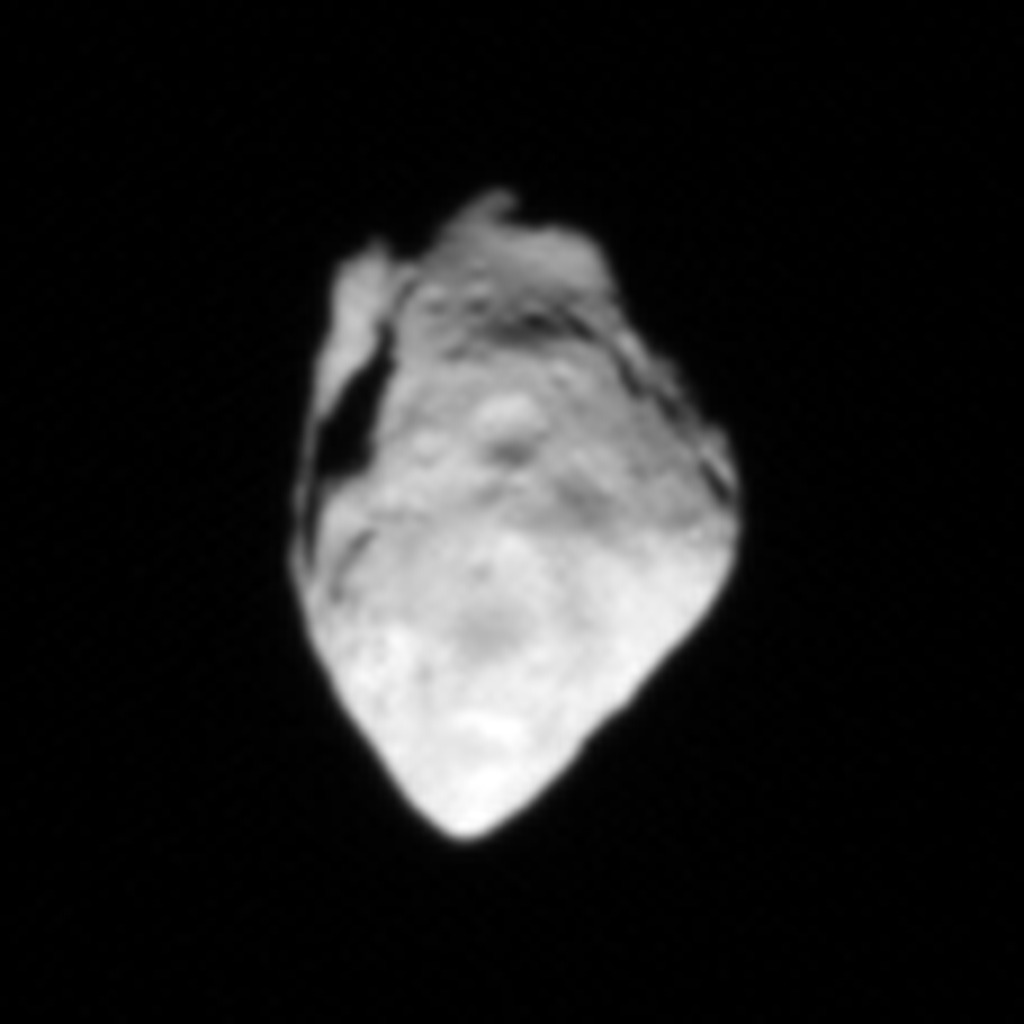
(2867) Šteins is a small E-type asteroid, about 5 km across, in the main belt. ESA's Rosetta flew 803 km from it on 5 September 2008, on its way to comet 67P, and found it shaped like a cut diamond.
Open in 3D viewSee (2867) Šteins in the live, interactive 3D map
Key facts
Radius
2.63 km
Distance from Sun
2.36 AU
Orbital period
3.63 years
Eccentricity
0.1468
Rotation
6.05 hours
Science
Physical
- Mean radius
- 2.63 km
- Rotation period
- 6.05 hours
Orbital
- Semi-major axis
- 2.36 AU
- From catalogued orbital elements (MPC)
- Eccentricity
- 0.1468
- From catalogued orbital elements (MPC)
- Inclination
- 9.92 °
- From catalogued orbital elements (MPC)
- Orbital period
- 3.63 years
- From catalogued orbital elements (MPC)
- Perihelion
- 2.02 AU
- Computed from the orbital elements
- Aphelion
- 2.71 AU
- Computed from the orbital elements
- Mean orbital velocity
- 19.4 km/s
- Computed from the orbital elements
Discovery
- Discovered
- November 4, 1969
- Discoverer
- Nikolai Chernykh (Nauchnyj, Crimea)
Composition
- Make-up
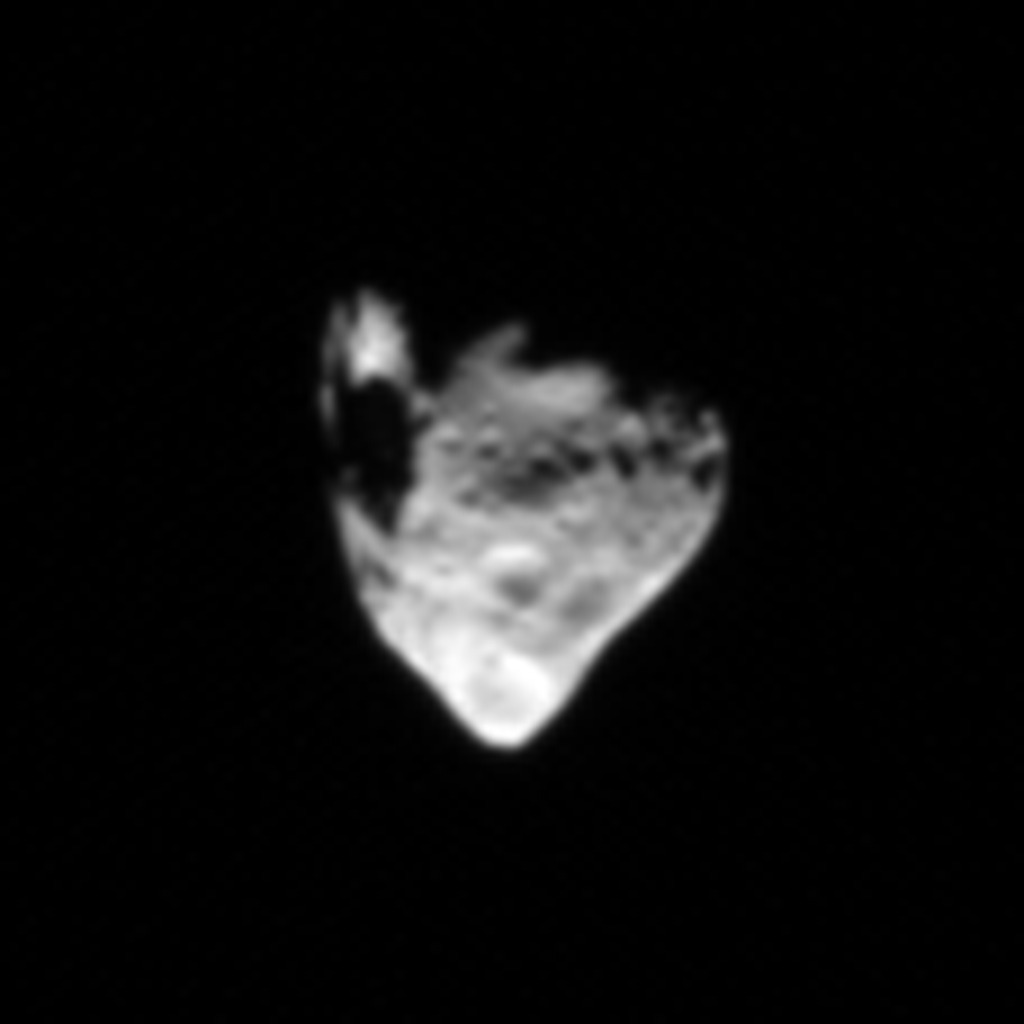
- A bright E-type asteroid, a rare class thought to be rich in iron-poor silicates. Near its south pole lies a crater about 2.1 km across, large for a body this size, and a chain of about seven pits runs from its north pole towards it. Its cone-like shape and the lack of small craters suggest a rubble pile reshaped as sunlight sped up its spin — the YORP effect (Keller et al. 2010). Its mass has not been measured.
Radiation & temperature
- Insolation
- 0.179 S⊕ · 18% of the sunlight Earth receives
- Computed from the distance to the Sun (inverse-square; Earth's sunlight = 1), before any atmosphere.
- Geometric albedo
- 0.39
- Geometric albedo 0.39 ± 0.02; Bond albedo 0.24 ± 0.01 (Spjuth et al. 2012).
- Equilibrium temperature
- 160 K (-113 °C)
- Computed from albedo + distance from the Sun (airless black body); uses the geometric albedo as an estimate
Discovery & history
- Discovered
- November 4, 1969
- By
- Nikolai Chernykh (Nauchnyj, Crimea)
- Name
- Named in memory of Kārlis Šteins (1911–1983), director of the astronomical observatory of the University of Latvia from 1959, known for his work on the origin of comets.
Nikolai Chernykh found it at the Crimean Astrophysical Observatory in Nauchnyj on 4 November 1969, and it was catalogued as 1969 VC. On 5 September 2008 Rosetta passed it at 8.6 km/s, 803 km away — ESA's first asteroid flyby, and the first of an E-type asteroid. About 60% of its surface was imaged.
ESA's first asteroid flyby, at 8.6 km/s; its pictures showed a body shaped like a cut diamond.
Images
Images from open archives · credit shown per image