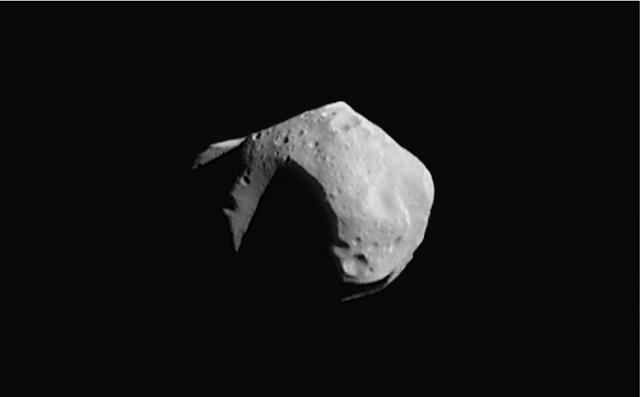
(253) Mathilde
Asteroid· orbits the Sun
(253) Mathilde is a dark, carbon-rich (C-type) asteroid about 53 km across in the main belt. NASA's NEAR flew 1,212 km from it on 27 June 1997 — the first close look at a C-type asteroid — and the pull it felt from Mathilde gave its mass.
Open in 3D viewSee (253) Mathilde in the live, interactive 3D map
Key facts
Radius
26.4 km
Distance from Sun
2.65 AU
Orbital period
4.31 years
Eccentricity
0.2643
Rotation
17.4 days
Science
Physical
- Mean radius
- 26.4 km
- Mass
- 1.03 × 10¹⁷ kg · 0.00000141 Moon masses
- Density
- 1,340 kg/m³ · 1.3× water
- Computed from mass and radius
- Rotation period
- 17.4 days
Orbital
- Semi-major axis
- 2.65 AU
- From catalogued orbital elements (MPC)
- Eccentricity
- 0.2643
- From catalogued orbital elements (MPC)
- Inclination
- 6.74 °
- From catalogued orbital elements (MPC)
- Orbital period
- 4.31 years
- From catalogued orbital elements (MPC)
- Perihelion
- 1.95 AU
- Computed from the orbital elements
- Aphelion
- 3.35 AU
- Computed from the orbital elements
- Mean orbital velocity
- 18.3 km/s
- Computed from the orbital elements
Discovery
- Discovered
- November 12, 1885
- Discoverer
- Johann Palisa (Vienna)
Composition
- Make-up
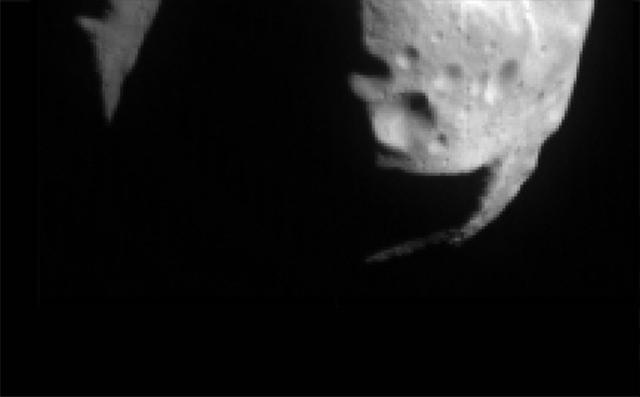
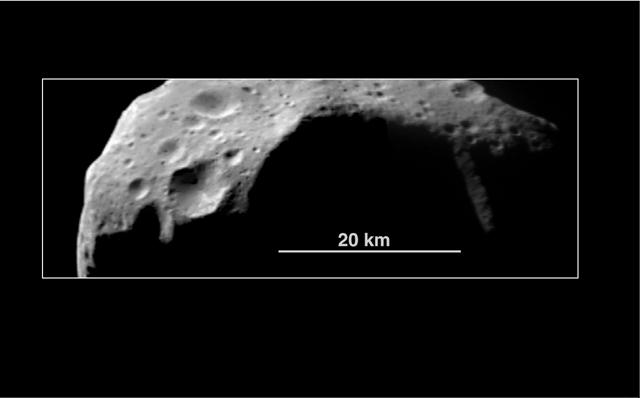
- Carbon-rich rock with a uniform surface — no colour or brightness differences were found (Clark et al. 1999). Its density, from its measured mass and volume, is about half that of the carbon-rich meteorites it resembles, so it is probably very porous inside, perhaps a rubble pile (Yeomans et al. 1997; Veverka et al. 1999). At least four craters are about as wide as Mathilde's radius; the largest two, Karoo and Ishikari, are 33.4 and 29.3 km across. It turns once every 17.4 days, one of the slowest spins known (Mottola et al. 1995).
Radiation & temperature
- Insolation
- 0.143 S⊕ · 14% of the sunlight Earth receives
- Computed from the distance to the Sun (inverse-square; Earth's sunlight = 1), before any atmosphere.
- Geometric albedo
- 0.05
- Geometric albedo 0.047 ± 0.005 (Clark et al. 1999) — one of the darkest surfaces a spacecraft has seen.
- Equilibrium temperature
- 169 K (-104 °C)
- Computed from albedo + distance from the Sun (airless black body); uses the geometric albedo as an estimate
Discovery & history
- Discovered
- November 12, 1885
- By
- Johann Palisa (Vienna)
- Name
- Named probably in honour of Mathilde Loewy, the wife of Moritz Loewy, vice-director of the Paris Observatory; V. A. Lebeuf, who computed its orbit, named it.
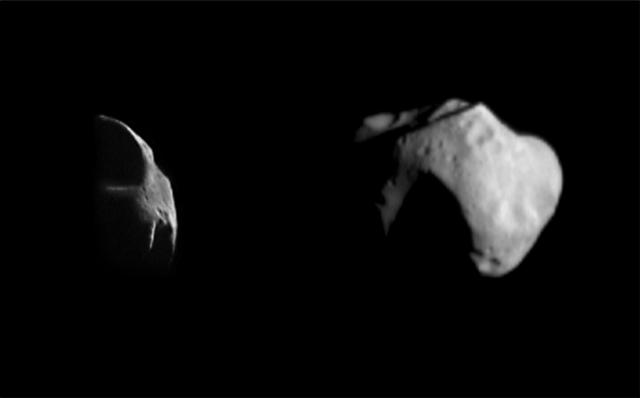
Johann Palisa found it at Vienna on 12 November 1885. On 27 June 1997 NEAR passed it at 9.93 km/s, 1,212 km away, and took over 300 pictures covering about 60% of its surface — the first close look at a C-type asteroid. The slight bend the asteroid's gravity gave NEAR's path measured its mass.
The first close look at a C-type asteroid: over 300 pictures, and its mass from the pull on the spacecraft.
Images
Images from open archives · credit shown per image