(52246) Donaldjohanson
Asteroid· orbits the Sun
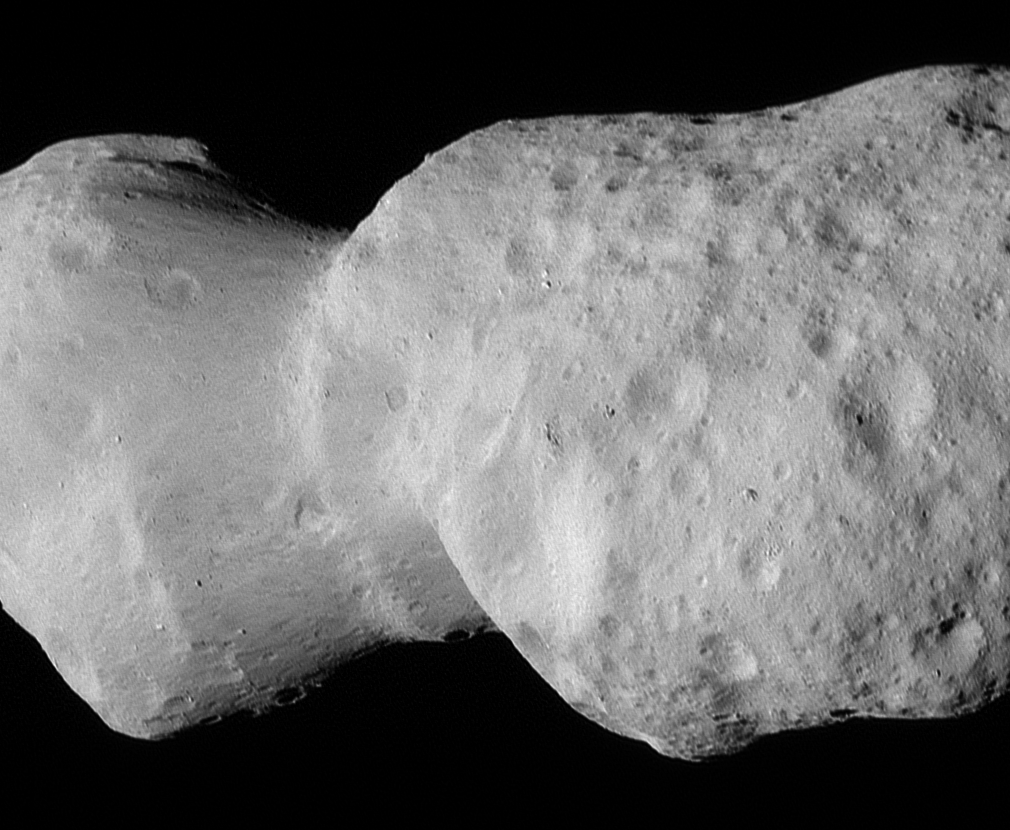
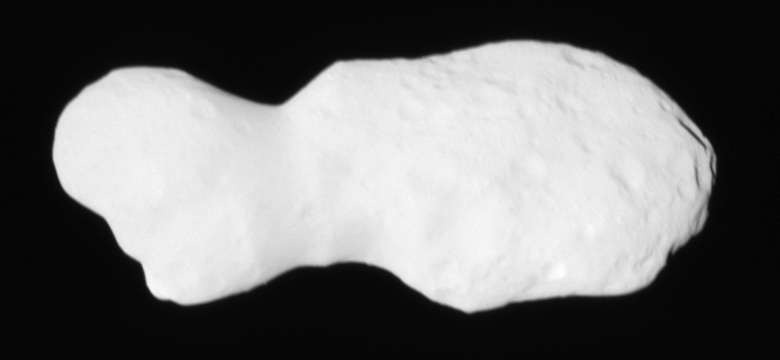
(52246) Donaldjohanson is a main-belt asteroid 8.8 km long, likely a member of the Erigone family. NASA's Lucy flew 961 km from it on 20 April 2025 and found two heavily cratered lobes joined by a smoother neck.
Open in 3D viewSee (52246) Donaldjohanson in the live, interactive 3D map
Key facts
Radius
2.4 km
Distance from Sun
2.38 AU
Orbital period
3.68 years
Eccentricity
0.1868
Science
Physical
- Mean radius
- 2.4 km
Orbital
- Semi-major axis
- 2.38 AU
- From catalogued orbital elements (MPC)
- Eccentricity
- 0.1868
- From catalogued orbital elements (MPC)
- Inclination
- 4.42 °
- From catalogued orbital elements (MPC)
- Orbital period
- 3.68 years
- From catalogued orbital elements (MPC)
- Perihelion
- 1.94 AU
- Computed from the orbital elements
- Aphelion
- 2.83 AU
- Computed from the orbital elements
- Mean orbital velocity
- 19.3 km/s
- Computed from the orbital elements
Discovery
- Discovered
- March 2, 1981
- Discoverer
- S. J. Bus (Siding Spring)
Composition
- Make-up
- Likely a fragment of a larger body destroyed in a collision about 155 million years ago, the age of the Erigone family; its crater density agrees with that age, except that craters smaller than 0.4 km have been preferentially erased. Its surface spectra show iron-bearing phyllosilicates, a sign of moderate alteration by water on the parent body. It tumbles slowly — its main period is 252.6 hours, with a second of 455.2 hours — likely because radiative forces slowed its spin (Marchi et al. 2026). Its mass has not been measured.
Radiation & temperature
- Insolation
- 0.176 S⊕ · 18% of the sunlight Earth receives
- Computed from the distance to the Sun (inverse-square; Earth's sunlight = 1), before any atmosphere.
- Geometric albedo
- 0.10
- Geometric albedo 0.103 ± 0.019, from NEOWISE's infrared measurements (Masiero et al. 2011).
- Equilibrium temperature
- 175 K (-98 °C)
- Computed from albedo + distance from the Sun (airless black body); uses the geometric albedo as an estimate
Discovery & history
- Discovered
- March 2, 1981
- By
- S. J. Bus (Siding Spring)
- Name
- Named after the American paleoanthropologist Donald Carl Johanson (b. 1943), who discovered the fossil of a female hominin known as "Lucy".
S. J. Bus found it at Siding Spring Observatory, Australia, on 2 March 1981, and it was catalogued as 1981 EQ5. On 20 April 2025 Lucy passed it at 13.4 km/s, 961 km away, and imaged it only on the way in.
Passed 961 km away at 13.4 km/s, imaging it only on the way in: two heavily cratered lobes joined by a smoother neck.
Images
Images from open archives · credit shown per image