(9969) Braille
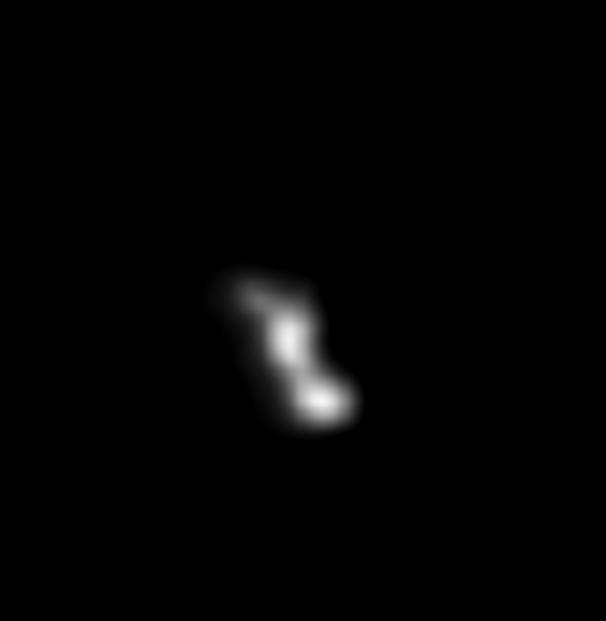
(9969) Braille is an asteroid about 2 km long whose orbit crosses Mars's. NASA's Deep Space 1 flew past it on 29 July 1999, about 26 km away; a tracking problem kept its camera from catching the asteroid on the way in, and its only pictures, taken on the way out from about 14,000 km, show it a few pixels across.
Key facts
Science
Physical
- Dimensions
- 2.1 × 1 × 1 km · approx. triaxial diameter
- Rotation period
- 9.4 days
Orbital
- Semi-major axis
- 2.34 AU
- From catalogued orbital elements (MPC)
- Eccentricity
- 0.4341
- From catalogued orbital elements (MPC)
- Inclination
- 29.02 °
- From catalogued orbital elements (MPC)
- Orbital period
- 3.58 years
- From catalogued orbital elements (MPC)
- Perihelion
- 1.32 AU
- Computed from the orbital elements
- Aphelion
- 3.35 AU
- Computed from the orbital elements
- Mean orbital velocity
- 19.5 km/s
- Computed from the orbital elements
Discovery
- Discovered
- May 27, 1992
- Discoverer
- Eleanor Helin and Kenneth Lawrence (Palomar)
Composition
- Make-up
- A stony asteroid of the rare Q type, whose spectrum is made of roughly equal parts pyroxene and olivine (Buratti et al. 2004). Its size, about 2.1 × 1 × 1 km, is estimated from Deep Space 1's images and its light curve (Oberst et al. 2001); it turns about once every 226 hours, a figure that may be wrong by 30 percent. Its mass has not been measured.
Radiation & temperature
- Insolation
- 0.183 S⊕ · 18% of the sunlight Earth receives
- Computed from the distance to the Sun (inverse-square; Earth's sunlight = 1), before any atmosphere.
- Geometric albedo
- 0.34
- Geometric albedo 0.34 (Buratti et al. 2004) — a bright surface for an asteroid.
- Equilibrium temperature
- 164 K (-109 °C)
- Computed from albedo + distance from the Sun (airless black body); uses the geometric albedo as an estimate
Discovery & history
- Discovered
- May 27, 1992
- By
- Eleanor Helin and Kenneth Lawrence (Palomar)
- Name
- Named in memory of Louis Braille (1809–1852), who invented the Braille writing system; the name was chosen through The Planetary Society's "Name That Asteroid" contest.
Eleanor Helin and Kenneth Lawrence found it at Palomar Observatory on 27 May 1992, and it was catalogued as 1992 KD. Deep Space 1's two pictures of it were taken about 15 minutes after the flyby, from about 14,000 km, and show it only a few pixels across.
Flew past at about 15.5 km/s; a tracking problem kept its camera off the asteroid on the way in, and it took two images from about 14,000 km on the way out.
Images
Images from open archives · credit shown per image