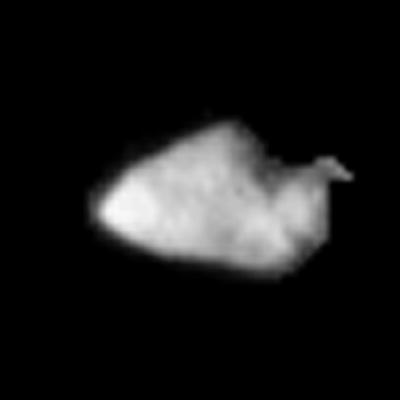
(5535) Annefrank
Asteroid· orbits the Sun
(5535) Annefrank is a small stony (S-type) asteroid in the main belt. NASA's Stardust flew about 3,100 km from it on 2 November 2002, rehearsing the encounter it would fly at comet Wild 2.
Open in 3D viewSee (5535) Annefrank in the live, interactive 3D map
Key facts
Radius
2.4 km
Distance from Sun
2.21 AU
Orbital period
3.29 years
Eccentricity
0.06324
Rotation
15.12 hours
Science
Physical
- Mean radius
- 2.4 km
- Rotation period
- 15.12 hours
Orbital
- Semi-major axis
- 2.21 AU
- From catalogued orbital elements (MPC)
- Eccentricity
- 0.06324
- From catalogued orbital elements (MPC)
- Inclination
- 4.25 °
- From catalogued orbital elements (MPC)
- Orbital period
- 3.29 years
- From catalogued orbital elements (MPC)
- Perihelion
- 2.07 AU
- Computed from the orbital elements
- Aphelion
- 2.35 AU
- Computed from the orbital elements
- Mean orbital velocity
- 20 km/s
- Computed from the orbital elements
Discovery
- Discovered
- March 23, 1942
- Discoverer
- Karl Reinmuth (Heidelberg)
Composition
- Make-up
- Stardust's images show a highly angular body at least 6.6 × 5.0 × 3.4 km — a lower limit, as only part of it was seen — mostly shaped like a triangular prism, with flat-looking faces that may be fractures from a larger parent body and smaller, rounder bodies possibly accreted onto it (Duxbury et al. 2004). The images followed its brightness out to a phase angle of 134°, the widest then reached for any S-type asteroid (Newburn et al. 2003). No shape model has been published, so it is drawn as a plain sphere. Its spin, about 15.1 hours, comes from light curves that may be wrong by 30 percent; its mass has not been measured.
Radiation & temperature
- Insolation
- 0.204 S⊕ · 20% of the sunlight Earth receives
- Computed from the distance to the Sun (inverse-square; Earth's sunlight = 1), before any atmosphere.
- Geometric albedo
- 0.24
- Geometric albedo 0.24 (Newburn et al. 2003), assuming the camera worked at 75% of its expected efficiency.
- Equilibrium temperature
- 175 K (-98 °C)
- Computed from albedo + distance from the Sun (airless black body); uses the geometric albedo as an estimate
Discovery & history
- Discovered
- March 23, 1942
- By
- Karl Reinmuth (Heidelberg)
- Name
- Named in memory of Anne Frank (1929–1945), "whose life and diary form a poignant record of the ravages of war and racism, as seen through the eyes of a young person" (Minor Planet Circular 25230).
Karl Reinmuth found it at Heidelberg on 23 March 1942. On 2 November 2002 Stardust passed it at 7.4 km/s, 3,079 km away, as a test of the sequence it would fly at comet Wild 2, and took over 70 images: an angular body at least 6.6 × 5.0 × 3.4 km.
A rehearsal for Wild 2: over 70 images at 7.4 km/s showed an angular body at least 6.6 × 5.0 × 3.4 km.
Images
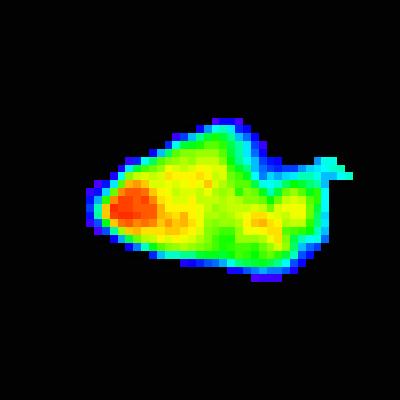
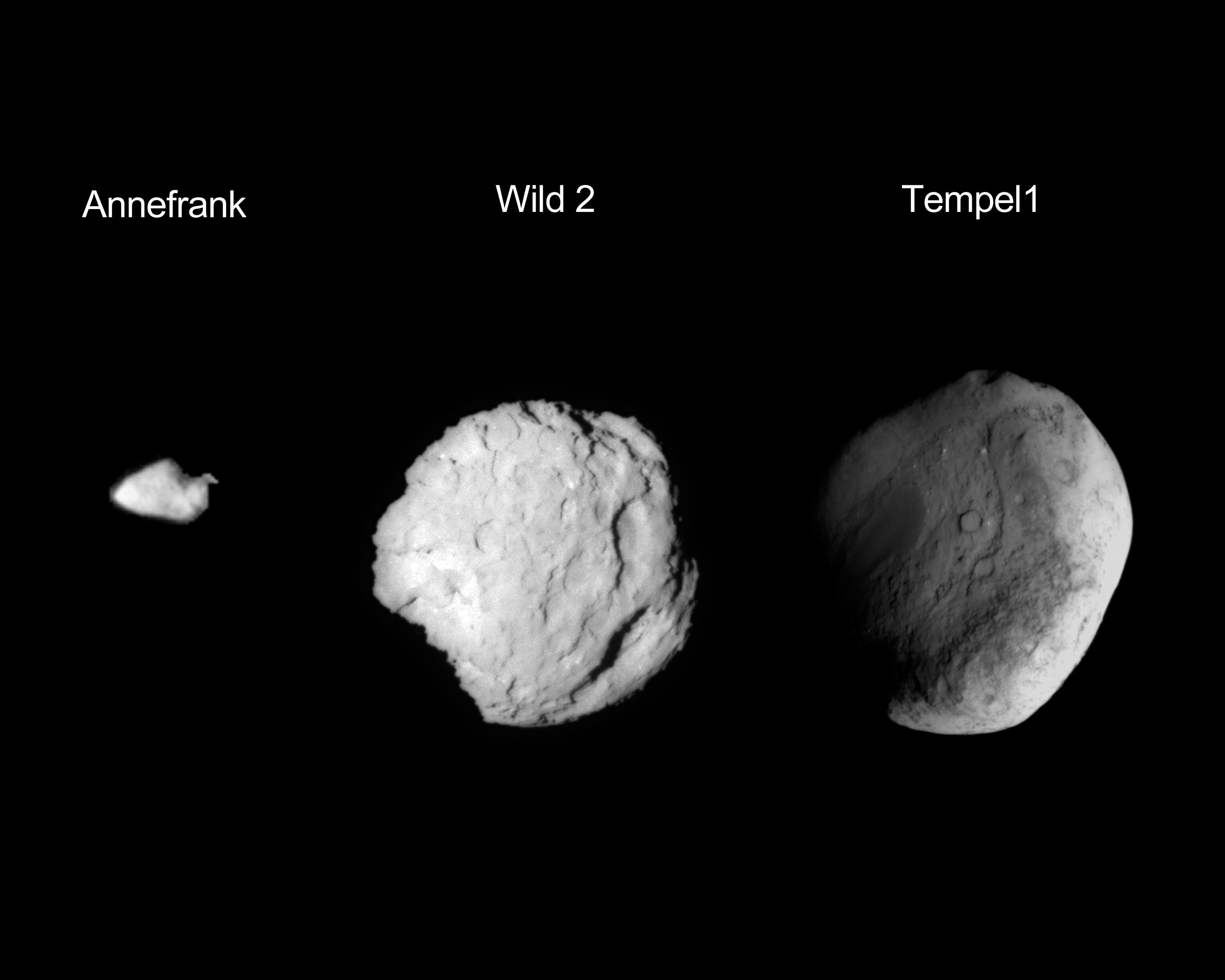
Images from open archives · credit shown per image