
Mir
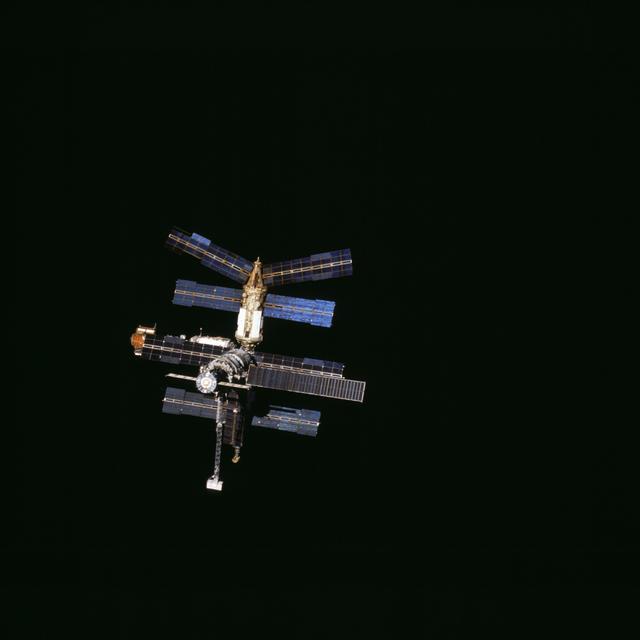
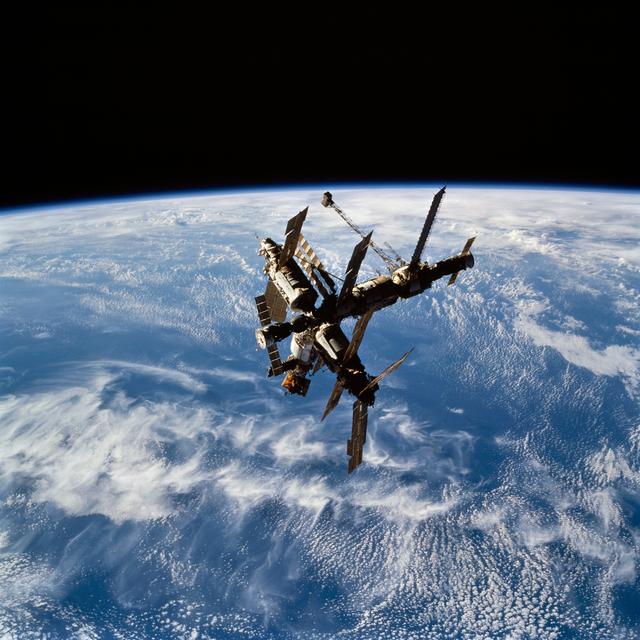
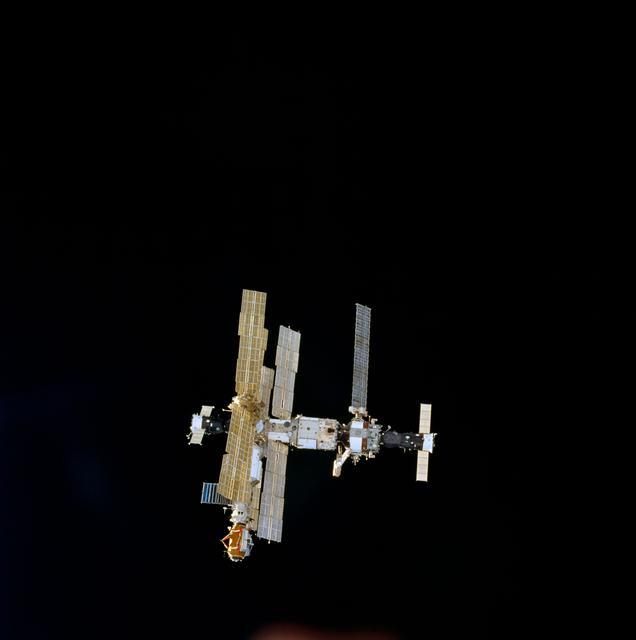
Mir — the first modular space station, inhabited almost continuously across its 15-year life (1986-2001) and home to the Shuttle-Mir partnership.
Key facts
Science
Mission
- Operator
- NPO Energia (USSR/Russia)
- Launched
- February 20, 1986
- Status
- Completed
Mission
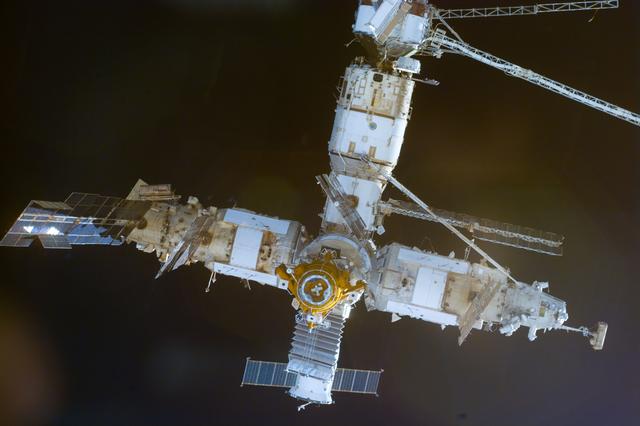
Mir — Russian for 'peace' or 'world' — was the first modular space station and, for fifteen years, the most ambitious structure ever assembled in orbit. Its core module launched on 20 February 1986, and over the next decade further modules — Kvant-1, Kvant-2, Kristall, Spektr and Priroda — were added one by one, growing Mir into a sprawling complex of laboratories, solar arrays and docking ports. For long stretches it was inhabited continuously, and aboard it Valeri Polyakov set the single-spaceflight endurance record that still stands: 437 days, a study in whether the human body could survive the journey to Mars. Assembling such a complex piece by piece in orbit, and keeping it flying far beyond its design life, was itself a pioneering feat of engineering and operations. Mir outlived the country that built it. After the Soviet Union dissolved, it became the stage for an extraordinary partnership: the Shuttle-Mir programme of 1995-1998, in which American Space Shuttles docked with the Russian station and US astronauts lived aboard for months alongside their Russian crewmates. It was the dress rehearsal for the International Space Station, teaching two former rivals how to build and fly together. Those later years were also hard, and Mir's troubles were faced honestly. In February 1997 a chemical oxygen canister ignited, sending flames and choking smoke through the station and briefly blocking a path to one of the escape craft. Months later, on 25 June 1997, a Progress cargo ship being guided in by hand during a docking test collided with the Spektr module, puncturing it and forcing the crew to seal it off as the station lost pressure and power — the most serious collision in the history of crewed spaceflight. The crews coped, repaired and carried on, but the ageing station grew ever more costly to maintain. With the ISS under way, Russia chose to retire Mir rather than refurbish it again. On 23 March 2001 it was guided to a controlled, deliberate re-entry, breaking up over the South Pacific. In its fifteen years Mir hosted 104 people from a dozen nations and proved that humans could live and work in orbit not for days but for years.
- 1986The core module launchesLaunch
Mir's first module reaches orbit — the heart of a station that will grow for a decade.
The first add-on module docks, beginning Mir's modular growth into a complex of laboratories.
Valeri Polyakov lands after the longest single spaceflight in history, still unbroken.
Space Shuttle Atlantis docks with Mir, opening the US-Russian partnership that rehearses the ISS.
- 1997Fire aboard MirMilestone
An oxygen-generating canister ignites, filling the station with smoke and briefly blocking a path to an escape craft.
- 1997The Progress collisionMilestone
A cargo ship strikes the Spektr module during a manual docking test, puncturing it and forcing the crew to seal it off.
- 2001Guided down to a controlled re-entryMission end
After 15 years and 104 visitors, Mir is guided to a deliberate re-entry over the South Pacific.
Images

Images from open archives · credit shown per image