
International Space Station
The International Space Station is a modular research laboratory in low Earth orbit, continuously crewed since November 2000. Built and operated by NASA, Roscosmos, ESA, JAXA and CSA, it circles Earth roughly every 90 minutes.
Key facts
Science
Mission
- Operator
- NASA / Roscosmos / ESA / JAXA / CSA
- Launched
- November 20, 1998
- Status
- Active
- Purpose
- Microgravity and space-environment research
Orbit
- Orbital speed
- 7.65 km/s
- Computed from the cached state vector
- Orbital altitude
- 420 km
- Orbital period
- 92.8 min
- Computed from the orbital altitude
- Inclination
- 51.60 °
Specifications
- Power source
- Solar arrays (~120 kW)
- Typical crew
- 7
Mission
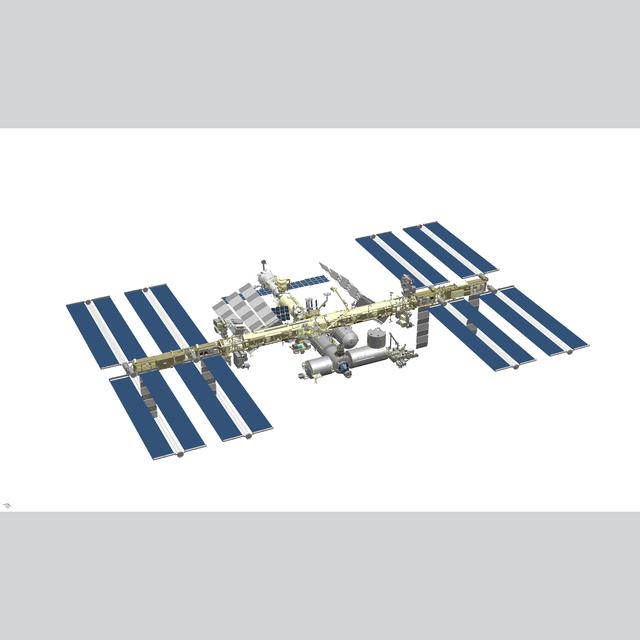
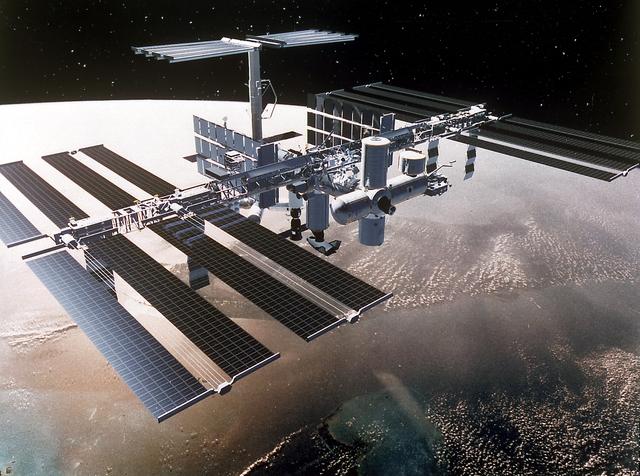
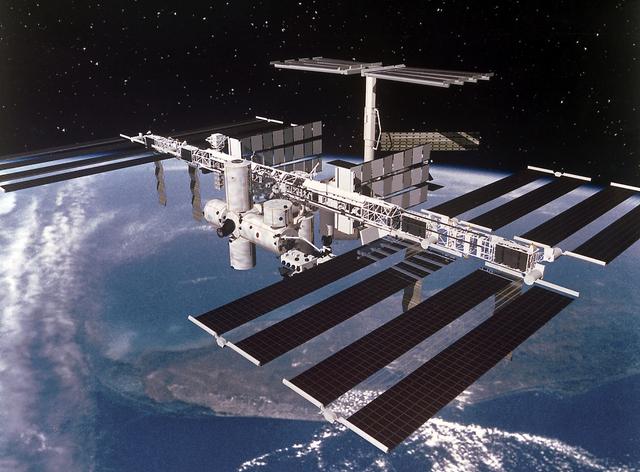
The International Space Station is the largest structure humans have ever built in space, and one of the most ambitious engineering and diplomatic projects in history. Assembly began on 20 November 1998 with the launch of the Russian-built Zarya module, and over the following years dozens of flights by the Space Shuttle and Russian rockets carried up module after module, bolting together a laboratory complex that now spans roughly the area of a football field and masses over 400 tonnes. It has been continuously inhabited since 2 November 2000, when the Expedition 1 crew arrived — meaning there has been an unbroken human presence in orbit for over two decades. Circling about 420 kilometres up at 28,000 kilometres per hour, the station sees sixteen sunrises and sunsets every day. It is a partnership of five space agencies — NASA, Russia's Roscosmos, Europe's ESA, Japan's JAXA and Canada's CSA — built and operated jointly even through periods of tension on the ground, a rare and durable example of international cooperation. Aboard it, rotating crews run thousands of experiments that exploit weightlessness, from studies of how the human body adapts to long spaceflight to research in physics, biology and materials that cannot be done on Earth. The station also became the destination for the first commercial crew and cargo flights, and is planned to operate until around 2030.
The Russian-built control module reaches orbit, beginning assembly of the station.
- 2000Continuous occupation beginsMilestone
The Expedition 1 crew arrives, starting an unbroken human presence in space that continues today.
- 2001Destiny laboratory addedMilestone
The US research lab is installed, expanding the station's scientific capability.
- 2011Assembly essentially completeMilestone
The final Space Shuttle flight delivers the last major US components.
- 2020First commercial crew arrivesMilestone
A SpaceX Crew Dragon docks, opening a new era of private transport to the station.
Images

Images from open archives · credit shown per image