
Starlink
SpaceX's low-Earth-orbit broadband constellation — thousands of small satellites providing global internet and the largest satellite network ever deployed. Shown here as a single representative constellation entry.
Key facts
Science
Mission
- Operator
- SpaceX
- Launched
- May 24, 2019
- Status
- Active
Mission
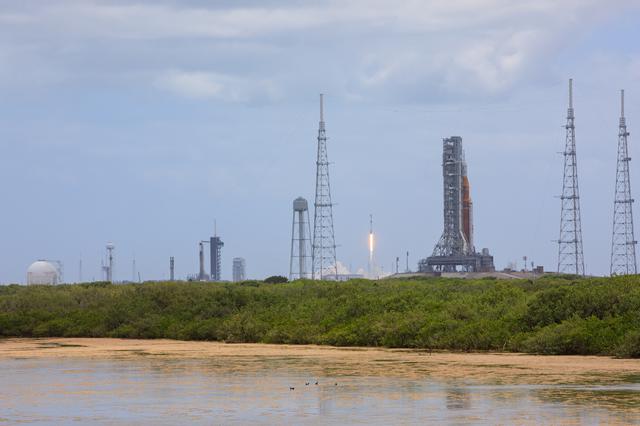
Starlink is SpaceX's constellation of internet satellites — by far the largest fleet of spacecraft ever built, and a venture that has changed the economics and the night sky of low Earth orbit. The first batch of sixty operational satellites launched on 24 May 2019, and SpaceX has been deploying them in dozens at a time ever since, building toward a network of many thousands flying at around 550 kilometres altitude. Their purpose is to beam fast, low-latency broadband to anywhere on Earth, especially the remote and underserved places that ground-based networks never reach; the service has since been used in disaster zones and conflict areas where other communications failed. The system works because the satellites are mass-produced — flat, compact and stackable — and because SpaceX launches them on its own reusable Falcon 9 rockets, driving the cost per satellite far below anything previously possible. That scale has a cost of its own: astronomers have raised serious concerns that the bright, numerous satellites streak telescope images and crowd the radio spectrum, and the sheer number of objects sharpens worries about orbital congestion and collision debris. SpaceX has worked to darken the satellites and coordinate with observatories, but the debate over who governs an increasingly crowded orbit continues. In the catalog, the constellation is shown as a representative cluster rather than as thousands of individual dots.
- 2019First 60 operational satellitesLaunch
SpaceX launches the first batch of its internet constellation into low Earth orbit.
- 2020Public service beginsMilestone
A beta broadband service opens to users, delivering low-latency internet from orbit.
- 2021Over a thousand satellites in orbitMilestone
The constellation passes 1,000 spacecraft, already the largest fleet ever flown.
- 2023Second-generation satellitesMilestone
Larger, more capable 'V2' satellites begin launching to expand network capacity.
Images
Images from open archives · credit shown per image