19P/Borrelly
Comet· orbits the Sun
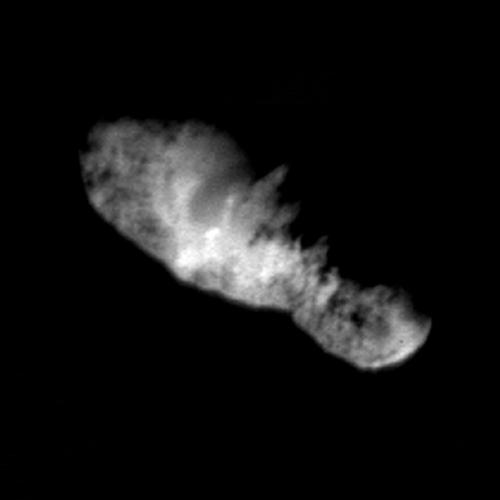
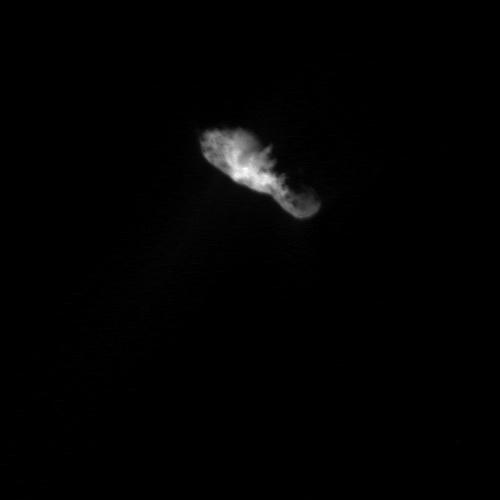
19P/Borrelly is a Jupiter-family comet that comes back to the inner Solar System about every 6.9 years. NASA's Deep Space 1 flew 2,171 km from its nucleus on 22 September 2001, and its pictures were the first high-resolution images of the nucleus of a Jupiter-family comet.
Open in 3D viewSee 19P/Borrelly in the live, interactive 3D map
Key facts
Perihelion
1.31 AU
Aphelion
5.91 AU
Orbital period
6.86 years
Eccentricity
0.6374
Science
Physical
- Nucleus
- ≈ 8.0 × 3.15 km (Deep Space 1)
- Composition
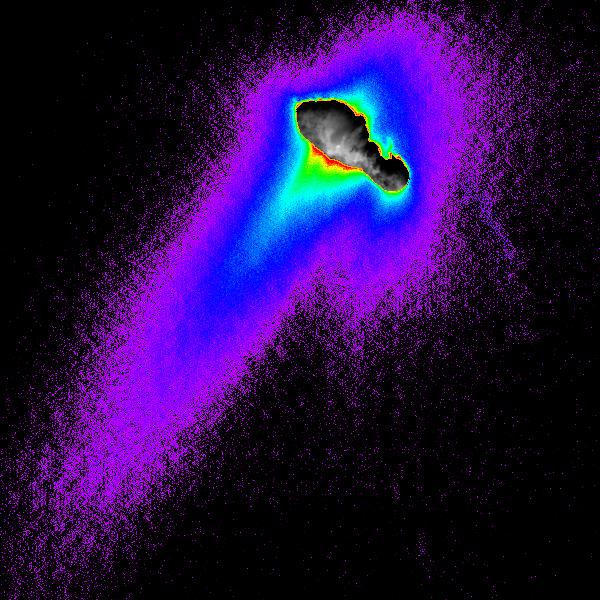
- A dark nucleus of ice and dust, shaped like a bowling pin, with jets of dust streaming from its sunlit side. Deep Space 1's infrared spectrometer found the surface hot and dry — about 300 to 345 K, with no water ice detected on it (Soderblom et al. 2002). Its mass has not been measured, so no density or gravity is shown.
Orbital
- Semi-major axis
- 3.61 AU
- From catalogued orbital elements (MPC)
- Eccentricity
- 0.6374
- From catalogued orbital elements (MPC)
- Inclination
- 29.30 °
- From catalogued orbital elements (MPC)
- Orbital period
- 6.86 years
- From catalogued orbital elements (MPC)
- Perihelion
- 1.31 AU
- Computed from the orbital elements
- Aphelion
- 5.91 AU
- Computed from the orbital elements
- Mean orbital velocity
- 15.7 km/s
- Computed from the orbital elements
Activity
- Perihelion distance
- 1.31 AU
- Becomes active within
- 5 AU of the Sun
Radiation & temperature
- Insolation
- 0.0768 S⊕ · 8% of the sunlight Earth receives
- Computed from the distance to the Sun (inverse-square; Earth's sunlight = 1), before any atmosphere.
- Geometric albedo
- 0.03
- Geometric albedo 0.029 ± 0.006 (Buratti et al. 2004) — its Bond albedo, 0.009 ± 0.002, is among the lowest measured in the Solar System.
- Equilibrium temperature
- 145 K (-128 °C)
- Computed from albedo + distance from the Sun (airless black body); uses the geometric albedo as an estimate
Discovery & history
- Discovered
- December 28, 1904
- By
- Alphonse Borrelly (Marseille Observatory)
- Name
- Named after its discoverer, the French astronomer Alphonse Borrelly.
Alphonse Borrelly found it at Marseille Observatory on 28 December 1904. On 22 September 2001 NASA's Deep Space 1 flew past it, 2,171 km from the nucleus, on an extended mission after its star tracker had failed; its pictures were the first high-resolution images of the nucleus of a Jupiter-family comet.
Photographed the nucleus from 2,171 km, driven there by its ion engine.
Images
Images from open archives · credit shown per image