103P/Hartley 2
Comet· orbits the Sun
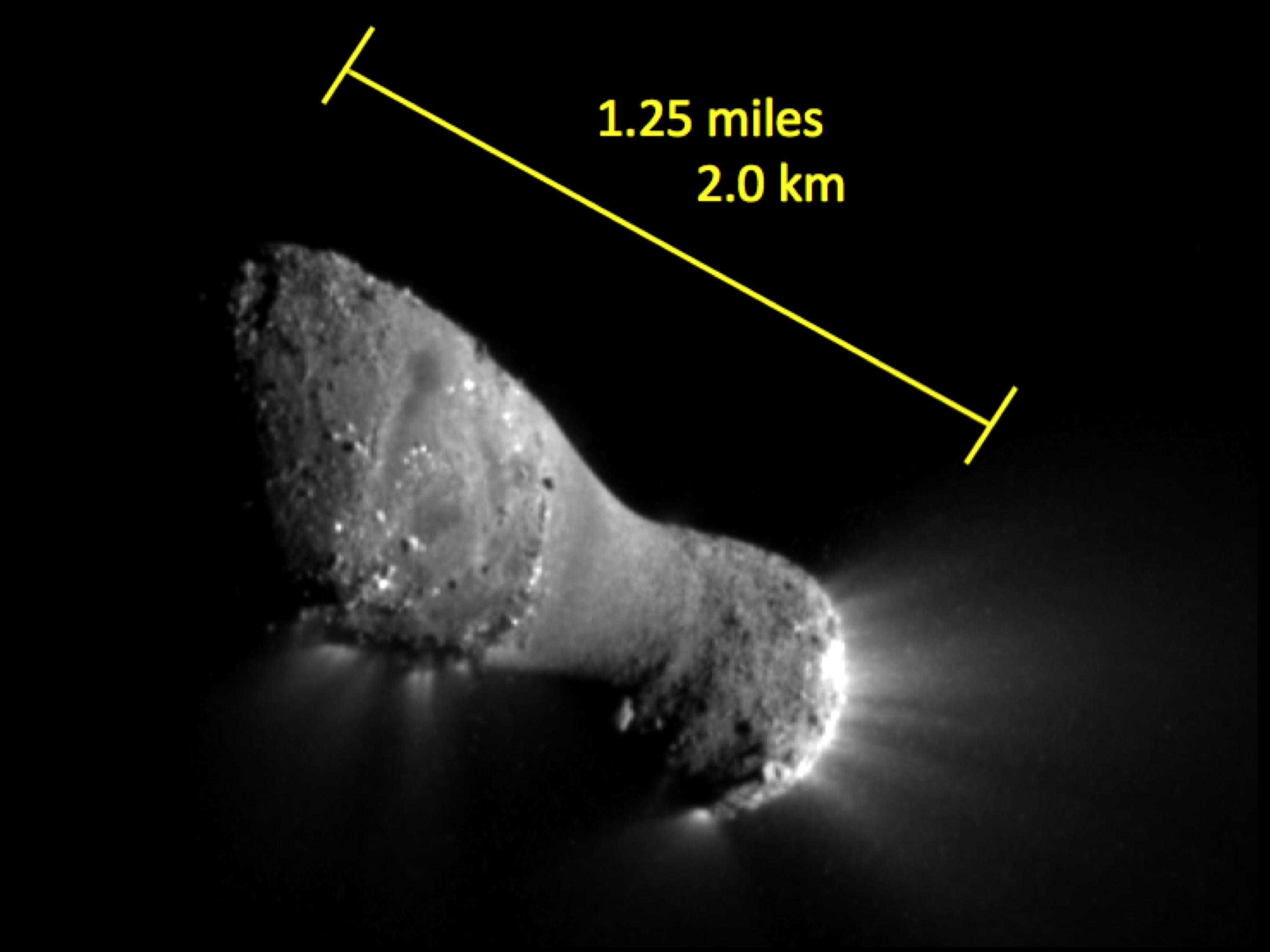
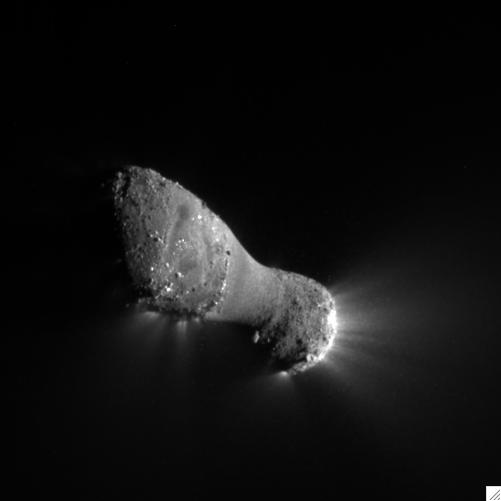
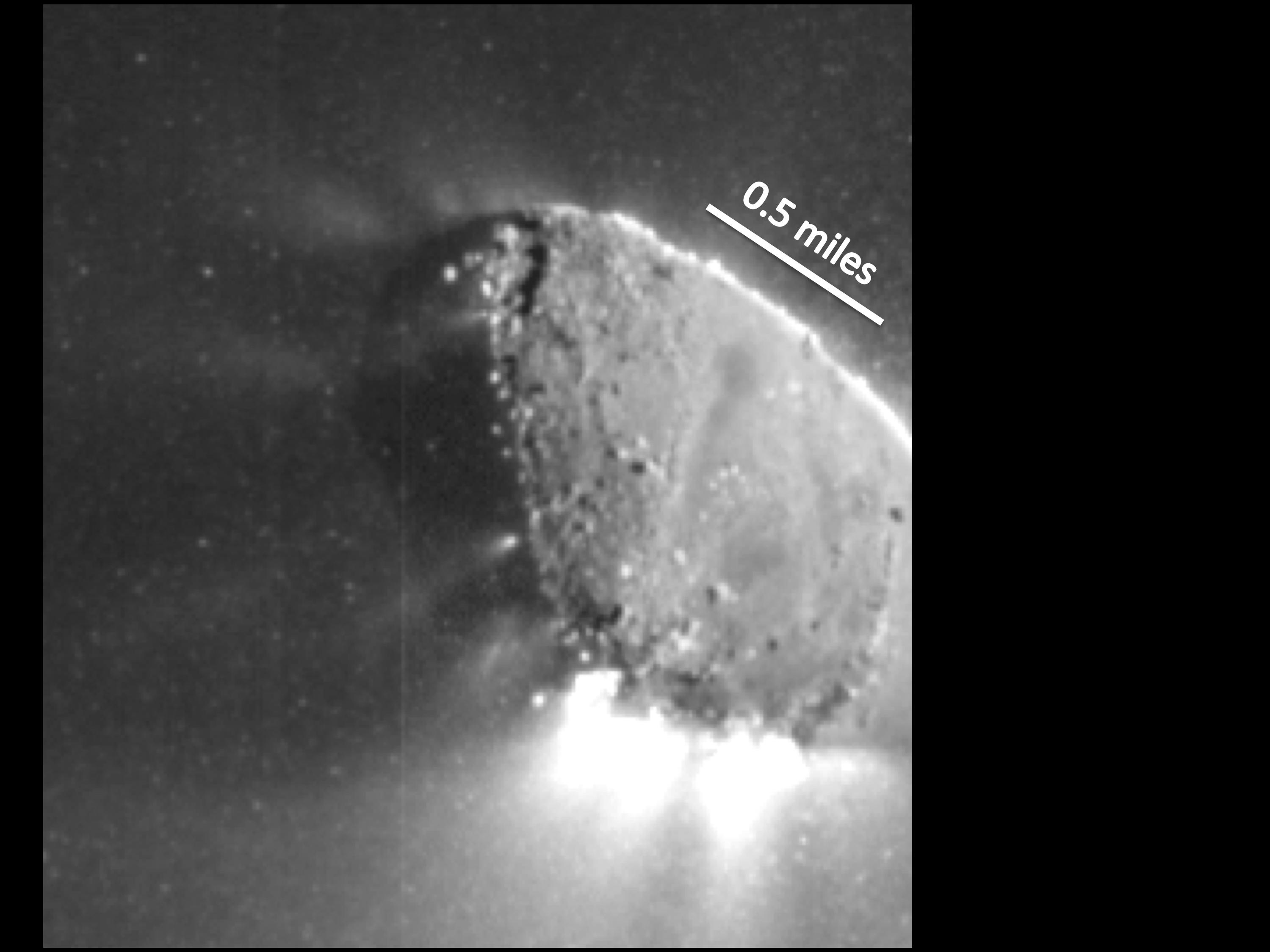
103P/Hartley 2 is a small Jupiter-family comet, 2.33 km long, that returns about every 6.5 years. On 4 November 2010 NASA's EPOXI mission, the Deep Impact spacecraft, flew 694 km from it and found jets driven by carbon dioxide dragging chunks of ice out of its ends.
Open in 3D viewSee 103P/Hartley 2 in the live, interactive 3D map
Key facts
Perihelion
1.07 AU
Aphelion
5.89 AU
Orbital period
6.48 years
Eccentricity
0.6931
Science
Physical
- Nucleus
- 2.33 km long; 0.580 km mean radius (Thomas et al. 2013)
- Composition
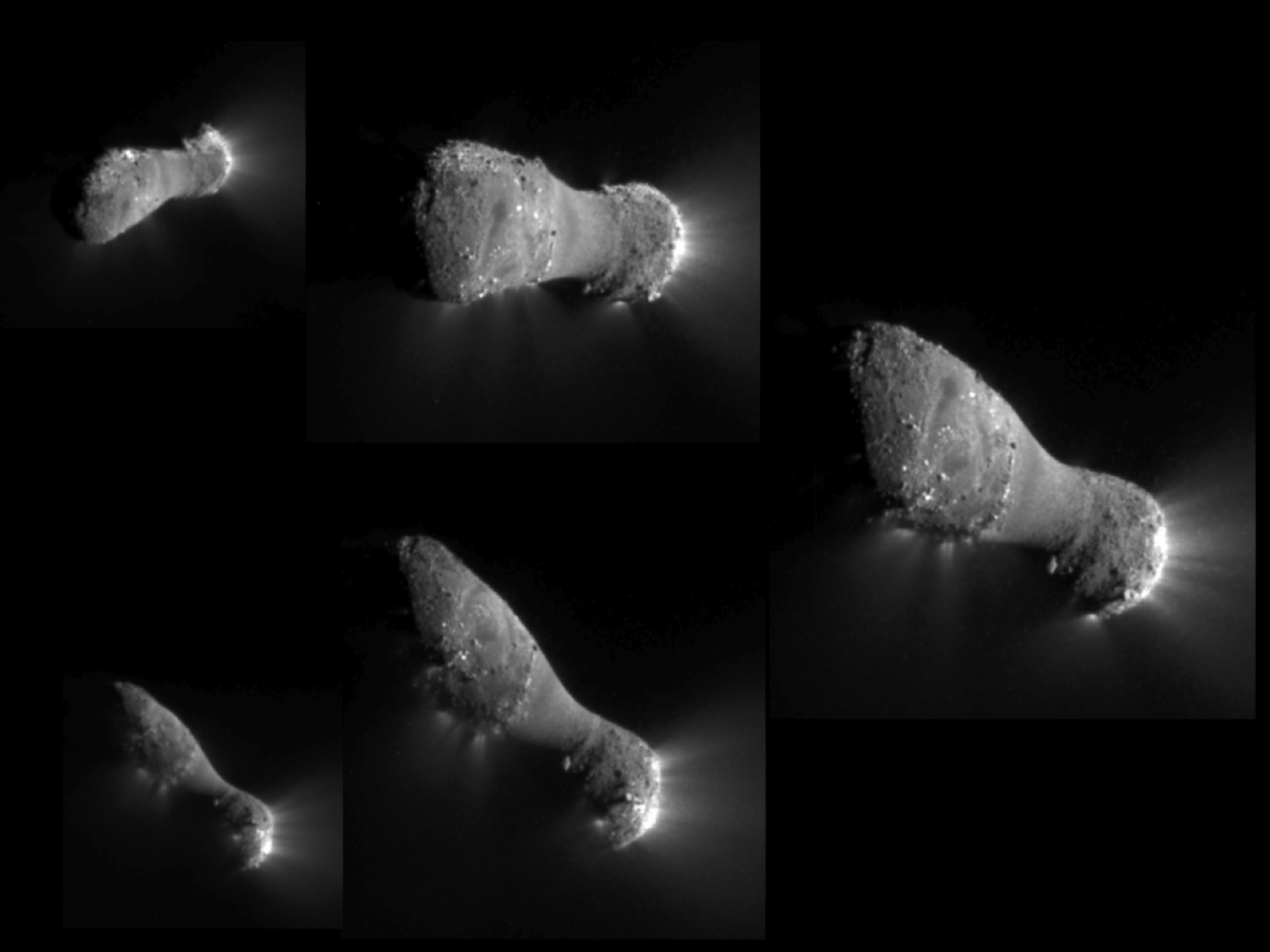
- Two rugged lobes joined by a smooth waist. Most of its activity is driven by carbon dioxide, which carries ice out of the nucleus, while the waist gives off water vapour with little carbon dioxide (A'Hearn et al. 2011); for its size it is very active, giving off about as much gas as the far larger Tempel 1. It tumbles rather than spinning about one axis: at the flyby its long axis circled every 18.4 hours and rolled every 26.7 hours (Belton et al. 2013). Its mass has not been measured; its density is estimated at 0.2–0.4 g/cm³ from its shape (Thomas et al. 2013).
Orbital
- Semi-major axis
- 3.48 AU
- From catalogued orbital elements (MPC)
- Eccentricity
- 0.6931
- From catalogued orbital elements (MPC)
- Inclination
- 13.60 °
- From catalogued orbital elements (MPC)
- Orbital period
- 6.48 years
- From catalogued orbital elements (MPC)
- Perihelion
- 1.07 AU
- Computed from the orbital elements
- Aphelion
- 5.89 AU
- Computed from the orbital elements
- Mean orbital velocity
- 16 km/s
- Computed from the orbital elements
Activity
- Perihelion distance
- 1.07 AU
- Becomes active within
- 5 AU of the Sun
Radiation & temperature
- Insolation
- 0.0827 S⊕ · 8% of the sunlight Earth receives
- Computed from the distance to the Sun (inverse-square; Earth's sunlight = 1), before any atmosphere.
- Geometric albedo
- 0.04
- Geometric albedo 0.045 ± 0.009; Bond albedo 0.012 ± 0.002 (Li et al. 2013).
- Equilibrium temperature
- 148 K (-126 °C)
- Computed from albedo + distance from the Sun (airless black body); uses the geometric albedo as an estimate
Discovery & history
- Discovered
- March 15, 1986
- By
- Malcolm Hartley (UK Schmidt Telescope, Siding Spring)
- Name
- Named after its discoverer, the British astronomer Malcolm Hartley; the 2 marks his second periodic comet.
Malcolm Hartley found it on 15 March 1986 on a plate taken with the UK Schmidt Telescope at Siding Spring, Australia. On 4 November 2010 the Deep Impact spacecraft, renamed EPOXI for its extended mission, passed 694 km from the nucleus at 12.3 km/s.
Passed at 12.3 km/s and found jets driven by carbon dioxide carrying ice out of the nucleus.
Images
Images from open archives · credit shown per image