9P/Tempel 1
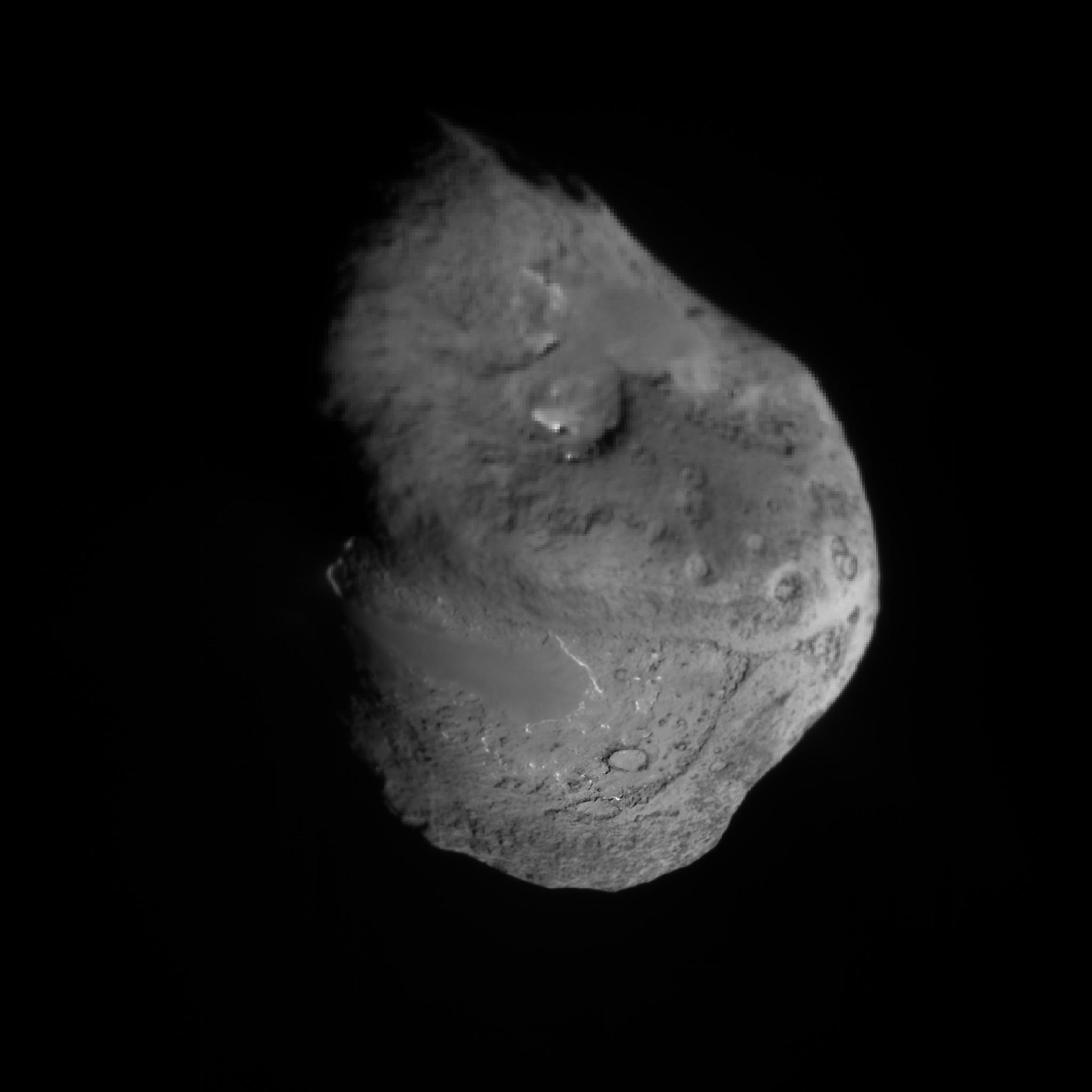
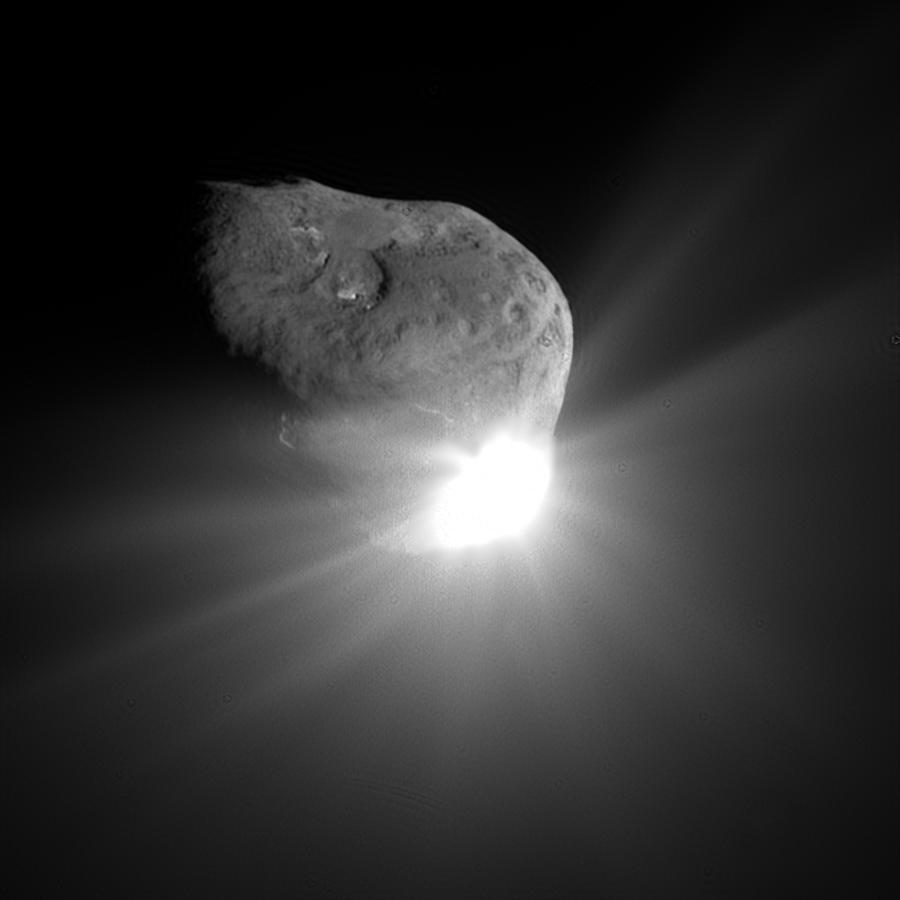
9P/Tempel 1 is a Jupiter-family comet that returns about every 5.6 years. On 4 July 2005 NASA's Deep Impact struck it with an impactor and watched the plume from about 500 km; on 15 February 2011 Stardust flew past at 181 km and saw the site again, making Tempel 1 the first comet visited twice.
Key facts
Science
Physical
- Nucleus
- ≈ 7.6 × 4.9 km (A'Hearn et al. 2005); 2.83 km mean radius (Thomas et al. 2013)
- Composition
- A nucleus of dust and ice under a surface layer of very fine, loose grains. The impact threw out material rich in organic compounds, and Deep Impact found the first water ice seen on a comet's surface — three small patches, far too little to supply the gas it gives off (Sunshine et al. 2006). Its density is estimated at about 0.4–0.5 g/cm³ from how the impact's ejecta fell back and from its measured volume (Richardson et al. 2007; Thomas et al. 2013); its mass has not been measured directly, so no gravity is shown. Its spin speeds up by 13 to 17 minutes at each pass near the Sun (Belton et al. 2011).
Orbital
- Semi-major axis
- 3.31 AU
- From catalogued orbital elements (MPC)
- Eccentricity
- 0.4648
- From catalogued orbital elements (MPC)
- Inclination
- 10.47 °
- From catalogued orbital elements (MPC)
- Orbital period
- 6.01 years
- From catalogued orbital elements (MPC)
- Perihelion
- 1.77 AU
- Computed from the orbital elements
- Aphelion
- 4.84 AU
- Computed from the orbital elements
- Mean orbital velocity
- 16.4 km/s
- Computed from the orbital elements
Activity
- Perihelion distance
- 1.77 AU
- Becomes active within
- 5 AU of the Sun
Radiation & temperature
- Insolation
- 0.0915 S⊕ · 9% of the sunlight Earth receives
- Computed from the distance to the Sun (inverse-square; Earth's sunlight = 1), before any atmosphere.
- Geometric albedo
- 0.06
- Geometric albedo about 0.06, with modest variations (Li et al. 2013).
- Equilibrium temperature
- 151 K (-122 °C)
- Computed from albedo + distance from the Sun (airless black body); uses the geometric albedo as an estimate
Discovery & history
- Discovered
- April 3, 1867
- By
- Wilhelm Tempel (Marseille)
- Name
- Named after its discoverer, the German astronomer Wilhelm Tempel; the 1 sets it apart from his other periodic comets, such as 10P/Tempel 2.
Wilhelm Tempel found it at Marseille on 3 April 1867. On 4 July 2005 Deep Impact's impactor, about 370 kg, struck the nucleus at about 10.3 km/s while the flyby spacecraft passed about 500 km away and watched the plume. On 15 February 2011 Stardust, on its extended mission, flew past at 181 km (178 km in the mission's archive) and saw the site of the impact.
Its impactor struck the nucleus at about 10.3 km/s while the flyby spacecraft watched from about 500 km.
Passed 181 km away (178 km in the mission's archive) and saw the site of Deep Impact's crater.
Images


Images from open archives · credit shown per image