
81P/Wild 2
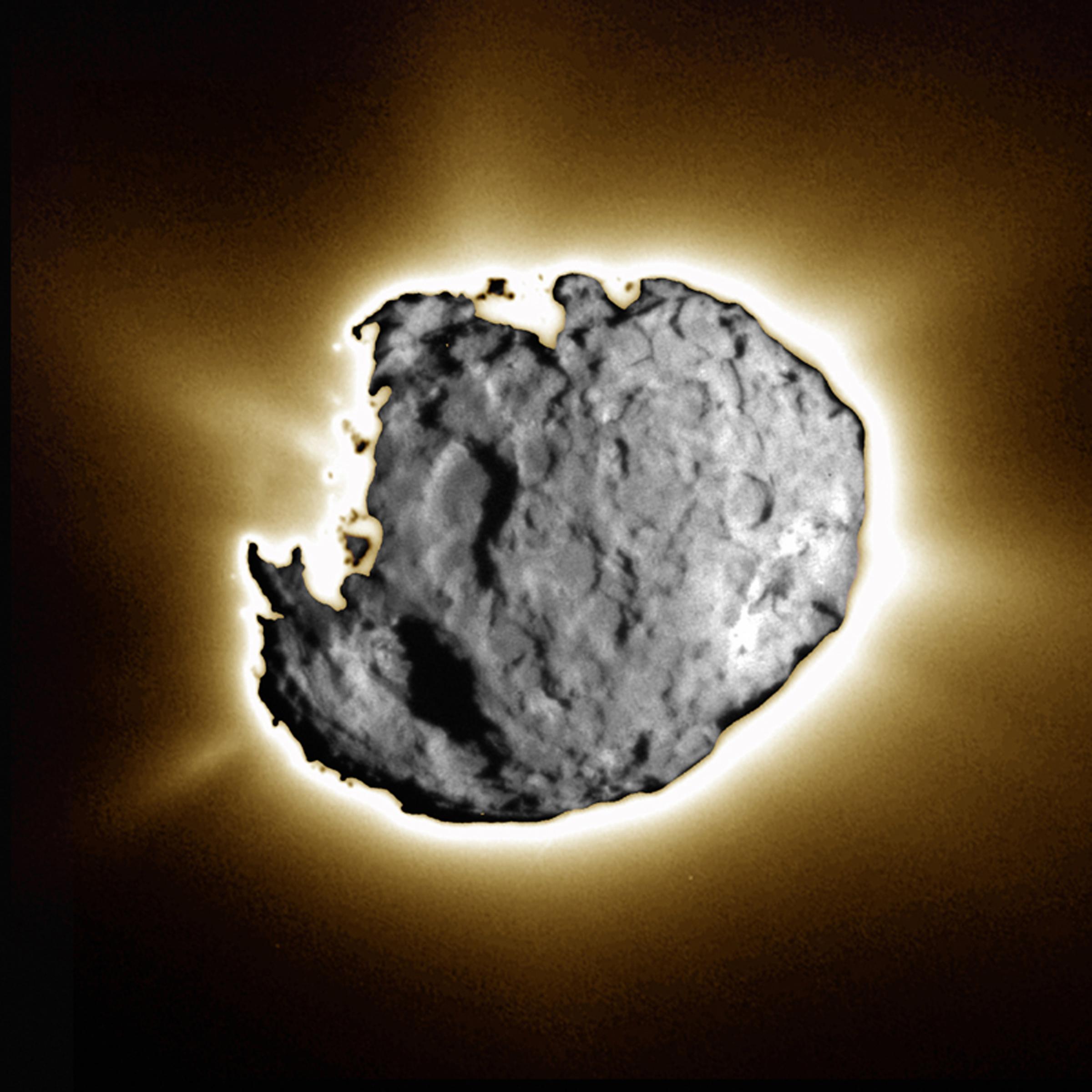
81P/Wild 2 is a Jupiter-family comet that returns about every 6.4 years; a close pass by Jupiter in 1974 brought it into the inner Solar System. On 2 January 2004 NASA's Stardust flew through its coma, 236 km from the nucleus, and brought samples of its dust back to Earth in 2006.
Key facts
Science
Physical
- Nucleus
- ≈ 5.5 × 4.0 × 3.3 km (Duxbury et al. 2004)
- Composition
- A cohesive nucleus with steep slopes, flat-floored depressions and at least 20 narrow jets (Brownlee et al. 2004; Sekanina et al. 2004). The returned dust holds minerals that formed at high temperature close to the young Sun, so material from the inner Solar System reached the comet-forming region (Brownlee et al. 2006), and it held glycine of extraterrestrial origin — the first amino acid found in a comet sample (Elsila et al. 2009). Its mass has not been measured; its density is known only to be below about 0.6 g/cm³, from a model of its orbit (Davidsson and Gutiérrez 2006). Its spin, about 13.5 hours, is estimated from features in its coma seen from Earth (Mueller et al. 2010).
Orbital
- Semi-major axis
- 3.45 AU
- From catalogued orbital elements (MPC)
- Eccentricity
- 0.5381
- From catalogued orbital elements (MPC)
- Inclination
- 3.24 °
- From catalogued orbital elements (MPC)
- Orbital period
- 6.41 years
- From catalogued orbital elements (MPC)
- Perihelion
- 1.59 AU
- Computed from the orbital elements
- Aphelion
- 5.31 AU
- Computed from the orbital elements
- Mean orbital velocity
- 16 km/s
- Computed from the orbital elements
Activity
- Perihelion distance
- 1.59 AU
- Becomes active within
- 5 AU of the Sun
Radiation & temperature
- Insolation
- 0.084 S⊕ · 8% of the sunlight Earth receives
- Computed from the distance to the Sun (inverse-square; Earth's sunlight = 1), before any atmosphere.
- Geometric albedo
- 0.06
- Geometric albedo 0.059 (Li et al. 2009).
- Equilibrium temperature
- 148 K (-126 °C)
- Computed from albedo + distance from the Sun (airless black body); uses the geometric albedo as an estimate
Discovery & history
- Discovered
- January 6, 1978
- By
- Paul Wild (Zimmerwald, University of Bern)
- Name
- Named after its discoverer, the Swiss astronomer Paul Wild; the 2 marks his second periodic comet.
Paul Wild found it on 6 January 1978 with the 40 cm Schmidt telescope at Zimmerwald, the University of Bern's observing station. In 1974 it had passed close to Jupiter, which moved its orbit into the inner Solar System. Stardust's flyby on 2 January 2004, at 236.4 km and 6.1 km/s, photographed the nucleus, and its capsule landed in Utah on 15 January 2006 with the first samples of a comet.
Flew through the coma 236 km from the nucleus, catching dust in aerogel that returned to Earth in 2006.
Images

Images from open archives · credit shown per image