
433 Eros
Asteroid· orbits the Sun
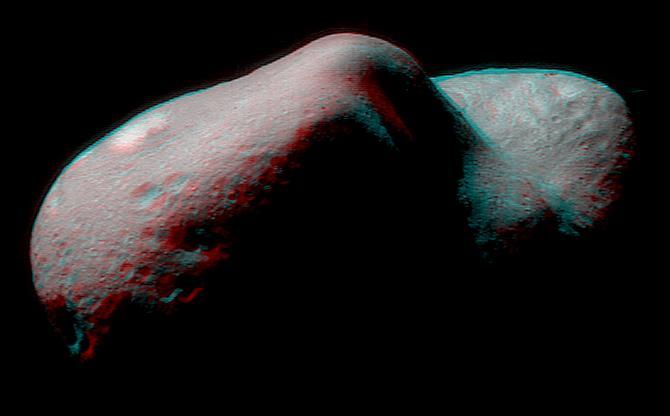
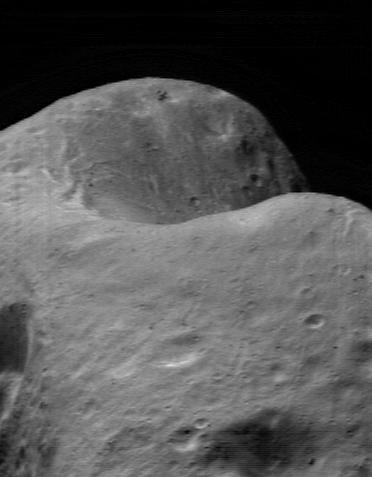
Eros is a large, elongated stony near-Earth asteroid and the first asteroid to be orbited and landed on, by NASA's NEAR Shoemaker in 2000–2001.
Open in 3D viewSee 433 Eros in the live, interactive 3D map
Key facts
Radius
8.42 km
Distance from Sun
1.46 AU
Orbital period
1.76 years
Eccentricity
0.2229
Rotation
5.27 hours
Science
Physical
- Mean radius
- 8.42 km
- Mass
- 6.69 × 10¹⁵ kg · 0.0000000911 Moon masses
- Density
- 2,674 kg/m³ · 2.7× water
- Computed from mass and radius
- Rotation period
- 5.27 hours
Orbital
- Semi-major axis
- 1.46 AU
- From catalogued orbital elements (MPC)
- Eccentricity
- 0.2229
- From catalogued orbital elements (MPC)
- Inclination
- 10.83 °
- From catalogued orbital elements (MPC)
- Orbital period
- 1.76 years
- From catalogued orbital elements (MPC)
- Perihelion
- 1.13 AU
- Computed from the orbital elements
- Aphelion
- 1.78 AU
- Computed from the orbital elements
- Mean orbital velocity
- 24.7 km/s
- Computed from the orbital elements
Discovery
- Discovered
- August 13, 1898
- Discoverer
- Carl Gustav Witt (and, independently, Auguste Charlois)
Composition
- Make-up
- An S-type asteroid of silicate rock (olivine and pyroxene) with some metal; an undifferentiated, primitive body.
Radiation & temperature
- Insolation
- 0.47 S⊕ · 47% of the sunlight Earth receives
- Computed from the distance to the Sun (inverse-square; Earth's sunlight = 1), before any atmosphere.
- Geometric albedo
- 0.25
- Geometric (V-band) albedo (NEAR Shoemaker).
- Equilibrium temperature
- 214 K (-59 °C)
- Computed from albedo + distance from the Sun (airless black body); uses the geometric albedo as an estimate
Discovery & history
- Discovered
- August 13, 1898
- By
- Carl Gustav Witt (and, independently, Auguste Charlois)
- Method
- Photographic plates
- Name
- The Greek god of love — the first asteroid given a male name.
Eros, found in 1898, was the first near-Earth asteroid discovered, and its close approaches to Earth were used to measure the scale of the Solar System. In 2000 NASA's NEAR Shoemaker became the first spacecraft to orbit an asteroid, and in 2001 it gently touched down on Eros — the first landing on an asteroid, even though the probe was never designed to land.
- 2000NEAR ShoemakerOrbiter
First spacecraft to orbit an asteroid; in 2001 it became the first to land on one.
Images

Images from open archives · credit shown per image