
Apollo 1
Apollo 1 — the first crewed Apollo mission, lost on the pad at Launch Complex 34 on 1967-01-27 when a fire swept the command module during a test, killing Gus Grissom, Ed White and Roger Chaffee.
Key facts
Mission & specifications
Mission
- Operator
- NASA
- Launched
- January 6, 1967
- Status
- Lost
Trajectory
- Distance from the Sun
- 0.998 AU
- Computed from the cached position
- Distance from Earth
- 1,371,608 km
- Computed from cached positions
- Distance from Venus
- 0.287 AU
- Computed from cached positions
Mission
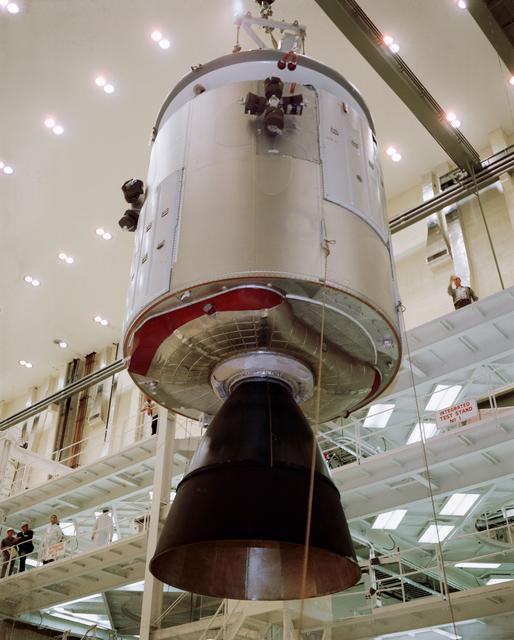
Apollo 1 was meant to be the first crewed flight of the Apollo programme — the spacecraft that would begin the journey to the Moon. It never flew. On 27 January 1967, the veteran astronaut Gus Grissom, the first American spacewalker Ed White, and the rookie Roger Chaffee were sealed inside their command module atop an unfuelled Saturn IB at Launch Complex 34, Cape Canaveral, running a 'plugs-out' rehearsal of the countdown a few weeks before their planned February launch. The test was considered routine and non-hazardous; the rocket carried no propellant. But the cabin was pressurised with pure oxygen above sea-level pressure, the hatch opened inward and was slow to release, and the cramped interior was full of flammable materials and wiring. In the early evening, after hours of frustrating communication faults, a spark — most likely from damaged wiring — ignited the oxygen-soaked cabin. Fire spread in seconds. The crew could not open the inward-opening hatch against the rising internal pressure, and all three men died before the pad team could reach them. They were the first American astronauts to die in the course of the space programme. The loss stunned NASA and the nation, but the investigation that followed almost certainly saved the Moon programme. A review board, with the astronaut Frank Borman among its members, traced not a single fault but a pattern of accepted risks: the pure-oxygen atmosphere, the flammable cabin, the dangerous hatch, and shortcomings in workmanship and oversight. In the redesign that followed, engineers fitted a quick-opening outward hatch, replaced flammable materials with self-extinguishing ones, re-routed and protected the wiring, and switched the cabin to a safer nitrogen-oxygen mix for launch. Apollo did not fly a crew again for twenty-one months. When it did, with Apollo 7, the spacecraft was far safer for the lessons paid for so dearly. The three astronauts are memorialised at the pad where they died, and the flight they never made is honoured as Apollo 1 at their families' request — remembered not as a failure, but as the sacrifice that made the journey to the Moon survivable.
- 1967Rollout to Launch Complex 34Milestone
The Apollo 1 spacecraft and its Saturn IB are stacked on the pad for testing ahead of a February launch.
Grissom, White and Chaffee are sealed in the command module for a countdown rehearsal, the cabin pressurised in pure oxygen.
- 1967The fire — Apollo 1 is lostMission end
A spark ignites the oxygen-rich cabin; the inward-opening hatch cannot be opened in time and all three astronauts die.
- 1967The review board reportsMilestone
The board traces the fire to the pure-oxygen cabin, flammable materials and the hatch; a sweeping redesign follows.
Apollo 7 safely flies the redesigned spacecraft, vindicating the changes made after the fire.
Images

Images from open archives · credit shown per image