
Artemis III
Artemis III — NASA's next crewed Artemis mission. On 27 February 2026 NASA redesignated it from a lunar landing to a crewed demonstration in low Earth orbit, now targeting late 2027; Orion will test the SpaceX Starship and Blue Origin Blue Moon human-landing-system pathfinders in Earth orbit. The first Artemis crewed lunar landing has shifted to Artemis IV (no earlier than 2028). The prime crew — Randy Bresnik, Luca Parmitano, Frank Rubio and Andre Douglas — was announced in June 2026. Shown here at a representative low-Earth-orbit position.
Key facts
Mission & specifications
Mission
- Operator
- NASA
- Status
- Planned
Trajectory
- Distance from the Sun
- 0.996 AU
- Computed from the cached position
- Distance from Earth
- 1,470,296 km
- Computed from cached positions
- Distance from Venus
- 0.276 AU
- Computed from cached positions
Mission
Artemis III is NASA's planned crewed lunar landing — the mission intended to return astronauts to the surface of the Moon for the first time since Apollo 17 in 1972, after a gap of more than half a century. As an upcoming flight, much about it may still shift, but its goals are set: to land near the lunar south pole, and to put the first woman and the first person of color on the Moon. The choice of the south pole is deliberate. Where the Apollo crews landed near the equator, Artemis III targets the polar region because the permanently shadowed floors of its craters are thought to hold billions of tonnes of water ice — never touched by sunlight, and never visited. That ice is both a scientific record of the Solar System's history and a potential resource: water to drink, oxygen to breathe, and hydrogen and oxygen for rocket propellant. NASA has identified a set of candidate landing regions clustered around the pole, each beside terrain that stays in near-constant sunlight for power while sitting next to the shadowed, ice-bearing craters. The mission architecture combines NASA and commercial hardware. The crew will launch on NASA's Space Launch System aboard the Orion spacecraft and travel to lunar orbit. There they will rendezvous with a separate lander — SpaceX's Starship Human Landing System, selected by NASA in 2021 as the surface transport vehicle and fuelled in orbit by a series of tanker flights. Starship will carry two of the astronauts down to the surface and back up to Orion, which then brings the full crew home. If it succeeds, Artemis III will be far more than a repeat of Apollo. It is intended as the first step toward a sustained human presence at the Moon's resource-rich south pole — the start of a new era of exploration rather than a brief return visit.
- 2027Planned launch (no earlier than 2027)Milestone
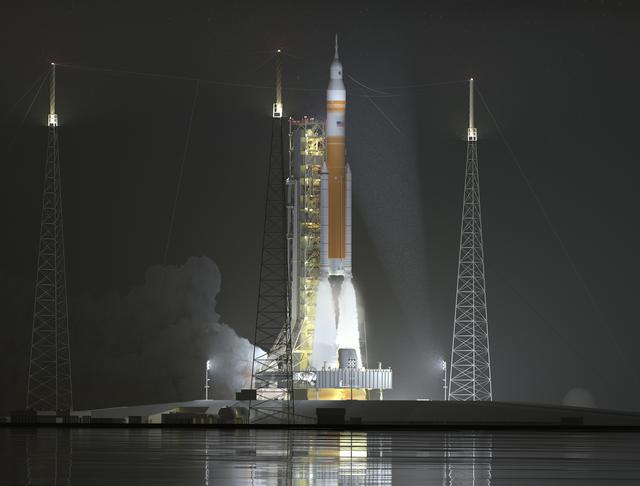
The crew is to launch on SLS aboard Orion and travel to lunar orbit.
Two astronauts are to descend in a Starship lander to a site near the lunar south pole — the first crewed landing since 1972.
After the surface stay, the crew is to rejoin Orion in lunar orbit and return home.
Images


Images from open archives · credit shown per image