
Chandra X-ray Observatory
Chandra — NASA's flagship X-ray observatory (since 1999), imaging the hot, violent universe of black holes, exploded stars and galaxy clusters from a high, elongated Earth orbit.
Key facts
Mission & specifications
Mission
- Operator
- NASA
- Launched
- July 23, 1999
- Status
- Active
Trajectory
- Speed rel. Earth
- 2.32 km/s
- Computed from the cached state vector, relative to Earth
- Distance from the Sun
- 0.997 AU
- Computed from the cached position
- Distance from Earth
- 1,776,328 km
- Computed from cached positions
- Distance from Venus
- 0.278 AU
- Computed from cached positions
Mission
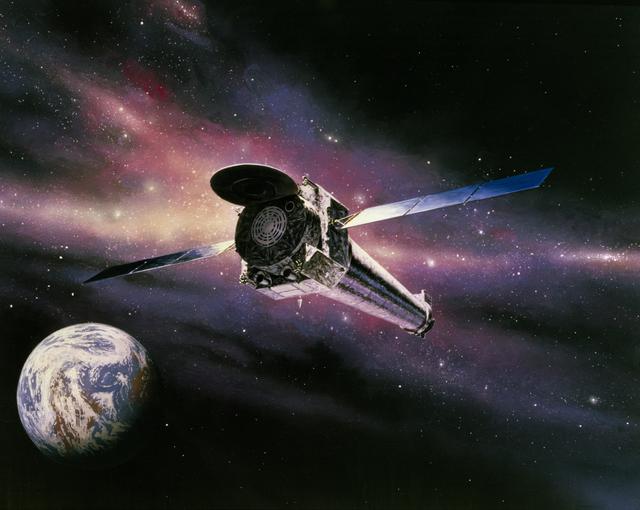
The Chandra X-ray Observatory is NASA's flagship for seeing the universe at its most violent. Most of the cosmos's high-energy drama — gas falling into black holes, the debris of exploded stars, colliding galaxy clusters — shines brightest in X-rays, which never reach the ground because Earth's atmosphere blocks them. To see that universe you must go above the air, with mirrors unlike any other. Launched by the Space Shuttle Columbia in July 1999, Chandra carries the smoothest, most precisely shaped mirrors ever made — nested, barrel-like surfaces that graze X-rays to a focus rather than reflecting them head-on. Named for the astrophysicist Subrahmanyan Chandrasekhar, it flies in a highly elongated orbit that swings a third of the way to the Moon, far above Earth's radiation belts, for long, uninterrupted observations. For more than two decades Chandra has produced some of the sharpest X-ray images ever taken. It has mapped the searing gas threaded through galaxy clusters, watched matter spiral into black holes, found the point-like source left by a supernova, and provided some of the best direct evidence for dark matter by imaging the collision of two galaxy clusters. Alongside Hubble and the great infrared observatories, it has been an essential eye on the energetic universe for a generation.
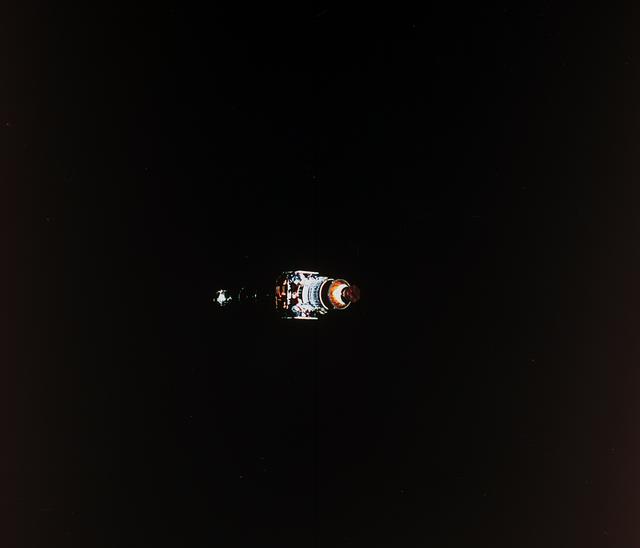
Deployed on STS-93 into a high, elongated Earth orbit.
- 1999First imageMilestone
Chandra opens its eyes on the X-ray sky.
- 2006Evidence for dark matterMilestone
Images of the Bullet Cluster collision separate dark matter from ordinary hot gas.
Images

Images from open archives · credit shown per image