
Sputnik 1
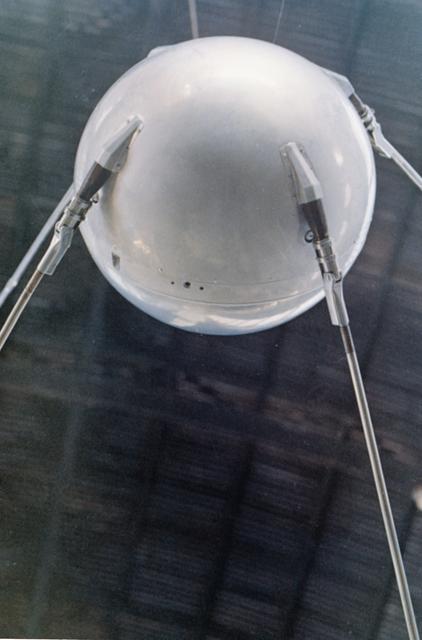
Sputnik 1 — the first artificial satellite (October 1957), whose radio beeps from orbit opened the space age.
Key facts
Mission & specifications
Mission
- Operator
- OKB-1 (USSR)
- Launched
- October 4, 1957
- Status
- Completed
Trajectory
- Distance from the Sun
- 0.998 AU
- Computed from the cached position
- Distance from Earth
- 3,852,237 km
- Computed from cached positions
- Distance from Venus
- 0.282 AU
- Computed from cached positions
Mission
Sputnik 1 changed history in a single night. On 4 October 1957 the Soviet Union launched a polished metal sphere just 58 centimetres across, with four trailing antennas, into orbit around the Earth — the first artificial satellite, and the first human-made object to circle the planet. It did almost nothing by modern standards: it carried no instruments beyond a radio transmitter, and simply broadcast a steady 'beep... beep... beep' on shortwave frequencies that amateur radio operators around the world could pick up for themselves. But that simple signal, passing overhead every ninety-six minutes, was electrifying. Anyone with a radio could hear the Space Age arrive; anyone who looked up at the right moment could see the rocket's spent stage glinting as it crossed the sky. For the United States the shock was profound. If the Soviets could place a satellite over American skies, the same rockets could carry warheads — and the nation that had assumed it led the world in technology suddenly felt behind. The reaction, sometimes called the 'Sputnik crisis', poured money into science education, spurred the creation of NASA the following year, and lit the fuse of the space race that would end with Americans on the Moon. Sputnik 1 itself was short-lived: its batteries died after three weeks, and in January 1958 it burned up as its orbit decayed. It had flown for only a few months and broadcast for only days, yet few objects in history have done more to change the course of the twentieth century.
- 1957The space age beginsLaunch
The Soviet Union launches the first artificial satellite, a 58 cm sphere broadcasting a radio beep.
Amateur radio operators worldwide pick up Sputnik's signal; the US is stunned into the space race.
- 1958Re-entryMission end
After its orbit decays, Sputnik 1 burns up in the atmosphere.
Images

Images from open archives · credit shown per image