
Swift Observatory
Swift — NASA's gamma-ray-burst hunter (since 2004), which slews within seconds to catch the fleeting afterglows of the universe's most powerful explosions.
Key facts
Mission & specifications
Mission
- Operator
- NASA
- Launched
- November 20, 2004
- Status
- Active
Trajectory
- Speed rel. Earth
- 7.74 km/s
- Computed from the cached state vector, relative to Earth
- Distance from the Sun
- 0.998 AU
- Computed from the cached position
- Distance from Earth
- 4,408,877 km
- Computed from cached positions
- Distance from Venus
- 0.281 AU
- Computed from cached positions
Mission
Swift was built to chase the fastest, most fleeting explosions in the universe: gamma-ray bursts. For a few seconds, a gamma-ray burst can outshine everything else in the sky combined — the death cry of a massive star collapsing into a black hole, or the collision of two neutron stars — but it fades within minutes, so catching it demands a telescope that can react almost instantly. Launched in 2004 and later renamed for the astronomer Neil Gehrels, Swift does exactly that. When its wide-field detector senses a burst, the whole spacecraft automatically slews within seconds to point its X-ray and ultraviolet telescopes at the fading afterglow, then radios an alert to observatories around the world so they can join the hunt before the light disappears. In doing so Swift has caught thousands of gamma-ray bursts, including some of the most distant objects ever seen, their light having travelled for over thirteen billion years. It helped open the era of multi-messenger astronomy by pinpointing the afterglow of a neutron-star collision also detected in gravitational waves. Between bursts, its rapid-response agility makes it one of the most versatile observatories in orbit, studying comets, flaring stars and distant galaxies.
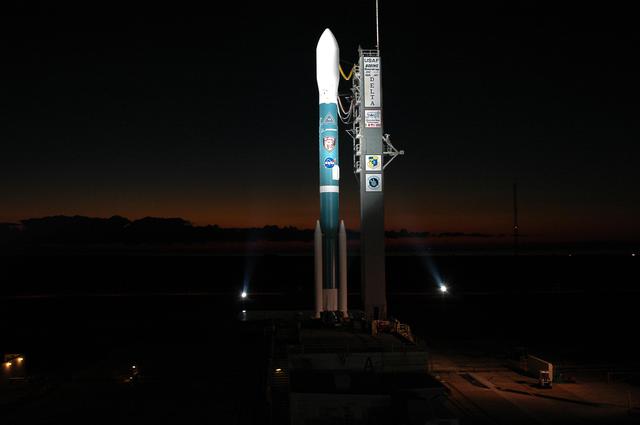
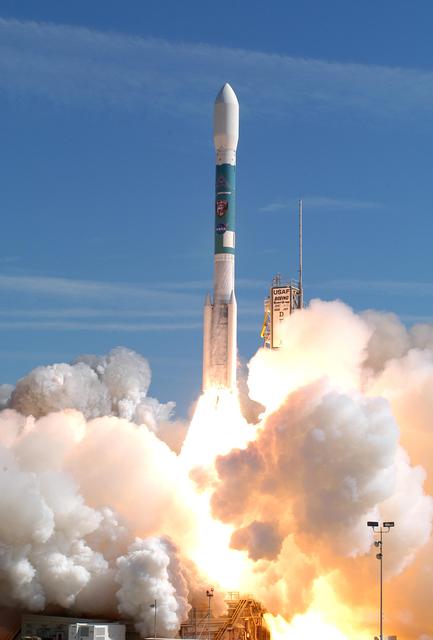
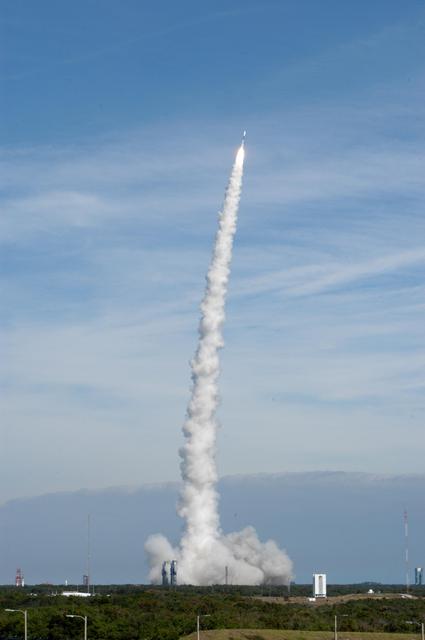
NASA's gamma-ray-burst hunter reaches orbit.
- 2008A burst seen with the naked eyeMilestone
Catches GRB 080319B, briefly visible without a telescope from 7.5 billion light-years away.
- 2017Neutron-star merger afterglowMilestone
Helps pinpoint GW170817, the first joint gamma-ray and gravitational-wave event.
Images



Images from open archives · credit shown per image